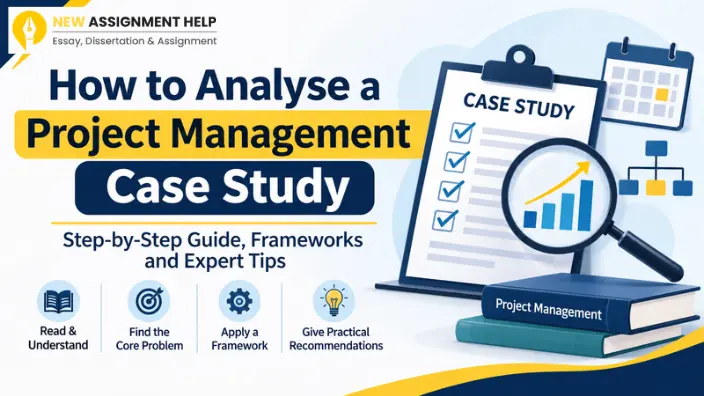
Project management case studies come with a lot of paper. Budgets, meeting notes, email chains and revised schedules all compete for your attention. Your tutor still expects a sharp answer on what went wrong and why. This often challenges Australian students at all semester levels. But a clear routine can make a genuine difference here. Once you know how to analyse a project management case study, the task becomes much easier. This post covers how to read the case, spot the core problem, apply theory and write recommendations that earn marks. So, let’s see how experts do it.
Re-read the Case to Understand Better
Start with a quick skim. Read the opening, the closing and any headings. In ten minutes, you should know the project’s goal, the key players and the final result. Then do it again with a pen this time. Mark every date, cost figure and major decision. Circle each moment where the plan changed because a scope that changes in month three says more than a page of company history.
Build a short timeline in the margin as you read to have a brief overview of how events connect. It also exposes causes that were hidden early in the case. With that timeline in hand, the main problem usually starts to stand out and our next step is to point it out.
Find the Core Problem
The most common issue seen during a project management analysis is the habit of students listing every issue they spot. That makes the report messy. A better way to deal with this is to pick the one or two problems that caused the most damage. Here, you can try asking three simple questions:
- What did the project plan to do?
- What actually happened?
- Where did the two paths split?
That split is usually your core problem. A late supplier is a symptom and poor risk planning might be the cause. Keep digging until you reach the root. With the problem clear, you now need a lens to examine it.
Match the Case to a Framework
Identifying the case problem is just the beginning because your tutor wants more than your opinion. They look for the theory that defines and analyses the issue. Frameworks give your analysis a clear structure. The table below shows common options and where they fit best.
| Framework | Best used for |
|---|---|
| Triple constraint (scope, time, cost) | Projects that ran over budget or late |
| PMBOK knowledge areas | Spotting gaps in planning and control |
| PRINCE2 principles | Governance and business case issues |
| Stakeholder matrix | Communication and conflict problems |
| Risk register review | Surprises that were never planned for |
Choose only one or two frameworks from above that suit your case because using all five may make your report shallow. Know that some Australian lecturers expect a specific method, such as PMBOK or AIPM standards. Therefore, checking your unit outline before finalising the framework on your own is a smart idea. The tricky part is that a framework only works if you apply it to the facts. Stakeholders are often where those facts get interesting.
Look at the People and Their Standing
Projects fail because of people as often as plans. Check who held power in the case along with who was ignored and who pushed for changes. Knowing these will give you a deeper knowledge of the case. To get the right answer, ask yourself the following things:
- Did the sponsor stay involved?
- Did the team know their roles?
- Were bad news and delays shared early?
Draw a quick map of the key stakeholders and mark their influence and interest. This often shows why a decision went wrong. It also gives you strong evidence for your discussion section. Now is the time to turn your findings into final advice.
Build Practical Recommendations
Recommendations are where many project management students lose marks. Vague advice like “improve communication” says very little; therefore, being specific here is often advised. Link each recommendation to a problem you found. Say what should change, who should do it, and when.For more guidance on structuring your work, explore our guide on how to write a project management assignment and learn how to present your ideas effectively.Then back it up with a source, such as a PMI paper or a textbook. Also, think about cost and risk. A fix that doubles the budget is unrealistic, and you must be aware of it. Show your tutor that you understand trade-offs and are not randomly making guesses. Lastly, before you submit, check for the common slip-ups.
Mistakes to Avoid While Analysing a Project Management Case Study
A few mistakes are often seen in most students’ papers that eat up their easy marks. The list here covers the ones tutors flag most often and are often avoidable if you pay a little attention.
- Retelling the story instead of analysing it
- Using theory with no link to case facts
- Ignoring the project’s final outcome
- Giving recommendations with no evidence
- Skipping the referencing style your university requires
Each of these is easy to fix once you spot it. The easiest way is to read your draft once with only this list in mind and you’ll be able to avoid most of it.
Final Thoughts
Analysing a project management case study gets easier with a repeatable routine. Read twice, find the root problem, choose a framework, study the people and write clear recommendations. Each step builds on the last. Practise on one short case before your assignment is due. If you want a second pair of eyes on structure or referencing, project management writing support can keep you on track. Start early, stay organised and trust your method and you’ll be able to score what you always dream of.

 8 Years | MBA (Marketing & HR)
.webp)
.webp)