Human resource management looks simple until you have to choose the right theory, include real examples and present it all in a clear argument. Many Australian students feel stuck at this point, as it often looks like too much to handle. However, the good news is that most HRM assignments follow a steady pattern and once you know it, each task feels lighter. In this guide today you’ll learn exactly how to write an HRM assignment using 6 simple steps. So, let’s walk through the process from the first read to the final proofread without wasting any time.
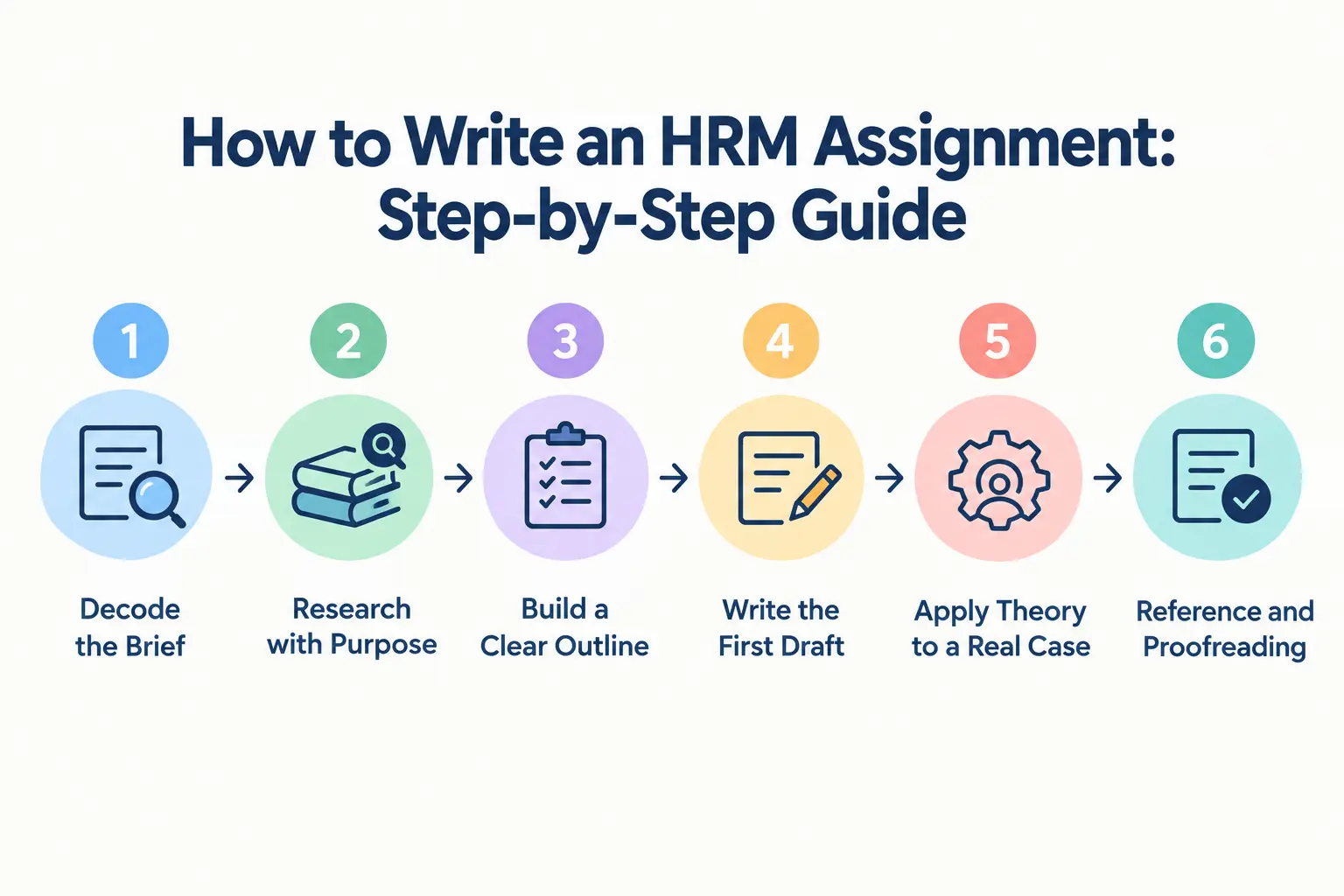
Step 1: Decode the Brief
Going through the brief once is just reading. If you wish to understand what it asks of you, read the question twice. Underline the task words, such as analyse, evaluate, compare or recommend because each one asks for a different skill. "Describe" needs facts. "Evaluate" needs a judgement backed by evidence.
Next, check the word count, referencing style and marking rubric. The rubric shows where the marks sit. If critical analysis carries 40 per cent, spend your time there. Once you know what the marker wants, the next logical step is to start gathering material.
Step 2: Research with Purpose
Finding the right sources can be difficult for most Australian HRM students. The best way is to begin with your unit material readings. Then move to journal articles through your library database. Search terms like "employee engagement" or "talent retention" as these often return strong papers.
Good HRM work also uses local sources. The Fair Work Ombudsman, the Australian HR Institute (AHRI) and the Workplace Gender Equality Agency all publish current data. Aim for sources from the last five to seven years. Keep a simple note for each source. Write the author, the year and one key point. This saves time when you reference it later. Now that your notes are ready, it is time to shape them into a plan.
Step 3: Build a Clear Outline
An outline keeps your ideas in order. It also stops you from wandering off topic. The layout below suits most HRM tasks, so adjust it to match your rubric. Think of each part as a small job with its own goal.
- Introduction: Set the scene in two or three sentences. Name the organisation or issue, state your purpose and share your main argument. Keep it short, since the marker wants to reach your analysis quickly.
- Theory: Pick one or two models that fit the question. Ulrich's HR roles, the Harvard framework and Herzberg's two-factor theory are common choices. Explain each in a few lines, then move on. This section only needs enough detail to support your analysis.
- Analysis: This is where most marks sit. Link the theory to your case or organisation. Ask what the model predicts, then compare it with what really happens. Provide support for each recommendation using the information collected during your research.
- Recommendations: Make practical suggestions that the organisation could implement. Consider issues of cost and time involved, as well as the effect on the employees. Relate each suggestion to the analysis that you conducted.
- Conclusion: Summarise your major points in one paragraph. Restate your argument and show what you found. Avoid adding new ideas here.
Each part has one job. If a paragraph does not serve that job, cut it or move it. With the plan set, drafting gets much easier in the next step.
Step 4: Write the First Draft
When you’re at this step, begin with the body first and write the introduction last. Because this way, you’ll know exactly what you are introducing.
Try the PEEL pattern for each paragraph. Start with a point, add evidence, explain it, then link back to the question. Keep one idea per paragraph in short sentences to keep the marker reading. Avoid long theory dumps.
Step 5: Apply Theory to a Real Case
Most HRM tasks reward application. Say your case is a retail chain like Woolworths. Ask what the theory predicts. Then check what the company actually does.
For instance, it would be useful to conduct an experiment that tests how effective flexible rosters may influence employee retention. It will be necessary to consider the legal aspects of Australia, including the Fair Work Act 2009 and the National Employment Standards, as they provide a certain degree of relevance to the analysis.
Step 6: Reference and Proofreading
After completing the draft of the assignment, it will be time to polish and reference the work. Here, always make sure to follow your university's preferred style, which is usually APA 7th or Harvard. Check that every in-text citation appears in your reference list, and the other way around.
Read your work aloud. Your ear catches clunky lines that your eyes skip. Set your spell check to Australian English, so "organisation" and "analyse" pass cleanly. Finally, review the rubric and word count one more time. If you can, take a short break before proofreading. Fresh eyes spot more errors.
Final Thoughts
An HRM assignment is a skill you build one step at a time. Read the brief, research with focus, outline, draft, apply the theory and proofread. Follow this exact order and your assignment task will start feeling far more manageable. Some topics will still feel tricky, and that is normal. Your tutor, your uni learning centre and HRM writing support can all add useful perspective. Use this guide as a checklist for your next task, and you will know exactly where to start.