NURSING ASSESSMENT AND MANAGEMENT OF AN EMBOLIC STROKE: A CASE STUDY OF MRS TERESITA MANALO
Introduction
This paper involves a critical analysis of nursing assessment and judgment about a patient, Mrs. Teresita Manalo, who was found to have an embolic stroke. The introduction satisfies the diagnostic paradigm that is actively working in the ISBAR communication model to improve positive patient outcomes by taking into account the medical determinants, values nurse intervention, and adhering to the diagnostic paradigm.
Students studying complex healthcare conditions can explore additional academic resources through our best assignment help Australia services.
Case Summary and ISBAR Analysis
Identify: Mrs. Teresita Manalo is a 65-year-old patient who is known to have had an embolic stroke. She was found to have weak and speech that was slurred, weakness on the left hemisphere, and that her level of consciousness was lowered during the night shift round during the ward round. FTA fibrillation state could not be left behind; that is why her clinical state should be offered with a timely and structured assessment and diagnosed with an embolic stroke.
Situation: Evaluation was done and the patient, Mrs. Manalo, has a Glasgow Coma Scale (GCS) score a 12/15, indicating a moderate level of consciousness impairment. Her physical condition did not augur well as her heartbeats are 132bpm and blood pressure 170/95mmHg, was more likely to be a cardiovascular instability.
Background: The reason she was confined to the hospital two days ago was due to the symptoms of feeling dizzy, palpitations, and experiencing malaise, in general. They discovered that an ECG evaluation had revealed that her heartbeat was atrial fibrillation (AF), and thus she was admitted to the Coronary Care Unit to be under the cardiologists. She had been having an embolic stroke, but had been set to go free.
Assessment:
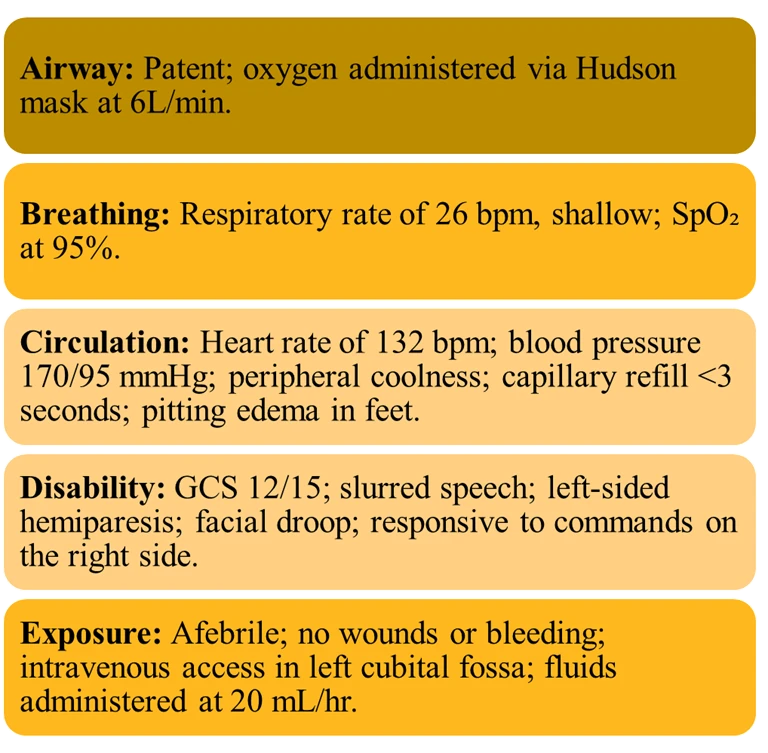
(Source: Self-Developed)
Recommendation: Semi to high urgency due to lack of consciousness; lie on the patient’s back semi to high Fowler, airway watch, oxygen saturation, initiates baseline laboratory investigations like coagulation screen; watch alertness group; maintain SpO of 95 or higher.
Q1: A to E Assessment Approach
A – Airway
- Assessment: Airway, 6L/min, oxygen on Hudson mask; she has a chance of obstruction.
- Clinical Significance: Ease of breathing is the key for stroke patients to prevent the development of hypoxia and further downward overload of the nervous system. Due to the constant observation, the possibility of intervening in time in case of airway compromise is possible (Tadi, 2023).
B – Breathing
- Assessment: Respiratory rate (RR) 26 shallow breaths per minute on the diaphragm. SpO₂, or oxygen saturation, is 95%. Bilateral air entrance is equal and less noises are produced when each base of the lungs.
- Clinical Significance: Hydraulic Significance High RR, Low SpO 2: May be an indication of respiratory distress or when the ventilation is poor. The combination of respiratory damage or aspiration risk can be tracked down with the help of observation of such parameters. (Ibrahim, 2022).
C – Circulation
- Assessment: HR 132 bpm; BP 170/95mmHg. pitting oedema on her feet, the edges are cool. The maximum time it takes is three seconds or less, which is the pillar refill time.
- Clinical Significance: Falling cerebral perfusion may be reversed by tachycardia and high blood pressure. The pitting oedema can indicate disequilibrium of the fluids or the insufficiency of venous circulation. Close monitoring should regulate these problems that affect the circulatory (Green, et al., 2021).
D – Disability
- Assessment: Diagnostics Glasgow Coma Scale 12/15 (Eye: 4, Verbal: 3, Motor: 5). Patient presents with a slurred speech and left-sided hemiparesis, having a facial droop. Sight-maids are spheric, equal and responsive.
- Clinical Significance: The GCS is 12, which is an indication that there is a moderate deficiency of consciousness. These aimed neurological alterations such as aphasia and hemiparesis, are the indications of the extent and site of the stroke that occurred. Review at a regular basis of every three days to identify neurological change is important as well (StrokeBestPractices.ca, 2022).
E – Exposure
- Assessment: Denies any bleeding or bruises, patient is afebrile. Blood glucose is 5.5mmol/L The Compound Sodium Lactate (Hartmann's) is 20 mL/hr in an intravenous cannula (IVC) on the left cubital fossa.
- Clinical Significance: Normothermia must be observed to prevent the upregulation of the metabolic requirements. IVC site should also be inspected regarding infections and infiltration. The blood sugar is to be measured frequently due to the possible influence on the provision of neurological recovery (Hill, et al., 2022).
Q2: High-Priority Nursing Interventions
1. Administer Intravenous Thrombolytic Therapy (Alteplase)
- Rationale: Prescription of alteplase when it is due after qualifying individuals does not consider the final prescription since it takes more than 4.5 hours after the onset of creation of the stroke, the guidelines of which are based on both the Australian Stroke Foundation and the MIMS Australia guidelines. This eases neuro-acceptance through the dissemination of the clot that is used to restore and block the brain circulation and infarction (Tadi, et al., 2023; NPS.ORG.AU, n.d.).
2. Monitor Neurological Status Using the Glasgow Coma Scale (GCS)
- Rationale: As the measurement of the change in the degree of consciousness, regular re-checking GCS techniques is applied to give the right response in a short period. The increased development of GCS that exceeds the level by two or more points than before reflects the seriousness of clinical examination and potential escalation of treatment (Tadi, 2023).
3. Maintain Oxygen Saturation Above 95%
- Rationale: Oxygen vitality is critical in the prevention of hypoxia since this factor would worsen the injuries of neurons in the event of oxygen deficiency. A sufficient supply of oxygen reaching 6L/min using a Hudson mask suffices to supply an adequate amount of oxygen to the brain tissue, and therefore keeps the tissue viable (Jupalli, & Iqbal, 2023).
4. Initiate Antiplatelet Therapy Post-Thrombolysis
- Rationale: The next thing to do after intravenous thrombolysis is to initiate the antiplatelet regimen, mostly aspirin, between 24-48 hours to prevent the recurring thromboembolic episode. This is the usual phenomenon that occurs to the treatment of acute ischemic stroke (StrokeBestPractices.ca, 2022).
Q3: Nursing Considerations for Medications
1. IV Alteplase
Pay the qualification within 3-4.5 hours since the emergence of the symptoms. Note any incidences of intracranial hemorrhage, including acute worsening of the state of consciousness. 0.9 mg/kg IV bolus, 10% being distributed over 1 minute, and the rest over the remainder of 60 minutes. Ensure that before taking that body pressure is normal and does not exceed normal (Hill, et al., 2022). Symptomatic intracranial hemorrhage (6%), major systemic hemorrhage (2rose angioedema (5-6).

2. Heparin IV Infusion
Surveillance of therapeutic monitor-activated partial thromboplastin time (aPTT). To quantify bleeding due to thrombophilia, heparin. IV, i.e. wisely depending on body mass index and aPTT. To comply with a therapeutic aPTT, regulate the infusion rate based on the needs. Bleeding, heparin-induced thrombocytopenia, and reactions of the injection sites are the common side effects (Tadi, et al., 2023).
3. Metoprolol 50 mg BD
Periodically monitor your pulse and blood pressure. Do tests of hypotension and bradycardia. Take it orally every day. None occurs, which is an acute decompensated heart failure. The possible side effects include bradycardia, hypotension, fatigue, and lightheadedness (Jupalli & Iqbal, 2023).
Understanding emergency interventions, patient monitoring and clinical decision-making is an important part of Medical Assignment Help.
Conclusion and Recommendations
Conclusion: In the management of embolic stroke, A to E examination and responsive nursing of stroke is inevitable. The treatment enhances better patient results and contributes to a reduction in the risk of complications since patient treatment is early, monitoring vital signs, and prescriptions are the most practical ways to administer vitals and drugs.
Recommendations
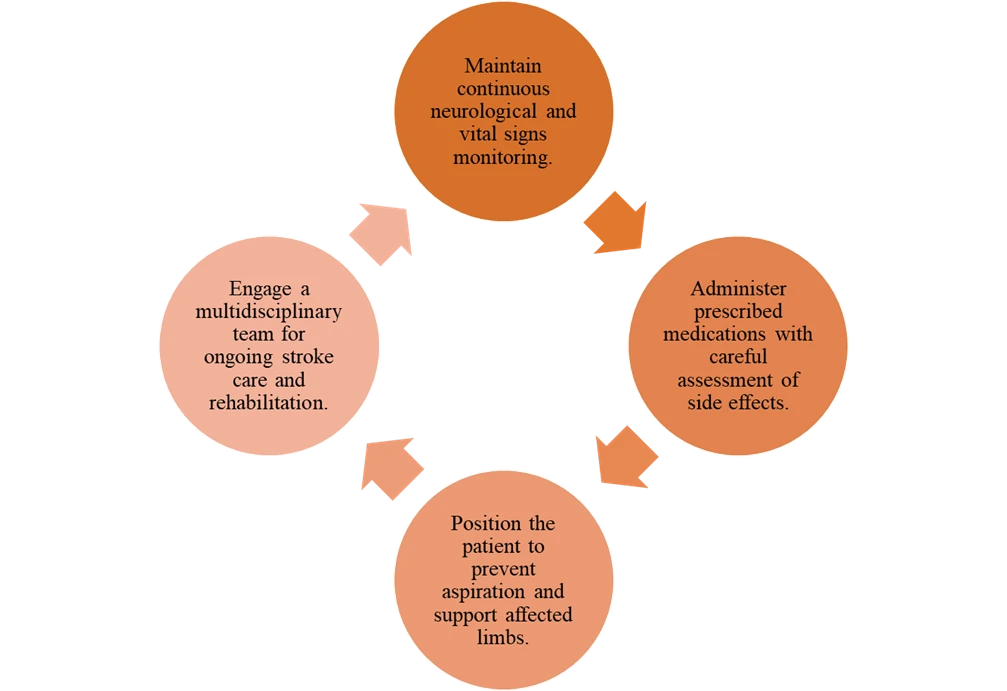
(Source: Self-Developed)
References
- Aamani Jupalli, & Arshad Muhammad Iqbal, (2023). Enoxaparin. Retrieved on: September 15th, 2025, from: https://www.ncbi.nlm.nih.gov/books/NBK539865/
- Green, T. L., et al., (2021). Care of the Patient With Acute Ischemic Stroke. Stroke. Retrieved on: September 15th, 2025, from: https://www.ahajournals.org/doi/10.1161/STR.0000000000000357
- Hill, M., et al., (2022). Nursing Care of the Acute Ischemic Stroke Endovascular Intensive Care Unit/Postinterventional Care. Stroke. Retrieved on: September 15th, 2025, from:
- Ibrahim, F., (2022). Embolic Stroke. StatPearls. Retrieved on: September 15th, 2025, from: https://www.ncbi.nlm.nih.gov/books/NBK564351/
- NPS.ORG.AU, (n.d.). Actilyse® alteplase Consumer Medicine Information. Retrieved on: September 16th, 2025, from: https://www.nps.org.au/assets/medicines/cb9e28b4-93db-4baf-89e2-a53300ff03ec-reduced.pdf
- Prasanna Tadi; Forshing Lui; Lori A. & Budd., (2023). Acute Stroke (Nursing). Retrieved on: September 15th, 2025, from: https://www.ncbi.nlm.nih.gov/books/NBK568693/
- StrokeBestPractices.ca.m (2022). Emergency Department Evaluation and Management of Acute Stroke. Retrieved on: September 15th, 2025, from: https://www.strokebestpractices.ca/recommendations/acute-stroke-management/emergency-department-evaluation-and-management
- Tadi, P., (2023). Acute Stroke (Nursing). StatPearls. Retrieved on: September 15th, 2025, from: https://www.ncbi.nlm.nih.gov/books/NBK568693/

 7 Years | PhD