Introduction
Eco-efficiency tools are commonly used in improvising both environmental and economic performance. It is a management approach that focuses on designing products and services by using limited resources and creating less waste. This literature review report is going to cover different aspect of eco-efficiency tool in a thematic manner.
Students exploring sustainability and industrial environmental practices can refer to Best Assignment Help Australia for academic guidance on understanding complex concepts, structuring reports and developing critical analysis.
1. Sort of eco-efficiency tools used to overcome environmental impacts cost effectively
According to the viewpoint of Saling (2024), BASF eco-efficient strategic tool has been utilised by businesses to quantify the sustainability of their product and business operations. BASF chemist organisation has introduced analysis lifecycle tool which is based on ISO 14040 standard. This eco-efficiency analysis has been validated by NSF international where this tool can be applied to support consumer’s sustainable development along with the potential value chain by minimising energy and resource intake.
This tool acts by analysing the environmental impact of the products starting from material sourcing and manufacturing. Further, analysis also undertakes consumption behaviour of customers and provides them recycling and disposing options. On contrary note Almeida et al, (2025) entailed that this life cycle assessment somehow lacks in providing fully decision support in finding the most appropriate environmentally sustainable management way.
Liu et al, (2025) depicted that life cycle assessment (LCA) and material flow cost accounting (MFCA) are identified as the most applicable in ensuring better environmental and economic performance. This tool is concerned with quantifying materials, economic and environmental losses and suggests better mitigation strategies through pareto analysis. MFCA also helps in analysing the total cost of the materials used in the production and measures total waste produced within the production. This information helps businesses to control their resource intake and minimise waste to improvise the sustainable business performance.
Conversely, Sithole et al, (2025) said that implementing MFCA can be expensive for the small and medium size business, while initial training for staff for its application may contribute to the overhead cost burden. Liu et al, (2025) analysed that green technological tool is also found efficient in ensuring eco-efficiency where digital integration serves both economy and environmental governance. This tool helps in minimising transaction costs and promotes organisational resource strategies. Thus, contributing towards rapid increase of contemporary work-pattern like virtual meeting, platform sharing which have been reducing energy and resources intake used in the employee commuting.
2. Using the facts and figures, analysing the way these tools have been useful in assisting with the industry's decision-making strategies
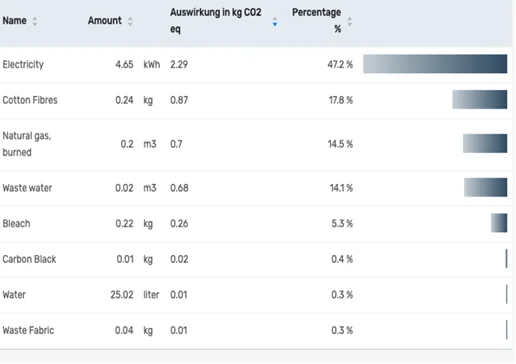
Zhang et al, (2025) elucidated that life cycle environmental tool is found to be effective in guiding critical decision making for the businesses. This systematic approach contributes in analysing environmental impact of product & services and thereby helps management to make decision and utilise resources that creates less waste as well as have less impact on environment. For example: Eco-chain Mobius has measured footprint of T-shirt product where LCA has helped in resulting that 50% of carbon footprint of T-shirt generally comes from electricity while 18% comes from cotton fibres (Ecochain, 2025).
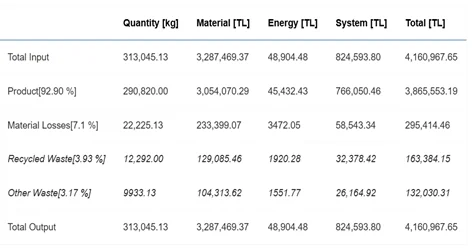
Conversely Luc Subal et al, (2024) explained that LCA is not only factor that contribute towards decision making, costs and environmental are other two factors that plays a role in making business decision. Additionally, Usul and Olgun (2025) said that use of MCFA is crucial in industries to measure monetary and quantitative rating of waste produced in the manufacturing process. This detail helps businesses in making decision to use more optimum solution that minimises waste and lead to financial benefit. Below table shows the calculation made by MFCA tool where output is categorised either in product or waste. Therefore, through this, businesses can enhance their resource utilisation and minimise waste. However, Failure in the use of MFCA tool can lead to false output affecting decision making.
In the perspective of Aragani and Thirunagalingam, (2025), green technological tool for environmental efficiency has been growing due to its cost effectiveness. For instance: Use of AI and predictive tool helps in promoting industry’s environmental stewardship while data gathered through these tools help in making the best informed decisions. Many businesses have reported that use of AI has strengthened their sustainability related decision about 70%. Moreover, accuracy in data helps in making the best strategic decision for business. Additionally, digital tools integration also helps in streamlining the manufacturing process, logistics and energy consumption thus minimising waste and operational costs.

Conversely, Malatji and Tolah, (2025) said that these tools are prone to cyber security concern that compromises sensitive organisational information. Further, biases in AI integration also affect decision making process of the industry. For instance: Employee who does not value sustainability is more likely to avoid the integration of sustainable policy with AI. Therefore, it can result into poor result for the business affecting their critical decision making. Overall, it is crucial to utilise proper cyber security governance when using AI and other green digital tools for business, awareness in it can help in taking informative business decisions.
3. Critically conduct a comprehensive analysis of these tools
Dekamin et al, (2024) assessed that LCA tool is complex to operate with since it is time consuming and require specialised person to carry out this job. Similarly, MFCA is complex, where staff may feel difficulty in accessing the information. While, predictive analytics green tool helps in quantifying statistical models to predict the future results and enable businesses to make robust decisions which minimises waste and reduces adverse environmental impact. Likewise, MFCA provides data that helps businesses to enhance their operational efficiency by recognising total cost linked with ineffective resource, leading to cost saving decisions and minimise waste. On the other hand Amicarelli et al, (2022) entailed about disadvantages and weaknesses of these tools. In the case of LCA tool variability in its approach leads to confusing result while, it also needed the large amount of information that result in maximum resource consumption. Further, it creates complexity for the decision maker to choose between products. Whereas, in case of MFCA tool the disadvantage and weakness identified in terms of its application in difficult production process where it overlook other factors like measuring supply chains.
MFCA is also time consuming where finding suitable data takes much time leading to the increased cost burden on business. While, green tools also have disadvantage and weakness in terms of knowledge gap among staff, high cost of equipment and cyber-attack concern. In addition to this, regular updates in green technology have been creating challenge for the businesses to remain update with it and change their infrastructure every-time when new update is found.
Lee et al, (2021) defined that there are some strength and applicability as well which make these tool effective in managing the environmental health. For instance: LCA have strength in terms of providing evidence based data that leads to the informed decision, its holistic approach in understanding product’s environmental performance helps businesses to keep it if appropriate and discard it if inappropriate. LCA is applicable to product designing to its manufacturing, also assists policy makers to understand consequences of different environmental policies. LCA is popular for its use in policy making where it helps staffs to adhere with the environmental policies. Whereas, MFCA also have strength in terms of its integration with PDCA (plan-do-check-act) where it increases the operational efficiency by minimising resource waste or loss.
MFCA can be applied to resource management and supply chain area where it helps in tracking the resource utilisation. Likewise, it’s ISO 14051 version is making it more popular and credible. Green tools also have strength in terms of optimising business functions as it assists in sustainable procurement leading to sustainable development of products leading to enhanced efficiency. They are applicable to resource management area, sustainable production and waste management. Green tools are popular due to its increasing demand and financial applicability in managing resources in a way that reduces waste.
4. Sector that could be benefit from use of eco-efficiency tools
It has been said by Guo, (2025) LCA and MFCA tools are effective in manufacturing industries, where life cycle assessment of manufacturing process and quantifiable analysis of waste and production process helps businesses in making decision. For instance: use of LCA helps sector to analyse initial stage of sourcing raw materials to end of life disposal leading to minimising resource overutilization.
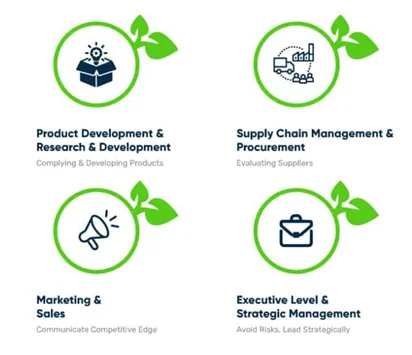
The above image has been showing how manufacturing sector can be benefited by using LCA as it helps in sustainable product designing to its sustainable marketing and sales. Further, use of green technology supports transportation, manufacturing, IT and energy sector to address global environmental challenges. For instance: In IT sector. green tools helps in designing, producing IT products within environmental friendly setting, thus minimises the level of energy consumption.
On the critical note, Juráček et al, (2025) said that high upfront cost and continuous maintenance of LCA, MFCA and green technology affects all the small size industry. Small manufacturing or IT businesses may avoid using it because of overhead cost associated with it. Likewise, large manufacturing, energy and transportation sector also avoids using these tools because of its complex structure which cause resistance among their staff for using it.
Literature Gap
Gap in literature identified in terms of few applicability of these tools in different business sector. For instance: MFCA and LCA are only being tested in textile and other product oriented sector, however there is no information about its applicability within healthcare sector. Likewise, there is no clarity in association of eco-efficiency tool in improvising environmental health.
For further academic guidance on environmental systems, resource efficiency and sustainable industrial practices, explore Environmental Engineering Assignment Help to understand key engineering concepts and their practical applications.
References
- Almeida, P. V., Deda, D., Gervásio, H., Gando-Ferreira, L. M., & Quina, M. J. (2025). Life cycle assessment and eco-efficiency of biorefineries and conventional management strategies for agro-industrial residues. Journal of Cleaner Production, 145895. <https://www.sciencedirect.com/science/article/pii/S0959652625012454>
- Amicarelli, V., Roe, B. E., & Bux, C. (2022). Measuring food loss and waste costs in the Italian potato chip industry using material flow cost accounting. Agriculture, 12(4), 523.< https://www.mdpi.com/2077-0472/12/4/523>
- Aragani, V. M., & Thirunagalingam, A. (2025). Leveraging advanced analytics for sustainable success: The green data revolution. In Driving Business Success Through Eco-Friendly Strategies (pp. 229-248). IGI Global Scientific Publishing. <https://www.igi-global.com/chapter/leveraging-advanced-analytics-for-sustainable-success/370051>
- Dekamin, M., Norooz-Valashedi, R., & Toranjian, A. (2024). Environmental, energy, and economic (3E) assessment of viticulture systems. Environmental Science and Pollution Research, 31(57), 65446-65463. < https://link.springer.com/article/10.1007/s11356-024-35575-x>
- Guo, K.W., (2025). Green Nanotechnology in Manufacturing Processes. In Green Nanotechnology Applications for Ecosystem Sustainability (pp. 89-129). Cham: Springer Nature Switzerland. < https://link.springer.com/chapter/10.1007/978-3-031-90766-1_4>
- Juráček, L., Jurík, L. & Makyšová, H., (2025). Institutional, Resource-Based, Stakeholder and Legitimacy Drivers of Green Manufacturing Adoption in Industrial Enterprises. Administrative Sciences, 15(8), p.311. < https://www.mdpi.com/2076-3387/15/8/311>
- Lee, J. K. Y., Gholami, H., Saman, M. Z. M., Ngadiman, N. H. A. B., Zakuan, N., Mahmood, S., & Omain, S. Z. (2021). Sustainability-oriented application of value stream mapping: a review and classification. IEEE Access, 9, 68414-68434.< https://ieeexplore.ieee.org/abstract/document/9422710>
- Liu, S., Xie, Y., Liang, W., Liu, T., & Luo, S. (2025). Study on Eco-Efficiency Optimization Based on LCA-MFCA Integration Method: A Case Study on the Cement Industry. The Journal of Environment & Development, 10704965251345509. <https://journals.sagepub.com/doi/full/10.1177/10704965251345509?casa_token=qqnvfT-rR7YAAAAA%3ABBbqvGwhN7uA6OHhVwCUsrah1zsNkeU3FuttT5EjYtoDgknP8WGQogrBk6i-DMpxRrFSIZ57F6S_NQ>
- Liu, S., Yang, W., Wen, H., & He, C. (2025). Impact of digital infrastructure on urban green eco-efficiency: an empirical analysis in China. International Journal of Climate Change Strategies and Management.<https://www.emerald.com/ijccsm/article/doi/10.1108/IJCCSM-11-2024-0197/1267766/Impact-of-digital-infrastructure-on-urban-green>
- Luc Subal, Arthur Braunschweig & Stefanie Hellweg, (2024). The relevance of life cycle assessment to decision-making in companies and public authorities, Journal of Cleaner Production, Volume 435, 2024, 140520, ISSN 0959-6526, <https://doi.org/10.1016/j.jclepro.2023.140520.>
- Malatji, M., & Tolah, A. (2025). Artificial intelligence (AI) cybersecurity dimensions: a comprehensive framework for understanding adversarial and offensive AI. AI and Ethics, 5(2), 883-910. < https://link.springer.com/article/10.1007/s43681-024-00427-4>
- Saling, P. (2024). Sustainability assessments of chemical products. In Handbook on Life Cycle Sustainability Assessment (pp. 279-289). Edward Elgar Publishing. <https://www.elgaronline.com/edcollchap/book/9781800378650/book-part-9781800378650-31.xml>
- Sithole, H. D., Ambe, C. M., & Van Niekerk, M. (2025). A Systematic Review of Material Flow Cost Accounting. In International Conference of Accounting & Business (pp. 613-626). Springer, Cham. < https://link.springer.com/chapter/10.1007/978-3-031-84885-8_33>
- Usul, H. & Olgun, E.B., (2025). An analysis of material flow cost accounting in companies using different cost accounting systems. Heliyon, 11(4). <https://www.cell.com/heliyon/fulltext/S2405-8440(25)00935-1>
- Zhang, K., Mo, J., Liu, Z., Yin, W., Wu, F., & You, J. (2025). Life cycle environmental and economic impacts of various energy storage systems: eco-efficiency analysis and potential for sustainable deployments. Integrated Environmental Assessment and Management, vjaf035. <https://academic.oup.com/ieam/advance-article-abstract/doi/10.1093/inteam/vjaf035/8046021>
- Ecochain, 2025. Life cycle assessment of T-Shirt. [Online]. Available through < https://ecochain.com/blog/life-cycle-assessment-lca-guide/ >