ASSESSMENT TASK 3: CHEMISTRY PAMPHLET ON METHYL ANTHRANILATE
Introduction
Methyl anthranilate and will join the ranks of naturally occurring esters but on the other hand is also a synthetic ester. It is made naturally in grapes, oranges and other fruits, such that it contributes to their normal odor. It has additionally been prepared and used in several years in the food and perfume industries because of the sweet smell. It is used as an initiator of repelling birds in the farmland because many types of birds are scared away by the flavor and smell of it. The present report attempts to explain the basis chemistry of methyl anthranilate, structure formula, polarity and solubility of the substance. Report also addresses the procedure of the compound preparation, and provides a balanced equation of a reaction of the compound preparation. Finally, its application in other industries is outlined that proves the significance of this compound in the never-never world.
Students exploring chemical compounds and their properties can access additional academic learning resources through our best assignment help Australia.
Compound Identity & Basic Data
| Property | Value |
|---|---|
| IUPAC name | Methyl 2-aminobenzoate |
| Common name | Methyl anthranilate |
| Molecular formula | C₈H₉NO₂ |
| Molar mass | 151.16 g mol⁻¹ |
| Physical appearance | Colourless to pale yellow liquid |
| Odour | Strong grape-like smell |
| Boiling point | ~256 °C |
| Melting point | ~24 °C |
| Solubility in water | Slightly soluble |
| Solubility in ethanol | Soluble |
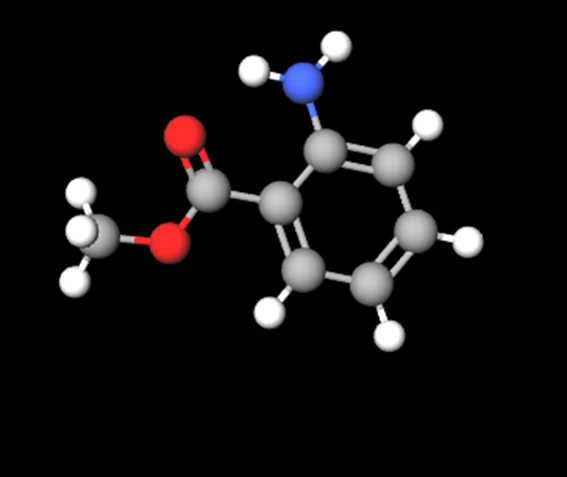
(Source: Self-made using Molview)
Fundamental Chemistry
Molecular Formula and Molar Mass
Methyl Anthranilate (C₈H₉NO₂)
| Element | Symbol | Number of Atoms | Atomic Mass (g/mol) | Total Mass (g/mol) |
|---|---|---|---|---|
| Carbon | C | 8 | 12.01 | 96.08 |
| Hydrogen | H | 9 | 1.01 | 9.09 |
| Nitrogen | N | 1 | 14.01 | 14.01 |
| Oxygen | O | 2 | 16.00 | 32.00 |
Summary
| Property | Value |
|---|---|
| Molecular Formula | C₈H₉NO₂ |
| Total Molar Mass | 151.18 g/mol |
Lewis Structure
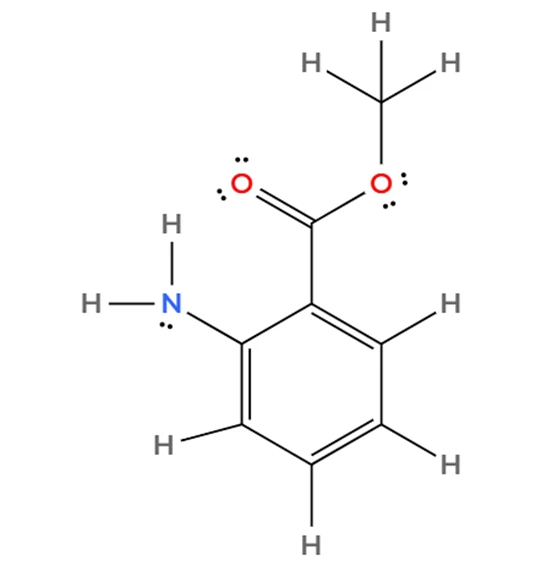
Lewis structure identifies the number of free electrons, bond structure and atom structure. The middle section of the molecule is composed by the benzene ring, and an amino group (-NH2) is covalently bonded to the second carbon atom in the ring, the second ester group (-COOCH3) is covalently bonded to the first carbon atom in the ring (Manna et al. 2024). The oxygen and nitrogen atom pairs have unbound pairs of electrons on them that are free.
(Source: Self-made using Molview)
Those electrons on the ring should be capable of donation by the amino group, but the oxidance of both the carbonyl oxide atom and the oxidance of the ester oxide atom themselves had 2 pairs of free electrons in common. This can affect the possibilities of the hydrogen bonding and its polarity.
3D Structure and Molecular Geometry
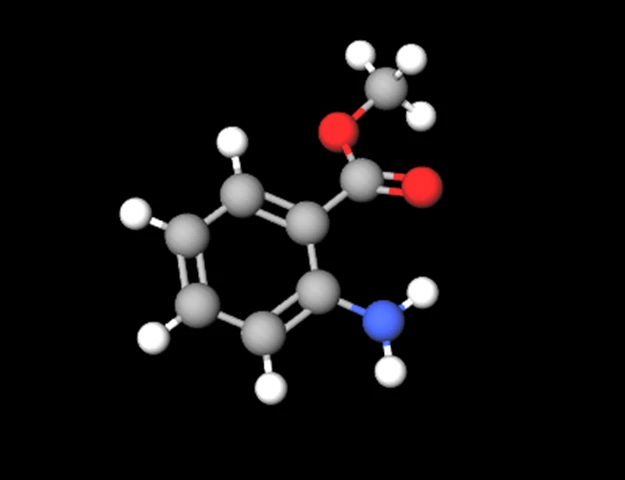
It may show the hypothesis because the three-dimensional structure indicates that the concerned aromatic ring is planar. The esp2 hybridised carbon atom of the ester group is trigonal and of plane geometry with angles that are almost equal, at 120 degress. The groups of electrons are not attached to another fissure and that is why, the carbonyl oxygen is situated on the same plane as the methoxy oxygen of the bond in the ester is turned. Its structure too is a threefold pyramid structure of the amino nitrogen; it is also, sp2 hybridised possessing a single pair of free electrons to the structure.
(Source: Self-made using Molview)
The substitution on the amino group and the appearance of the ester group may permit possible intra-molecular hydrogen bonding in which the N-H hydrogen might weakly show up to be bonded into the carbonyl oxygen.
Bond Polarity and Intermolecular Forces
The compound Methyl Anthranilate has polar and nonpolar groups. Carbon-carbon bond is what forms benzene ring. Electrons exchange in equal amounts in these bonds, thus, rendering them nonpolar (Selladurai & Karuthapandi, 2024). On the other hand, the carbonyl of the ester initial group has a carbon-oxygen twin bond. The polar force of this bond can be attributed to the large attraction on the electrons by oxygen.

The bond that exists between the atom of carbon and oxygen is methoxy or, put differently, part of an ester. Compared to the carbonyl bond, this bond is too polar. The amino group has two N-H bonds. These bonds are also polar of the fact that Nitrogen is more electronegative than hydrogen. Thanks to such groups, the molecule is composed of regions, which are predominantly polar.
When the molecule is dissolved, then the hydrogen bonds can just be made. The amino group can also supply hydrogen bonds to the adjacent molecules. The carbonyl oxygen atom might be employed as a hydrogen bond acceptor. These are severe and strongly noticeable in mixing of the molecule with the solvents (Ghazwani et al. 2023). Meanwhile the aromatic ring is not a polar molecule, and has weak interaction dispersion principles. The result is that there is the existence of the anti-polar and the polar regions of the molecule. This mixture of character is free to explain at least part of its behaviour.
Solubility
The solubility of methyl anthranilate is a soluble substance whose solubility is dependent on the specific solvent. The compound is not highly soluble in water. This would be attributable to the fact that the big benzene ring and ester group cannot react with the polar water molecules because they are nonpolar molecules. It is also limited by the solubility factor since it is only amino group and carbonyl one which can conjugate with water to form a hydrogen bond. This is not the case in the organic solvents as in ethanol. Ethanol has also an effective polar hydroxyl group along with nonpolar hydrocarbon group (Holland et al. 2025). This allows each of the two groups of the methyl anthranilate to react with ethanol. The particles of hydrogen bonds are established with the hydroxyl group of the ethanol, the polar amino group and the regular carbonyl group, the benzene ring and the ester group with the hydrocarbon portion. This enhances the dissolution capacity of the compound in ethanol and other similar solvents.
The solubility of this compound is also affected by acidic conditions. In case, the solution is acidic, the amino group is protonated and the compound becomes -NH3 +. Such a charged group dispertures with water and the water dissolution advances. This depicts how the chemical behaves on the physical behaviour of the chemical.
Resonance
The aromatic ring of methyl anthranilate is stabilised by the resonance. The two bonds that are between the atoms are not fixed in between the atoms of the benzene ring. Instead, the electrons are fielded all around the ring. It is what makes the ring delocalised.
The donations that are projected into the ring are via the amino group. This raises the concentration of the electrons at the ortho position and para position of the ring (Api et al. 2022). As such, these roles are receptive. The ester resonance is also in the carbonyl group. The carbon-oxygen two bond can transfer sugar electrons between the oxygen and carbon atoms. This effect can result in the bond to become that shorter and stronger than the commonly observed normal single bond but longer than the uncorrupted double bond.
A pair of these resonance effects contribute to the stability of methyl anthranilate and make certain parts of the molecule more reactive than others.
Understanding molecular structures, chemical bonding and reaction mechanisms is an important part of Chemistry Assignment Help.
Chemical Reaction and Preparation
Fischer Esterification Reaction
Methyl anthranilate may be synthesized by the combination of anthranilic acid with methanol through usage of acid. This reaction is known as Fischer esterification and is an equilibrium reaction (Wulan et al. 2021). The catalyst is added to the carboxyl group in order to make the oxygen more reactive and vulnerable to frequent attacks, using a strong acid like sulfuric acid or p-toluenesulfonic acid, which protonates the oxygen atom. The reaction is catalyzed by the heating up of the mixture and the extraction of water.
Balanced equation:
C₇H₇NO₂ + CH₃OH ⇌ C₈H₉NO₂ + H₂O
Anthranilic acid + methanol ⇌ methyl anthranilate + water
Hydrolysis
Hydrolysis can also take part in the reverse reaction with the ester. When subjected to acidic field, methyl anthranilate splits with water to yield anthranilic acid and methanol. The hydrocutation of the simple conditions gives rise to the anthranilate anion and methanol.
Applications and Significance
Food Industry
Methyl anthranilate is a flavouring agent that has long been used. It has a very strong grape like taste and is used as an ingredient in soft drinks, candies, and chewing gum. It happens also in grapes, strawberries and oranges. Due to its low toxicity levels in the food use levels, it is broadly accepted to use in food.
Fragrance Industry
Methyl anthranilate is used in perfumes and other personal care products so as to provide a sweet, fruity and floral effect. It finds a lot of applications in the formulation to add depth and naturally fruity notes. Its powerful scent causes it to be the favourite imitation grape perfume.
Agriculture and Bird Repellent
In farming, Methyl anthranilate may be used as a bird repellant. It is sprayed on grass, flora / homes so as to drive away birds who are feeding or nesting. Birds are very sensitive to the taste and smell of the compound and human beings find it to have a nice taste (Tokalı et al. 2023). This last permits its being an excellent and undisputed repulsive. It is also used in the air transport in an effort to reduce bird strike within the airports.
Other Uses
Methyl anthranilate has been also investigated as part of sunscreen as it absorbs UV sunrays. They also have touched on its use in the control of insects.
Safety and Toxicity
At concentrations potentially used as food flavouring, methyl anthranilate is safe. However, its crude form is very irritating to the skin and the eyes. Long term exposure may cause swellings of the bronchi, which are mild (Khan et al. 2022). It is biodegradable and it is considered to possess low environmental toxicity at excess levels it can cause effects on the aquatic systems.
Conclusion
Methyl anthranilate is a significant aromatic ester and it has varied applications. Its molecular formula is C₈H₉NO₂ and molar mass 151.16 g mol⁻¹. The structure of the compound consists of the structural component of an ester coupled with an amino component affixed on a benzene ring. It has an organic approach by resonance, polarity, and hydrogen bonding. It dissolves well in organic solvents although slightly in water. Anthranilic acid can be converted into it by the Fischer esterification reaction in the presence of methanol, and it can be hydrolyzed back to its mother acid.
The uses of methyl anthranilate are numerous, such as flavours in food and scentures in perfumes to safe, effective, bird repulses in farming. Its sweet scent and relative safety enable the compound to have its utilisation in our daily life.
References
- Api, A. M., Belsito, D., Botelho, D., Bruze, M., Burton Jr, G. A., Buschmann, J., ... & Tokura, Y. (2022). RIFM fragrance ingredient safety assessment, methyl N-methylanthranilate, CAS Registry Number 85-91-6. Food and Chemical Toxicology, 161, 112777. Retrieved From: https://fragrancematerialsafetyresource.elsevier.com/sites/default/files/85-91-6.pdf [Retrieved On: 11.09.2025]
- Ghazwani, M., Hani, U., Alqarni, M. H., & Alam, A. (2023). Development and characterization of methyl-anthranilate-loaded silver nanoparticles: A phytocosmetic sunscreen gel for UV protection. Pharmaceutics, 15(5), 1434. Retrieved From: https://www.mdpi.com/1999-4923/15/5/1434 [Retrieved On: 11.09.2025]
- Holland, C. K., Watson, A. P., & Chiang, E. (2025). Anthranilate at the interface of tryptophan and specialized metabolite biosynthesis. Frontiers in Plant Science, 16, 1625337. Retrieved From: https://www.frontiersin.org/journals/plant-science/articles/10.3389/fpls.2025.1625337/pdf [Retrieved On: 11.09.2025]
- Khan, B. S., Flores-Romero, V., LeBlanc, J., & Lavoie, G. G. (2022). Lactide Polymerization Using Zinc Dichloride Complexes Containing a Neutral Bidentate Ligand with a Diacylated Cyclic Guanidine. Organometallics, 41(19), 2668-2677. Retrieved From: https://pubs.acs.org/doi/abs/10.1021/acs.organomet.2c00254 [Retrieved On: 11.09.2025]
- Manna, S., Sahoo, S., & Rit, A. (2024). Synthesis of quinazolinone scaffolds via a zinc (ii)-stabilized amidyl radical-promoted deaminative approach. Chemical Communications, 60(55), 7097-7100. Retrieved From: https://pubs.rsc.org/en/content/articlehtml/2009/vv/d4cc01554a [Retrieved On: 11.09.2025]
- Selladurai, V., & Karuthapandi, S. (2024). Competing electrophilic substitution and oxidative polymerization of arylamines with selenium dioxide. Beilstein Journal of Organic Chemistry, 20(1), 1221-1235. Retrieved From: https://www.beilstein-journals.org/bjoc/content/pdf/1860-5397-20-105.pdf [Retrieved On: 11.09.2025]
- Tokalı, F. S., Taslimi, P., Sadeghian, N., Taskin‐Tok, T., & Gülçin, İ. (2023). Synthesis, characterization, bioactivity impacts of new anthranilic acid hydrazones containing aryl sulfonate moiety as fenamate isosteres. ChemistrySelect, 8(13), e202300241. Retrieved From: https://www.researchgate.net/profile/Feyzi-Tokali/publication/369749139_Synthesis_Characterization_Bioactivity_Impacts_of_New_Anthranilic_Acid_Hydrazones_Containing_Aryl_Sulfonate_Moiety_as_Fenamate_Isosteres/links/654b63d9b86a1d521bc644f7/Synthesis-Characterization-Bioactivity-Impacts-of-New-Anthranilic-Acid-Hydrazones-Containing-Aryl-Sulfonate-Moiety-as-Fenamate-Isosteres.pdf [Retrieved On: 11.09.2025]
- Wang, B., Diao, Y., Yuan, J., Zhang, F., Zhou, H., & Du, L. (2022). Optimization of Methyl Anthranilate Synthesis Process by Response Surface Methodology and Its Reaction Mechanism. Synthesis, 54(23), 5261-5272. Retrieved From: https://www.thieme-connect.com/products/ejournals/html/10.1055/s-0042-1751357 [Retrieved On: 11.09.2025]
- Wulan, F. F., Wahyuningsih, T. D., Jumina, J., & Kumar, N. (2021). Synthesis studies of n-acetyl glyoxylamide derivatives using unreactive amines. Key Engineering Materials, 884, 312-319. Retrieved From: https://www.scientific.net/KEM.884.312 [Retrieved On: 11.09.2025]