Access Free Samples Prepared by our Subject Matter Experts, known for offering the Best Online Assignment Help Services in Australia
Introduction
This report is about the design and making of digital logic circuits for a vending machine that passes out snacks. The machine has a total number of 8x8 grid layouts with two 3-bit inputs to select the snack location in the machine - the Left number L and Top number T. It vends successfully if L and T are valid snack locations and different types of numbers. The assignment has two parts - Part A implements the core vending logic with only AND, OR, NOT gates. Part B adds counters and shutdown circuitry that locks the machine if a set number N of errors occur. Overall the project applies concepts of combinational and sequential logic, encoders, decoders, flip flops and digital design using Logisim software to model the system. Meeting the specifications requires strategic circuit partitioning into modular subcircuits and templates.
Description
This report is all about the design and simulation of digital logic circuits in a vending machine that dispenses snacks. The key components include inputs to select a snack location, decoding circuitry, output indicators for successful vending, and additional logic to count errors and shutdown the machine(Shallom et al. 2021). This report focuses on implementing the core vending logic using only AND, OR, and NOT gates. Another part is the design by adding counter circuits to track successful and unsuccessful vending attempts, allowing the machine to lock itself after a set number of errors. The circuits are using Logisim software for this machine. Modular subcircuits and templates are used to create all the things of the machine while simplifying the total circuit. The project applies concepts of combinational and sequential logic, encoders, decoders, flip flops, and digital circuit design.
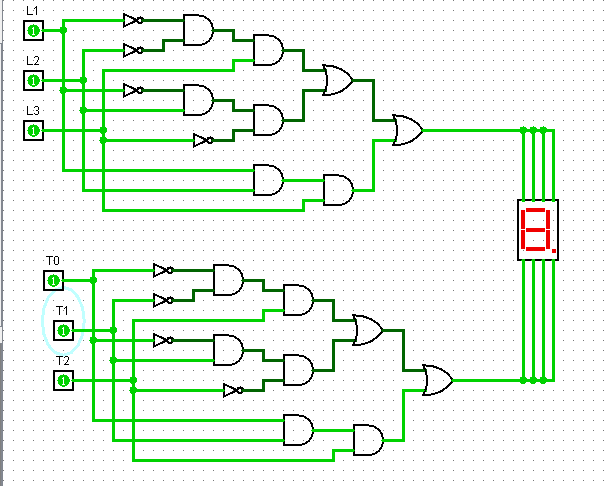
Figure 1: Model in Logisim
Part A
This part requires the core vending logic using only AND, OR, and NOT gates with up to 2 inputs each in the circuit. There are two 3-bit inputs - Left number L and Top number T - that are decoded to select the snack location to vend for the user when the user selects the items.
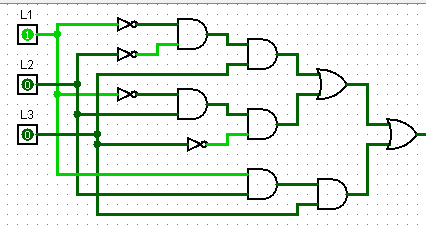
Figure 2: Input L in Logisim
The output pin labelled "Successful" lights up if L and T specify a valid location with snacks present in the machine , by checking that L and T are in the set {0, 1, 3, 6, 7} and L≠T. This logic selects if each selection meets the vending requirements of the machine. All other combinations of L and T values result in no vending in the machine(Öztekin, 2022). The circuits use decoders constructed from the permitted gates to evaluate the inputs and light the output when right vending conditions are met correctly. Overall, this part understood the key vending logic using basic Boolean operations in Logisim.
Part B
Part B will help to increase the design by adding a counter logic to track unsuccessful and successful vending attempts. It helps to implement an alert system to shutdown the vending if a set number N of errors occur, indicating people are selecting invalid locations. Additionally the circuitry increments the unsuccessful counter when vending conditions fail and increments the successful counter when vending completes(Nair, 2021). N is fixed at 5, while 7611 students set the N variably from 1-7. If unsuccessful attempts reach N, a “Vending shutdown” LED locks the circuit permanently.
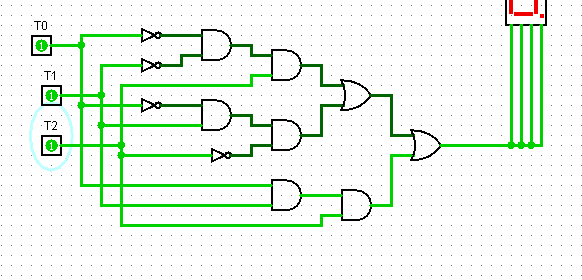
Figure 3: Input T in Logisim
For 7611, 2 successful vends reset both counters(La Imu et al. 2022). The new logic allows remote monitoring of usage errors. Students combine comparators, counters, flip flops and buttons with the Part A system, applying sequential logic concepts to create stateful shutdown behaviour.
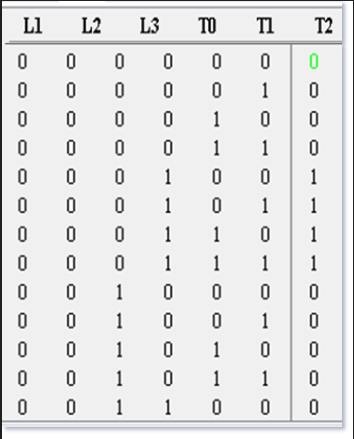
Figure 4: Truth table in Logisim
Conclusion
This project helped to encompass the complete design flow for modelling a snack vending machine through digital logic circuits and Logisim simulation. This will help to combine the assignment reinforced core concepts of combinational and sequential logic while allowing creative implementation. Splitting the system into modular decode and control blocks enabled organised design. Part A focused on the foundational vending logic using basic gate-level operations. Part B then expanded the system complexity, requiring stateful logic and shutdown behaviours. Incrementally developing the circuits in this manner promoted understanding. Additional challenges involved meeting constrained input, output and gate requirements. Creating a generalised decoder building blocks promoted reuse. Overall, the design, debugging and simulation process provided practical experience in applying digital logic principles to build a complex sequential system from the ground up. The vending machine example tied the logic functionality into a realistic context. With its breadth, the project served as an effective learning tool in this digital circuit course.
Reference List
Journal
Nair, D., 2021, June. Online laboratory course using low tech supplies to introduce digital logic
design concepts. In 2021 International e-Engineering Education Services Conference (e-
Engineering) (pp. 121-126). IEEE.
Öztekin, H., 2022. BiCAM-based automated scoring system for digital logic circuit
diagrams. Open Chemistry, 20(1), pp.1548-1556.
Shallom, D., Naiger, D., Weiss, S. and Tuller, T., 2021. Accelerating Whole-Cell Simulations of mRNA Translation Using Dedicated Hardware. ACS Synthetic Biology, 10(12), pp.3489-3506.
La Imu, A.M., Budi, A.S. and Ichsan, M.H.H., 2022. Implementasi CPU berbasis Simple-As-
Possible (SAP) pada FPGA Xilinx Spartan-3E. Jurnal Pengembangan Teknologi Informasi dan Ilmu Komputer, 6(5), pp.2402-2411.

 6 Years | Master of Teaching