1. Industry Challenges
1.1 Prompt
As an initial step in completing this assignment by exploring industry issues, I used the following AI prompt in the ChatGPT app to look into the issues that arise in the application of IT/IS solutions in the banking and medical industries. Specifically, I was attentive to the business processes of fraud detection and managing patient data since these are the activities depending heavily on the efficiency and availability of information systems.
Figure 1: Initial Prompt
1.2 AI Response
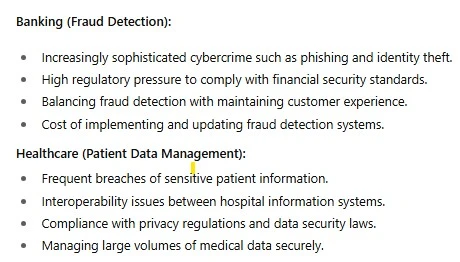
Figure 2: Response to Industry Challenges
1.3 Evaluation
The AI feedback was effective to identify high-level problems across banking and in healthcare. But yet it lacked plausible folks and interesting facts. Although the mentioned statements were consistent with the problems of the real world, most of these were excessively generalised (Shittu et al. 2024). This was a necessity to ensure it is checked against academic and industrial sources to make it accurate and reliable.
1.4 Modification and Final Result

Figure 3: Prompt Output
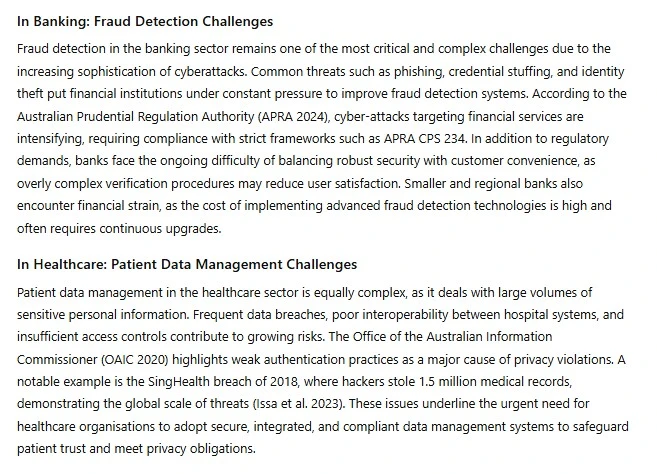
Figure 4: Prompt Final Result
1.5 Rationale for Modification
The response generated by the artificial intelligence indicated a productive beginning since the important problems in the banking and health care business were identified by it. However the information remained more generalised and not more scholarly and lacked sources and research documentation that could be ascertained and research work written in a formal way. Indicatively, the AI did not provide the regulatory frameworks, case studies, and examples of cybercrime in the country to validate the proposed theories even though it suggested examples of cybercrime in the banking sector and data breaches in healthcare. To counter this drawback, I employed the cross-checking characteristic against the information sources of high credibility levels (Australian Prudential Regulation Authority, 2024; Office of Australian Information Commissioner, 2020). In addition, I have also provided a case study of a real-life case of SingHealth breach written by Issa et al. (2023) because these issues universally apply.

2. IT/IS Solutions
2.1 Prompt
Figure 5: Initial Prompt
2.2 Response
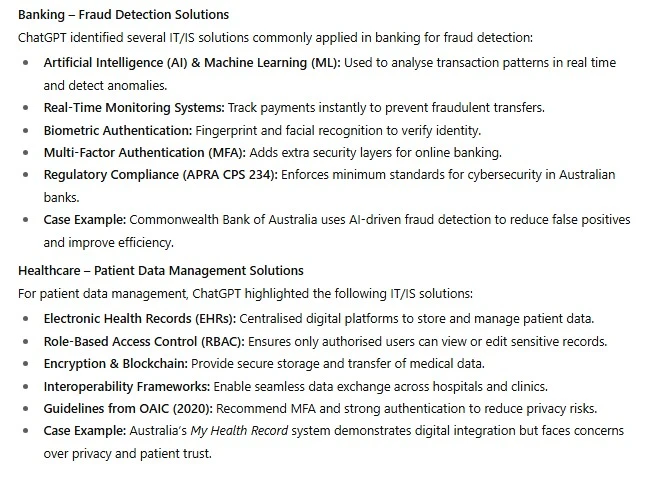
Figure 6: Response
2.3 Evaluation
The AI response has been a good overall generalisation of IT/IS solutions that can be used within the two industries with focus on the hi-techs that include AI, ML, and EHR systems. It was useful in realising specific tools such as role-based access control and real-time monitoring that are directly associated with the problems of the issues mentioned above (Chowdhury 2024). However, the allusions to technologies, who were generic and unverified in the scholarly circles were also present, e.g. blockchain in healthcare. Even though the cases with Commonwealth Bank and My Health Records were timely, they were to be supported by other trusted sources in the industry and the government.
2.4 Modification and Final Result

Figure 7: Prompt for IT/IS Solutions
Figure 7: Response
2.5 Rationale for Modification
The initial AI option was useful in identifying generic IT / IS solutions, but lacked specificity, authoritative resources and industry-centred information. As an indicator, despite the mention of the business term blockchain, the application of blockchain in the healthcare system could not be identified in its active form. To promote a better level of accuracy, I have tailored the prompt based on the Australian regulatory settings and practical case based examples (Wu et al. 2022). This has been improved to ensure that the right examples such as the APRA CPS 234 in the banking sector and My Health Records in the healthcare services were employed.
3. Benefits – Business Value
3.1 Prompt

Figure 8:Prompt to Identify Business Value
3.2
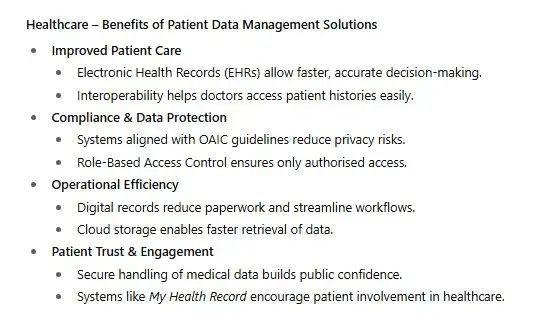
Figure 9: Response
3.3 Evaluation
AI provided its response, which consisted of an organised review of the benefits of the IT/IS in each domain. In computing the banking industry, it rightly focused on how AI and machine learning could make fraud detection more efficient and help with the APRA CPS 234 compliance. The credibility among customers also aligned with the actuality in that credible systems would enhance the degree of credibility among customers relying on the digital banking platform (Khiong 2022). The response also helped to select the EHRs role in the improved patient care and interoperability and the importance of having the principles of OAIC privacy applied in the healthcare case.
3.4 Modification and Final Result

Figure 10: Prompt
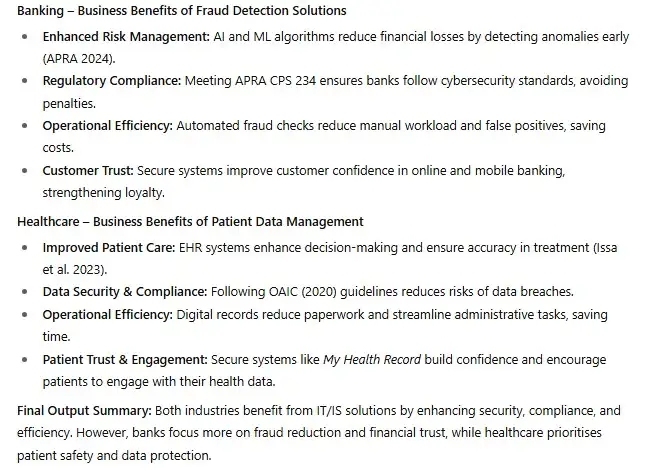
Figure 11: Response
3.5 Rationale for Modification
The AI answer has discussed useful benefits but that was too general and was not supported by plausible sources. I reduced it to include validated sources that were offered by APRA (2024), OAIC (2020), and Issa et al. (2023). This ensured accuracy, localisation and professional relevance in the sense that the final product was evidence-based and credible.
4. Legal (Security/Privacy) and Ethical/Social Concerns
4.1Prompt
Figure 12: Prompt
4.2 Response
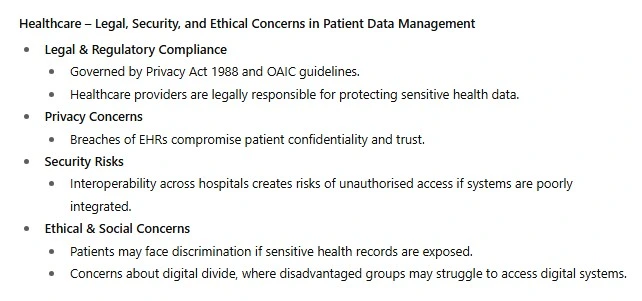
Figure 13:Response
4.3 Evaluation
The answer presented by AI was a justifiable set of legal, privacy, and ethical matters in the two areas. It would be convenient when mentioning such regulations as APRA CPS 234, the Privacy Act 1988. However, some of its entries were broad based and had to be affirmed using some legitimate materials in a bid to ensure scholarly correctness.
4.4 Modification and Final Result
Figure 14: Prompt
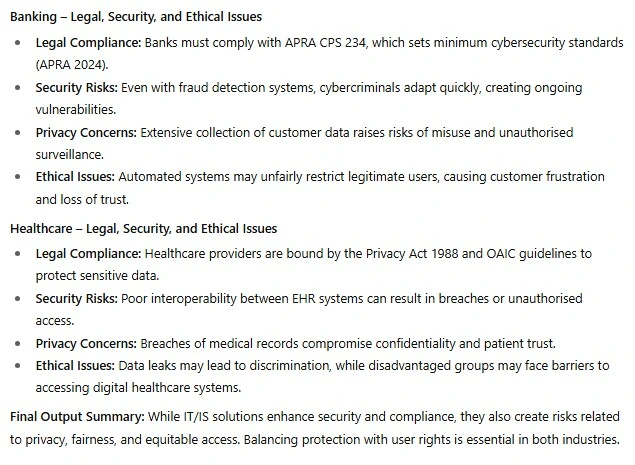
Figure 15:Prompt Response
4.5 Rationale for Modification
The initial AI response favoured urgent problems, but was excessively general and rested on objective sources of scepticism. To make the academic useful I used to narrow down the search by categorising it to professional regulation and case study in Australia (Srivastava et al. 2022). The evaluation of the APRA CPS 234 and the Privacy Act 1988 was the final result that presented a more balanced, evidence-based and assignment requirement-consistent form of it.
5. Reflection
Reflection 1
Using AI was practical in the framework of this assignment since it allowed an initial push to identify the most significant challenges, IT/IS solutions, and benefits in banking on one hand and healthcare on the other, one. The tool was easy to work with, and provided rich valuable information, however, I understood that on its own, the tool provides responses too vast and general without the help of the appropriate scholarly sources. I had an impact on my strategy because this worked as a reminder that AI should be approached with care because it cannot replace independent research or critical thinking.
Reflection 2
I would become more strategic with ChatGPT in the future; firstly, to generate ideas, refine prompts, and identify opportunities to enhance the work. However, I will not rely only on the chances but will constantly verify the statements with peer-reviewed articles and company reports. I also understand the importance of having conversations with lecturers and peers as the feedback is less robotic and easier to contextualise, comprehend and academic in a way AI cannot achieve everything. The lessons in a university are not in vain, to create usability and view how they operate in practice.
Journals
- Chowdhury, R.H., 2024. AI-driven business analytics for operational efficiency. World Journal of Advanced Engineering Technology and Sciences, 12(2), pp.535-543.
- Khiong, K., 2022. Impact and Challenges of Digital Marketing in Healthcare Industries during Digital Era and Covid-19 Pandemic. Journal of Industrial Engineering & Management Research, 3(5), pp.112-118.
- Rahul, K., Banyal, R.K. and Arora, N., 2023. A systematic review on big data applications and scope for industrial processing and healthcare sectors. Journal of Big Data, 10(1), p.133.
- Shittu, R.A., Ehidiamen, A.J., Ojo, O.O., Zouo, S.J.C., Olamijuwon, J., Omowole, B.M. and Olufemi-Phillips, A.Q., 2024. The role of business intelligence tools in improving healthcare patient outcomes and operations. World Journal of Advanced Research and Reviews, 24(2), pp.1039-1060.
- Srivastava, S., Pant, M., Jauhar, S.K. and Nagar, A.K., 2022. Analyzing the prospects of blockchain in healthcare industry. Computational and mathematical methods in medicine, 2022(1), p.3727389.
- Wu, J., Qiao, J., Nicholas, S., Liu, Y. and Maitland, E., 2022. The challenge of healthcare big data to China’s commercial health insurance industry: evaluation and recommendations. BMC health services research, 22(1), p.1189.

 6 Years | MBA