Introduction
This assignment explains the main points of client engagement in financial advice as applied to the case of Anita and Boris. It covers conflict management and negotiation, motivations and barriers influence client decision-making, use of behavioural finance and biases and the ethical/professional context of advisers. The structure is based on three key questions: conflict management and negotiation, client behaviour and decision-making, and legal, ethical, and professional considerations and theory is matched to the practical usage.
Students exploring financial advice, client engagement, and behavioural finance can use best assignment help Australia to find academic guidance on understanding financial concepts and structuring their assignments.
Question 1: Conflict Management and factor of Negotiation
(a) Styles of conflict- Anita and Boris
The most typical type of conflict style shown by Anita thrives on cooperation without doing away with compromising aspects. Her directness has made her show patience and restraint through building trust with Boris even though it is her natural behaviour.
It means that she attaches importance to a positive relationship and ensures that professional standards are achieved. Her approach is prone to facilitate open discussion, problem oriented, and because of long-term oriented results, she is not keen on immediate opposition.
Boris on the other hand might have an opposing temperament. His record of get rich quick programmes implies that he favours aggressive self-seeking styles that put a lower value in long term outcomes (MacDonald et al., 2023). Meanwhile, his nervousness regarding the troublesome draw of the 20,000 might be a case of avoidance especially when factoring in uncomfortable questions. These two confrontations imply that he can advocate intensely forceful temporary profits but retreat when confronted.
In the meeting, a lack of cooperation by Anita might have tension with the competitive aspect of a person like Boris. Otherwise, this can get out of hand into defensiveness or confrontation. Nevertheless, the fact that Anita provides firmness, but achieves the balance between being firm and empathetic, places her in a better position to refocus the discussion that would build trust and upset Boris to make detrimental decisions (Schnusenberg, 2025). It is important to realise the distinct conflict styles so as to manage the driving forces of the meetings and influence towards an equal resultant effect.
(b) Behavioural biases
Confirmation bias is also possible in the case of Anita because people pay attention to information in a manner that helps them support what they already believe in. Since Boris has a history of failure in his ventures, Anita may feel an inclination to take his new opportunity as another reckless endeavour, irrespective of the specifics of the opportunity (Turtiainen, 2021). This may restrict her receptiveness in enquiring as to whether there are any moments of the proposal that can be viable. Although one should be careful, overdependence on the past experience can destroy the sense of balance and can make Boris feel rejected by her actions.
Boris however is highly affected by the overconfidence bias. Such bias makes people tend to exaggerate their knowledge, judgement or capacity in being able to predict anything. As reflected in his opinion that he could be set in life and retire in two years, his decision is an unrealistic evaluation of the market risk and his decision making abilities (Roongruangsee and Patterson, 2024). His overconfidence can lead him to underestimate the losses, and ignoring one of the options offered by experts makes his own retirement security endangered.
(c) Negotiation preparation
In the process of preparing the review meeting, the goals of Anita are three:
- Protect long-term retirement plan of Boris, by not encouraging undue risky behaviour.
- Maintain the trust relationship with Boris but the rest of the family and relationship that is paramount to the practise.
- Boris has very different aims. He desires to retire and get financial freedom, which is inspired by the annoyance of having to work another ten years.
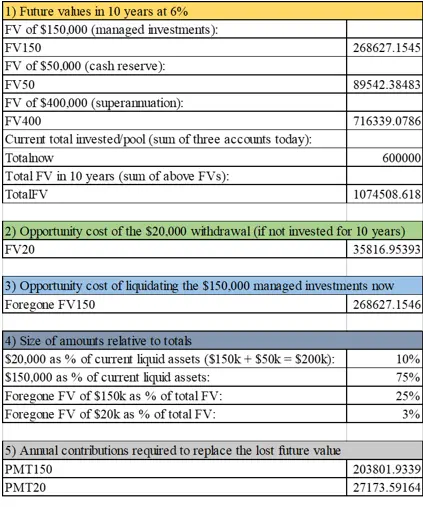
(Source: self-created)
The calculations reveal that the opportunity cost of making this decision afforded Boris the decision to withdraw $20,000 is around a value of $35,817 and the opportunity cost of the withdrawal of his investment of a balance of 150,000 under management is equal to about $268,627. The preparation of an argument in negotiation carried out by Anita should emphasise the expression of all these calculated long-term loss. She wants to secure Boris in his retirement by preventing the further selling of assets and yet she must be trusted. The desired result is a situation where Boris retains his portfolio, concedes the conflict of his desired outcome in experience at least with his long-term plans, and undertakes a life of discipline in saving. Her BATNA (best alternative) is to settle on a decline to a reduced and controlled distribution of his cash stock to fulfil the autonomy granted by Boris without weakening his portfolio. The walkaway point would be if Boris insists on liquidating the entire amount of the $150,000 given that this is contrary to his retirement plan and fiduciary rights of Anita.
Boris, on the other hand, wants financial independence sooner and the aim is to get money for his venture. He would like to see high-risk investments give him an early retirement. The BATNA he has is to seek the opportunity with the help of the money he already withdrew (20,000 dollars) without selling additional property. His walkaway point may be taking away more funds contrary to the views of the advisor. The zone of possible agreement (ZOPA), consequently, consists in the availability of some cash in the process of protecting most of the invested points.
(d) Conflict resolution steps
In order to cope with the conflict over the withdrawal of Boris and the liquidation that he proposes to do, Anita may use a systematic conflict management model. Set the stage. It will also help Anita provide a safe and professional space which will signal that the review process will be an exercise in collaboration, and not adversarial. Identifying rules of having a qualified discussion will make Boris speak freely without defensiveness. Develop an interest, not a position (Sim et al., 2022). Although Boris is defined as an early retirement, his motivation is very financial, not a long-term job. In the same manner, the role that Anita plays is the portfolio preservation, although she is concerned with the accumulation of wealth in a sustainable way. These interests can be clarified and common ground can be identified.
Standardise criteria. Financial estimates and morality should serve amongst the benchmarks that Anita employs. E.g. by demonstrating the lost compound effect of withdrawing $20,000 (or 35, 800 in 10 years at 6%) (Chatterjee and Fan, 2023). The objective data categorises the discussion in terms of quantifiable effects of objectivity in favour of rational decision-making.
(e) Strategies for Anita
(i) conflict management at the meeting.
Anita can use active listening to listen to Boris without being judgmental and avoid being judgmental by empathising with him besides steering the discussion into a goal-oriented manner. Reducing defensiveness by reframing the words of Boris into positive terms (e.g., You want financial independence sooner; how can we make that be sustainable?) helps (Omowole et al., 2024). Teamwork is critical because when Boris is included in brainstorming on the best strategies, there is a sense of ownership to him and less resistance. Anita has managed to maintain rapport by being firm and emotional at the same time, so as not to escalate.
(ii) Manipulating the critical thoughts of Boris.
Boris is an overconfident person that will make rash decisions. Anita can counter this by teaching to reflect before committing the cash, that is, System 2. Indicatively, probing questions should be asked or posed as questions (instead of asking questions) like What evidence are the promised returns? which will induce self-evaluation and not confrontation. Besides, trying to define the long-term effect of diversification and compounding, Anita correlates the principles of finance with the objectives of Boris (Kaluarachchi and Sedera, 2024). Lastly, she is able to use behavioural nudges, including showing comparative situations (e.g. risky liquidation vs. income-consistent growth to retirement) which will nudge Boris to a rational decision without violating autonomy.
Question 2: Client Behaviour and Decision-Making
(a) Ideal Target Client Segment
The ideal market in a financial planning practise is those who are aged 35-55 and whose annual income is cumulative of 120,000 or above and are also within the professional fraternity and company owners. It also happens to be their best earning period in life between accumulating money and settling loans on a home loan, educating kids and retirement. Their demography consists of those typically two-yield families, residing in metropolil and technologically savvy ones, and highly aware of time utilisation. Psycles with Psychographics These clients are financially secure, value custom compelling and risk-averse but prepared to spread to solutions that will optimise long-term rises in wealth. Majority of them require a helping hand in complex financial product offerings, tax efficiency and management of superannuation. Data indicates that, according to behavioural segmentation, they enjoy communicating openly on a regular and on time updates and reputable relationship (Bhuiyan, 2024). This is theoretically in accordance with the principles of the Kotler segmentation that recommends the targeting of clients, narrowing on specific attributes that are measurable, meaningful, and doable.

(b) Value Proposition
The practise value proposition is to offer trusted and personal confidential and ethical financial advice which empowers the clients to make an informed choice and helps them to guarantee that they will be assured of financial independence. Unlike the generic advisory services, it represents more of the long-term relationships on the basis of transparency, customised strategies, and engagement (Del Sarto et al., 2025). This value proposition is enticing in the clients who desire to be quiet and increase over the extended period of time since it is an all-inclusive reaction of the requirements of the clients who convey to him/her with the accountability, careerism, and the incidental guidance. A blendanywhere within the integrations of technicalities and customer orientation gives the service some expression of peace, in the meaning of the financial decisions implemented against the objective of life. The offer (says) 3 benefits (that is) (1) trust in honest qualities as the basis of principles, (complying) (2) approach to individual goals, (3) absolute service in the form of constant interaction and education. This will be in order to have the clients feel assisted and valued during the financial process.
(c) Integrating Value Proposition into Client Contact
The fulfilment of the value proposition has to be incorporated in each of the steps of the client journey, and all the touchpoints have to uphold the promise of trust, personalisation, and stability in quality.
Initial Contact/Branding: The first impression as branding, web platform and marketing materials should be professional, ethical and centred on the client care. Much trust is created during the initial stages of the presentation through good description of services and testimonials. Reception employees and digital enquiry services must know how to highlight these values through responsiveness in terms of serving with relevancy, politeness and rapidity.
First Consultation/Fact-Finding: During the initial experience interaction, the consultant acts as an active listener to customer concerns, elucidates objectives and undertakes intensive fact finding. Empathy and competence make the clients feel that they are being advised in a more personalised and trusted manner (O’Dwyer and Richards, 2021). The instrumental tools such as questionnaires and risk-profiling software or financial modelling, play a role in enhancing up to the demands had to be professional and aligned with the strategies and needs of the clients.
The constant Discussion/ Portfolio Examination: The dedication of the practise to the transparency and reliability lies within timeliness of updates, frequent review of performance and proactive modifications in the strategic direction. A report in plain language and frequent cheque-ins (quarterly) will ensure that the clients are not kept in the dark. A communication calendar will ensure that there is a constant pace of communication. Support all the touchpoints beyond adviser must be used to help enhance the value proposition (Kishore et al., 2024). The management will ensure speedy response to customers when they have questions, and they will be provided with online portals that enable customers to view investment reports and financial updates in a secure and user-friendly format. The dehumanisation of the routine practises enhances the efficiency of the operations in a manner that is aligned with the provision of individualised services.
1. Support Services (Admin, Digital Platforms, Staff):
All the touchpoints beyond adviser must be used to help enhance the value proposition. The management will ensure speedy response to customers when they have questions, and they will be provided with online portals that enable customers to view investment reports and financial updates in a secure and user-friendly format. The dehumanisation of the routine practises enhances the efficiency of the operations in a manner that is aligned with the provision of individualised services.
(d) Strategies to Maintain Service Level
Strategy 1: Continuous Professional Enrichment and employee education of the employees.
Particular to the maintenance of high service levels, due to the provision of advice to customers, advisers and staff are supposed to monitor the changes in regulations, financial products, and the needs of the customers. Instead, a continuing professional development (CPD) enables advisers to recall both their technical skills and aid in sharpening soft skills measured by communication, negotiation, and empathy (Attah et al., 2024). Digital training and compliance training of personnel members provide customer service support to help serve clients through consistency at any touchpoint of clients. It follows the ideas of Total Quality Management (TQM) in that continuing training put in place a mindset of constant improvement and provided the employees with the ability to deliver more value. This means privacy to clients, that they are dealing with an adviser who can be relied upon, that he is ethical and works practises that are the best in the industry, and this then increases a sense of trust and loyalty.
Understanding client behaviour, financial decision-making, and ethical advisory practices is also valuable when preparing a finance assignment on real-world financial planning scenarios.
Strategy 2: Strategy 1 monitoring through the Feedbacks loop, KPI and Client Surveys.
The other approach that is critical is the introduction of formalised service quality analysis. The feedback provides the clients with an opportunity to express their satisfaction levels and the problems they wish to be improved in contrast to conventional surveys making the clients express their impressions of responsiveness, clarity of answers provided and trust. Among the most remarkable performance management measurements, one could single out key performance indicators (KPIs) whose popular examples would consist of response time to client requests or frequency or volume of evaluation of portfolios (Onabowale, 2024). According to the client relationship management theory, the constantly observed fact implies the client expectations are measured and exceeded. This proactive approach inserts on transparency, and real urge to change. All these strategies form a service-oriented culture with a basis of trust, competency and a client-based care. By imparting capacity in the individuals and developing a feedback-based system of quality, the practise stands prepared to launch on its value proposition, and retain long-term relations to its customers.
Question 3: Legal, Ethical & Professional Context
Lauren is a 35 years professional and has a salary of about over 190-000 per annum and visits an insurance agent where she seeks some advice on how to maintain her own independence and securing quality care in the event of an accident or disease. The underwriting is quite challenging because her BMI is elevated and this can result into a conflict. This discussion encompasses sources of Conflict, consideration of the person and strategy to involve in the conflict and also control emotions.
(a) News on the contact and the potential consequences
(i) Sources of conflict
The issue that the main conflict is conflict between the expectation of the position and reality of the insurance underwriting. This comes about due to her high BMI thus being more inclined to be loaded out or ineligible to carry certain covers such as trauma and income protection (Reece et al., 2022). This strains her desire to obtain low priced but comprehensive protection and the obligation of the advisor to frame out attainable timetable. One of the other factors that have contested to this problem is that weight and health conversations are delicate and therefore may spark some insensitive voices or discomfort.
(ii) Employment in trust and communication
This might stress a relationship between an adviser and a client that may be strained by such fights. Lacking an attempt to empathise with her, Lauren might sense that she is accused when questions about her BMI are brought up therefore leading to a lack of trust between them. Another barrier to effective communication is the failure of the adviser to discuss the sensitive issue in a clear and direct way or in an overly professional way (McCoy et al., 2022). Also, in case the insurance possibilities appear to be rather improbable or unaffordable, then Lauren will feel uninsured, and, consequently, will begin to look at the means of disengagement. One can say that insensitive listening is a possibility to maintain rapport and trust.
(b) Zoning on one advantage as well as disadvantage
(i) Key strength
One of my strengths that I am applying in this situation is active listening as well as my empathy. This will allow me to listen to Lauren and take into account the problems she encounters and not interrupt her stating that she is correct and creating an appropriate and favourable environment so that she could cooperate with me in revealing sensitive information (Northey et al., 2022). By receiving her goals and difficulties without telling, I will do as little as possible to be defensive, create rapport and get Lauren engaged in a collaborative system of problem-solving to give her the necessary degree of protection despite the problems with writing.
(ii) Weakness area and my strategy of improvement.
Being intimidated when discussing a personal topic that someone deems sensitive such as weight or health status is one area that has been found as a weakness of mine. This would create slack time to make things right which directly affects the outcome of the underwriting. I will resolve this by having planned communication which will begin with the open ended questions which I will paraphrase sensitive issues according to the purposes of Lauren and should tie the talks to her financial security. Further development will entail constant training on issues related to tough conversations, post-meeting and feedback search on different matters to encourage improvement of my practise.
(c) Strategy to address the issue with Lauren
(i) Process to discuss insurance challenges
My strategy begins with the realisation of the financial independence and quality healthcare needed by Lauren in case of ill or injury. Then I would explain courteously and in a professional way about how BMI will influence the underwriting process with the added that insurers might use loadings, exclusions or small benefits. The other alternatives I would provide you second include crossing between the policies of other different insurers, taking group insurance on superannuation or an individual cover because of priorities of the top major types of cover. I would also highlight on wellness-support programmes offered by certain insurers in as much as it is possible. Finally, I would ensure that the understanding occurs through summarising the dialogue between me and Lauren and posing questions to the clients and repeating the theme of the two way and client centred approach.
(ii) Three key questions
- What percentage of your holdings is insured towards you (i.e. income, trauma, life cover) - gets priorities straightened out?
- The level of good or bad regarding the cost and level of coverage it provides? - Talks about being able to handle the premium.
- Have you thought about any of the cover options available against one of the available workplace or superannuation cover?
(iii) Information to provide
I would show the underwriting index, and the influence of the BMI in regard to loadings, restrictions or refusals. To assist in making informed choice, I would have comparison of insurance policy and variety of premiums. I would also profane my rights to Lauren as a client of full disclosure limit, opportunities to make a request to a decision made by bad underwriting, and the likelihood of submitting another application in future. This is so as to ensure that Lauren will be understandable and she will be assured of the decisions she will make regarding her cover.
(d) Managing emotional reactions
(i) Empathising with the emotions of Lauren.
Where I would use empathetic listening in order to assist Lauren in many effective ways and not to judge upon her concerns the way it would assist her in feeling that she is not being judged and her experienced activities are being accepted as they are being experienced. As well, I will be able to reduce the sense of stigma by normalising the challenges of securing insurance with high BMI and, also, enable her focus more on the more viable options. The possibility to rebrand the BMI and make it an insurance provision is far more than a failure on the personal level, and it is the reason why the discussion can be organised on a professional and objective level. I would adopt a calm, respectful, non judgemental tone of voice all along, but would lay emphasis on what is available by her goals.
(ii) Learning to control own emotions being an advisor.
As the adviser, it will be expected of you to be professional since at the time you will not be using your own thoughts, but rather using the needs of the other person you are working with such as the needs of Lauren in this instance. Reflective thinking and self-awareness will enable me to notice the biases and tendency to avoidance which are personal. My self-regulation response to cope with stress then would be to take a moment before responding, such as pausing and opening up my mind to handle the situation in a solution-focused require.
Conclusion
The assignment emphasised how conflict management, decision making on behavioural and ethical framework can be involved in financial advice. By means of the new business negotiation she has been involved in with Boris, it becomes apparent that in order to reach positive results, it is important to comprehend the conflicts, styles, biases, and motivations. The law and professional requirements track or limit the scope of the client with a constraint, whereas the thinking behind the decision distortions are discussed in the concepts of behavioural finance. Proper interaction with the client relies on active communication, training, and fair bargaining. With professional skills, ethics and psychological engagement, advice givers this can provide reliable client-focused advice that maintains a viable long-term relationship.
Reference List
Journals
- Attah, R.U., Garba, B.M.P., Gil-Ozoudeh, I. and Iwuanyanwu, O., 2024. Corporate banking strategies and financial services innovation: Conceptual analysis for driving corporate growth and market expansion. Int J Eng Res Dev, 20(11), pp.1339-49. https://www.researchgate.net/profile/Ifechukwu-Gil-Ozoudeh/publication/386997394_Corporate_Banking_Strategies_and_Financial_Services_Innovation_Conceptual_Analysis_for_Driving_Corporate_Growth_and_Market_Expansion/links/675c00638a08a27dd0bbfe2d/Corporate-Banking-Strategies-and-Financial-Services-Innovation-Conceptual-Analysis-for-Driving-Corporate-Growth-and-Market-Expansion.pdf
- Bhuiyan, M.S., 2024. The role of AI-Enhanced personalization in customer experiences. Journal of Computer Science and Technology Studies, 6(1), pp.162-169. https://al-kindipublishers.org/index.php/jcsts/article/view/6588
- Chatterjee, S. and Fan, L., 2023. Surviving in financial advice deserts: limited access to financial advice and retirement planning behaviour. International Journal of Bank Marketing, 41(1), pp.70-106. https://www.emerald.com/insight/content/doi/10.1108/ijbm-01-2022-0022/full/html
- Del Sarto, N., Bocchialini, E., Gai, L. and Ielasi, F., 2025. Digital banking: How social media is shaping the game. Qualitative Research in Financial Markets, 17(2), pp.348-369. https://www.emerald.com/qrfm/article/17/2/348/1241453
- Kaluarachchi, B.N. and Sedera, D., 2024. Improving efficiency through AI-powered customer engagement by providing personalized solutions in the banking industry. In Integrating AI-driven technologies into service marketing (pp. 299-342). IGI Global. https://www.igi-global.com/chapter/improving-efficiency-through-ai-powered-customer-engagement-by-providing-personalized-solutions-in-the-banking-industry/355999
- Kishore, K.K., Absar, H., Pant, P. and Tripathi, B., 2024. The Future of Robo-Advisors in Wealth Management. In Artificial Intelligence and Machine Learning-Powered Smart Finance (pp. 161-172). IGI Global Scientific Publishing. https://www.igi-global.com/chapter/the-future-of-robo-advisors-in-wealth-management/339167
- MacDonald, K.L., Loy, E., Brimble, M. and Wildman, K., 2023. The value of personal professional financial advice to clients: A systematic quantitative literature review. Accounting & Finance, 63(4), pp.4399-4429. https://onlinelibrary.wiley.com/doi/abs/10.1111/acfi.13099
- McCoy, M., Machiz, I., Harris, J., Lynn, C., Lawson, D. and Rollins-Koons, A., 2022. The science of building trust and commitment in financial planning: Using structural equation modeling to examine antecedents to trust and commitment. Journal of Financial Planning, 35(12), pp.68-89. https://www.financialplanningassociation.org/learning/publications/journal/DEC22-science-building-trust-and-commitment-financial-planning-using-structural-equation-modeling-OPEN
- Mithani, M.A., 2023. Scaling digital and non-digital business models in foreign markets: The case of financial advice industry in the United States. Journal of World Business, 58(4), p.101457. https://www.sciencedirect.com/science/article/pii/S1090951623000329
- Northey, G., Hunter, V., Mulcahy, R., Choong, K. and Mehmet, M., 2022. Man vs machine: how artificial intelligence in banking influences consumer belief in financial advice. International Journal of Bank Marketing, 40(6), pp.1182-1199. https://www.emerald.com/insight/content/doi/10.1108/IJBM-09-2021-0439/full/html
- O'Dwyer, M. and Richards, D.W., 2021. Occupational boundaries: Gender capital and career progression in the financial planning industry. Financial Planning Review, 4(2), p.e1123. https://onlinelibrary.wiley.com/doi/abs/10.1002/cfp2.1123
- Omowole, B.M., Urefe, O., Mokogwu, C. and Ewim, S.E., 2024. Building financial literacy programs within microfinance to empower low-income communities. Journal name if available. https://www.researchgate.net/profile/Oreoluwa-Onabowale-2/publication/388491509_The_Rise_of_AI_and_Robo-Advisors_Redefining_Financial_Strategies_in_the_Digital_Age/links/679a98c896e7fb48b9a7aba9/The-Rise-of-AI-and-Robo-Advisors-Redefining-Financial-Strategies-in-the-Digital-Age.pdf
- Onabowale, O., 2024. The rise of AI and Robo-Advisors: Redefining financial strategies in the digital age. International Journal of Research Publication and Reviews, 6. https://www.researchgate.net/profile/Oreoluwa-Onabowale-2/publication/388491509_The_Rise_of_AI_and_Robo-Advisors_Redefining_Financial_Strategies_in_the_Digital_Age/links/679a98c896e7fb48b9a7aba9/The-Rise-of-AI-and-Robo-Advisors-Redefining-Financial-Strategies-in-the-Digital-Age.pdf
- Reece, S., Sheldon, T.A., Dickerson, J. and Pickett, K.E., 2022. A review of the effectiveness and experiences of welfare advice services co-located in health settings: A critical narrative systematic review. Social Science & Medicine, 296, p.114746. https://www.sciencedirect.com/science/article/pii/S0277953622000491
- Roongruangsee, R. and Patterson, P., 2024. Engaging robo-advisors in financial advisory services: the role of psychological comfort and client psychological characteristics. Australasian Marketing Journal, 32(4), pp.339-354. https://journals.sagepub.com/doi/abs/10.1177/14413582231195990
- Schnusenberg, O., 2025. Navigating Client Engagement: Considering Client Knowledge and Willingness. Journal of Financial Planning, 38(2). https://search.ebscohost.com/login.aspx?direct=true&profile=ehost&scope=site&authtype=crawler&jrnl=10403981&asa=N&AN=183111478&h=iBtjOCiI6Ond5hYKj%2BbNL6qe3%2BRdnNu5cG1HvN34mD8cHDfCwTc%2FKjgLStDKpWd8eN55NT0EpUvaLUUgbAcHbw%3D%3D&crl=c
- Sim, M., Conduit, J., Plewa, C. and Hentzen, J.K., 2022. Customer engagement with service providers: an empirical investigation of customer engagement dispositions. European Journal of Marketing, 56(7), pp.1926-1955. https://www.emerald.com/insight/content/doi/10.1108/EJM-12-2020-0879/full/html
- Turtiainen, T., 2021. Customer engagement and hybrid wealth advice model: Case study of combining human interaction and digital advisory for retail banking customers in Finland. https://www.theseus.fi/handle/10024/496947