Part A: Consolidation Question
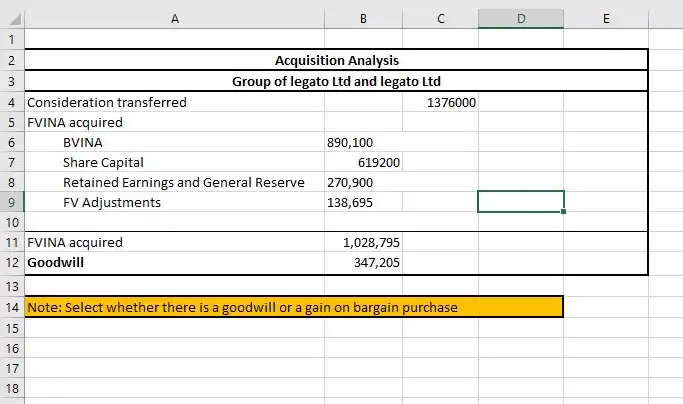
Figure 1: Acquisition Analysis
The analysis on the acquisition has shown that 100% of Iegato Ltd was acquired by Tie Ltd at a cost of $1,376,000. The firm modelled the fair value of the net assets of Iegato as $1,028,795 which included book value amounting to $890,100 and equipment revaluation amounting to $138,695. Since the market value of the acquirable assets were lower than market price of the purchases, there was the creation of goodwill of $347,205. This goodwill includes the amount paid as a premium upon future earning capacity and future synergies.
Looking for academic guidance? Take advantage of free, expert-reviewed sample papers from the Best Assignment Writing Service Australia.
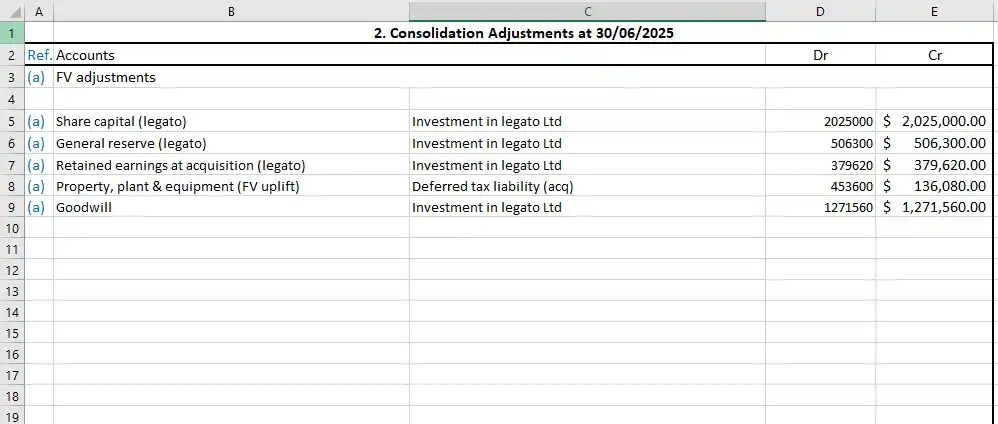

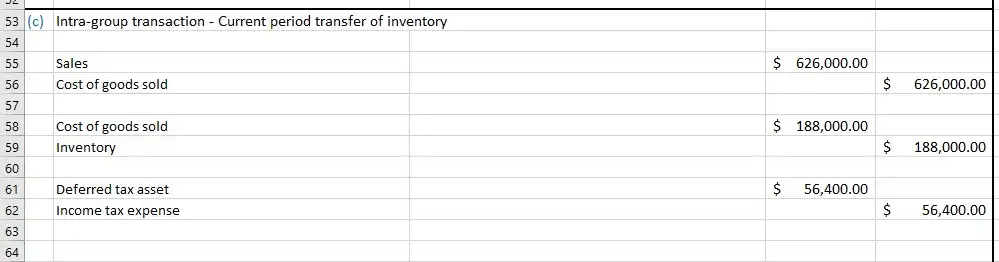

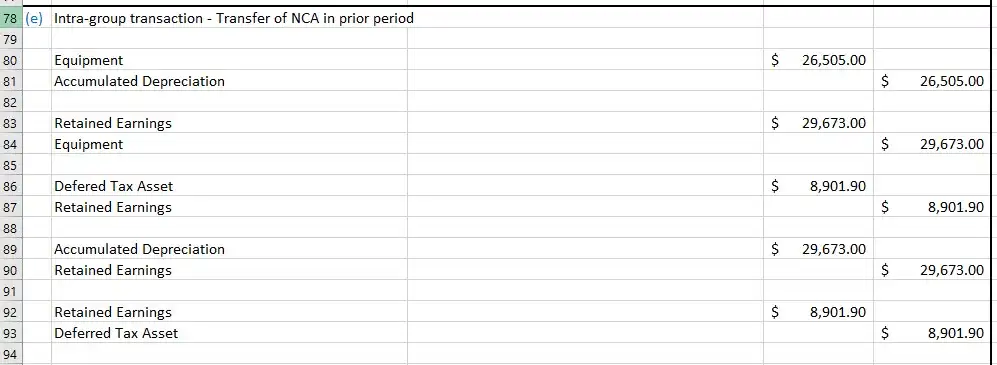
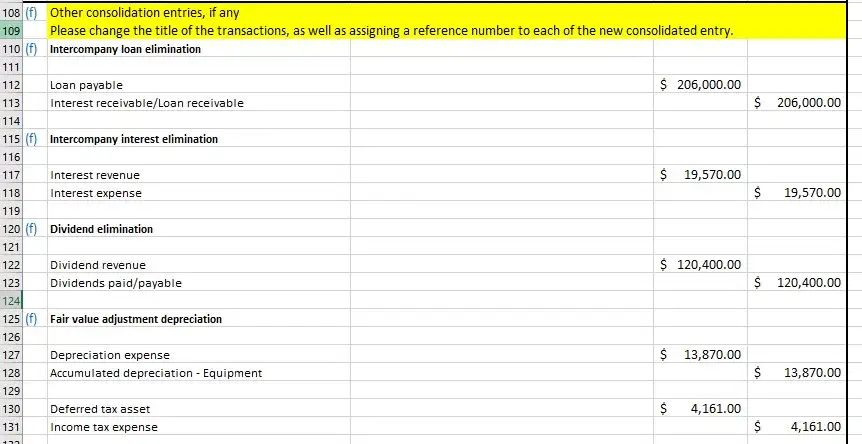
Figure 2: Consolidated Journal Entries
The consolidated Journal entries eliminate all the transactions between subsidiaries and the parent companies. These material changes will include the following: elimination of intercompany sales of the amounts of $626,000, the destruction of the unrealized inventories gains, and the winding up between companies- to- companies’ borrowing along with the elimination of dividends between- companies. The entries also contain $5,310 goodwill impairment and other revaluation on its depreciating equipment. These amendments are made in ways that only the outside transactions undertaken with the third parties are reflected off the consolidated accounts.
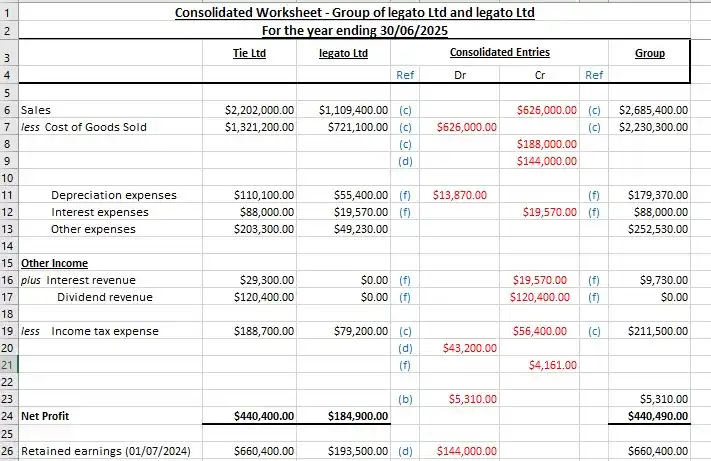
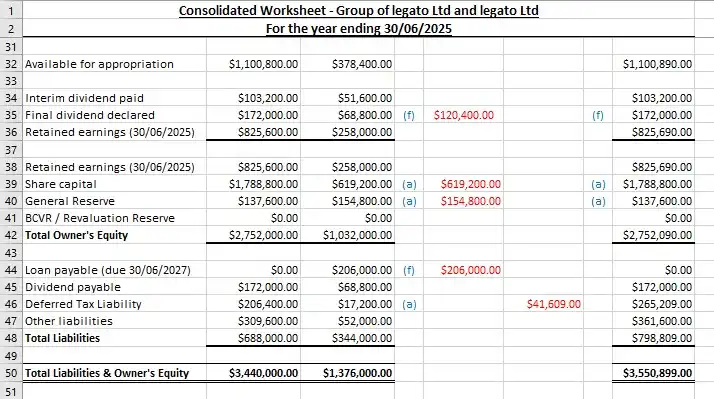
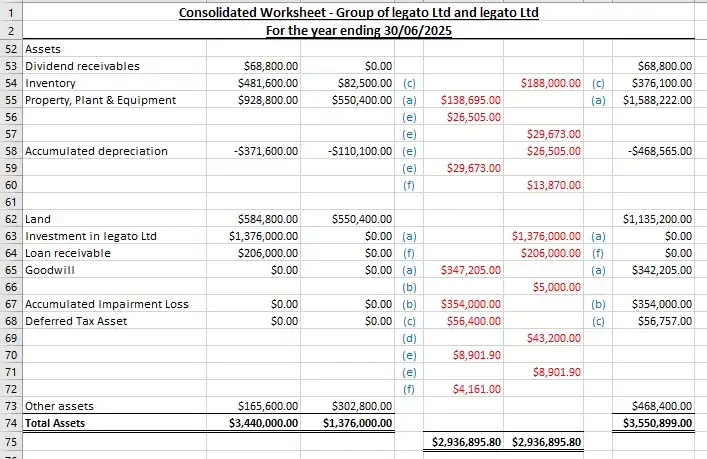

Figure 3: Consolidated Worksheet
The consolidated worksheet consolidates all the financial statements of the two companies, and utilises all the elimination entries to create the group numbers. The consolidated final results indicate that total assets are $3,550,899 and net profit was $440,490. With the removal of all the internal transactions, the worksheet forges the group to be seen as a single economic entity. Other key changes include the scored out intercompany balances, modified values of inventories, goodwill recorded and merge external wonderful. This provides the real economic position of the whole group to the stakeholders.
Part B: Discussion on Control
1. Introduction
In the financial reporting, consolidation helps to show financial position and performance of a group of companies as one company. The international standards, particularly the IFRS 10 and their relevant counterparts in Australia, the AASB 10, in particular pays significant attention to control as the factor that pushes one company to purchase another company. This essay defines control, problems that are present in the acts and implementation of these prohibitions by the example of Cratchett. The discussion begins by providing the definition of control as describe by statutory under the IFRS 10 and then the role of potential voting right a broader world-wide reporting and finally the provision of the rules on the case study.
2. Control under IFRS 10 / AASB 10
As per details in IFRS 10 and AASB 10, an investor gains control in a three prerequisite occasion: a power over the investee, exposure to yielding returns and capability to execute power to influence the returns. Power is normally based on the vote right but power could be gained over a contract, over the appointment of management or in other ways. The investor is subjected to gain or loss depending on the performance of the investor when subjected to variations in returns. Finally, the ability to influence is what links the preceding two conditions with each other regarding its power to influence.
The challenge is that such situations are the ones where professional judgement is at stake rather than the rules. The IFRS 10 pushed the preparers and auditors to make further decisions, especially, to try to identify a sensible approach as to whether voting rights or a contractual right give the control (Bedford et al., 2022). The uncertainty came as a result of the implementation of IFRS 10 and IFRS 12 in South Africa, regardless of whether the rules were applied uniformly or not (Sihiya & Malan, 2022). The joint response of these researches shows that standard has clearly described three elements of control but applications in a real life situation are often a matter of interpretation, and circumstances of a given case (Golubeva, 2023).
3. Potential Voting Rights
A relatively significant test under the IFRS 10 is how potential voting rights should be treated such as options or convertible instruments. Such rights are said to be brought under control assessment as long as they are substantial. A substantive right is the type of right that can apply both to the present moment, as well as fiscally viable to exploit. The non-substantive alternatives cannot provide power to its holder and that, is unnecessary because too expensive, will not prove to be utilized or another option is highly restricted by practical reasons, the non-substantive option is not substantive.
This is one of the necessities that cause problems in implementation. Many companies have been forced to scrutinize a potential right being substantive and several consolidation resolutions on an interpretation can vary (Bedford et al., 2022). It is also identified in cross-border research that regulators are free to exercise substantive rights in varying ways and this makes it hard to have international comparability (Prather-Kinsey et al., 2022).
It is a crucial idea that (radically out of the money) options are not substantive. It ensures that the potential rights no longer have any influence on control except when they practically cause it. However there is a high probability of significant level of judgement required in every application where it is suitable to determine when a right is substantive and this may become a cause of variant treatment between countries.
Students exploring corporate finance, regulatory compliance and auditing practices can seek Corporate Finance Assignment Help for academic guidance
4. Broader IFRS Context
Strategies of IFRS 10 cannot be considered as isolated ones. They are part of the bigger reporting dead space in the global sphere where shareholder confidence and rectitude are at work. One of the attempts of the IFRS Foundation to create a sense of legitimacy and respond to the needs of different stakeholders is the creation of the International Sustainability Standards Board (ISSB) (Bohn et al., 2025). Their study makes it clear that it is the perception of standards that matters not the technicality.
The second school of thought is in the studies that were carried out on relation between IFRS adoption and institutional quality. These findings suggest that benefits of the IFRS, such as increased transparency and providing fair reporting depend greatly on the environment that the rules find application (Jamaani et al., 2024). Strong institutions have the capability of gaining more in the process of IFRS implementation compared to weak institutions.
These observations suggest that IFRS 10 provides effective guidance of control despite the fact that its effective application on a global front is dictated by the level of trusting the stake holders coupled with the strength of the environment within which reporting is being done.
5. Case Application: Cratchett
In the case study, it is worried about Cratchett which is a company with two key investors. Scrooge controls 70% of the voting stock where Marley controls 30%. Marley may also share a half-voting rights in Scrooge, but the option is well out of money, and would be likely to be so within the next two years.
The procedures to implement the IFRS 10 should account for the first one taking into consideration power. Scrooge having 70% of the votes, it is evident that he has given himself the mandate to control the right operations of Cratchett. Marley is only 30% and the option is not substantive because it is too expensive and this option is not likely to be exercised. As such, Marley is powerless.
Secondly is the exposure to variable returns. Regarding the shareholding, the investors both have an exposure, although Scrooge is the owner of the higher percentage of shares and, will therefore, be at a loss, when it comes to the performance of the investor.
The one that comes last is ability to influence returns through power. The 70% stock of Scrooge suggests that it can contribute to the decision-making process and appoint the management along with distributing it. This has allowed Scrooge to have the ability to impact the returns. This Marley cannot do, starved of substantive rights.
The solution to this is research-based. The concept of control is considered in relation to present-day competence, rather than the improbable occurrence of an event in (or hypothetical isolation of) the futures (Sihiya & Malan, 2022). Also worth noting are uniformity in enforcement that implies that Scrooge is in compliance with all three requirements of controls applied on a strict interpretation of IFRS 10 (Prather-Kinsey et al., 2022).
Indeed, it means that Scrooge should prepare financial statements of Cratchett and Marley does not. As it has been stated in the case, the implementation of IFRS 10 in practice has been observed, and it can be concluded that judgement about potential rights is an important factor.
6. Conclusion
The essence of consolidation is based on control and IFRS 10 / AASB 10 described the reality that control entails power, exposure to the returns and the capability to exercise the same to affect the returns. In contrast with the situation in the example of Cratchett where Scrooge possesses the coupling majority power and fulfils all 3 criteria of control, Marley possesses no substantive rights and is incapable of consolidation. This finding demonstrates the spirit of IFRS 10 such that only those that have real control have consolidated accounts. The bigger implication is that it needs to be used throughout the world for further uniformity in reporting finance to retain trust in it.
Reference List
Journals
- Bedford, A., Bugeja, M., & Ma, N. (2022). The impact of IFRS 10 on consolidated financial reporting. Accounting & Finance, 62(1), 101-141. Retrieved from: https://opus.lib.uts.edu.au/bitstream/10453/147419/3/0FFE5959-84D3-42BE-895B-1C6463B01D98%20am.pdf [Retrieved on: 08-09-2025]
- Bohn, L., Macagnan, C. B., & Kronbauer, C. A. (2025). Navigating legitimacy: diverse stakeholder perspectives on the IFRS Foundation’s establishment of the ISSB. Meditari Accountancy Research, 33(1), 86-113. Retrieved from: https://www.researchgate.net/profile/Luciano-Bohn-3/publication/384932696_Navigating_legitimacy_diverse_stakeholder_perspectives_on_the_IFRS_foundation's_establishment_of_the_ISSB/links/6723d59e77f274616d54229f/Navigating-legitimacy-diverse-stakeholder-perspectives-on-the-IFRS-Foundations-establishment-of-the-ISSB.pdf [Retrieved on: 08-09-2025]
- Golubeva, O. (2023). Accounting for transition: A literature review. Journal of International Accounting, Auditing and Taxation, 51, 100548. Retrieved from: https://www.sciencedirect.com/science/article/pii/S1061951823000277 [Retrieved on: 08-09-2025]
- Jamaani, F., Alidarous, M., & Alharasis, E. (2024). The combined impact of IFRS mandatory adoption and institutional quality on the IPO companies’ underpricing. Journal of Financial Reporting and Accounting, 22(4), 811-841. Retrieved from: https://www.researchgate.net/profile/Esraa-Alharasis-2/publication/360493083_The_combined_impact_of_IFRS_mandatory_adoption_and_institutional_quality_on_the_IPO_companies'_underpricing/links/62e0e5643c0ea878876000e2/The-combined-impact-of-IFRS-mandatory-adoption-and-institutional-quality-on-the-IPO-companies-underpricing.pdf [Retrieved on: 08-09-2025]
- Prather-Kinsey, J., De Luca, F., & Phan, H. T. P. (2022). Improving the global comparability of IFRS-based financial reporting through global enforcement: a proposed organizational dynamic. International journal of disclosure and governance, 19(3), 330-351. Retrieved from: https://link.springer.com/content/pdf/10.1057/s41310-022-00145-5.pdf [Retrieved on: 08-09-2025]
- Sihiya, K., & Malan, M. (2022). A Post-implementation Review Of The Adoption Of IFRS 10 And IFRS 12 On The Financial Statements Of South African Entities. Journal for New Generation Sciences, 20(2), 1-11. Retrieved from: https://journals.co.za/doi/pdf/10.10520/ejc-newgen-v20-n2-a1 [Retrieved on: 08-09-2025]