Introduction
The modern era encryption is fundamental in the assurance of communication and protection of confidential information against getting hacked by products of a rival. This task is aimed at the analysis of classical and modern cryptographic schemes to learn about their weaknesses and strengths. The exercises will help illustrate the feasibility of the targeted solutions in breaking the traditional ciphers, discussing an inherent leapfrog the mathematical characteristics of the block cipher architecture, and assessing the security of one of the high-tech solutions. The assignment brings out the application of theoretical knowledge in cryptanalysis by the step-by-step solutions.
Students looking to improve their understanding of technical concepts, encryption methods and academic report writing can explore Best Assignment Help Australia for subject-specific academic guidance.
Task A Breaking the Monoalphabetic Substitution Cipher
Alphabet monoalphabetic substitution cipher is one of the classical meanings of encryption, whereby the letters of the original text were replaced by the distinct letters of the alphabet. Even though the key space is large, the structure of the natural language is not disturbed: thus, the cipher can still be attacked systematically (Banoth & Regar, 2023). Frequency analysis is the best-known technique of cracking this cipher. There are more letters in the English language that fall under the common category of use like E, T, A and O. The frequency of the letters in ciphertext can be compared with standard frequency lists by an attacker to come up with an initial guess about the substitutions.
Besides the sole letter frequency, the rest of the patterns, e.g., diagram and trigram, also consist of the ones, which come to mind as happening to play a decipher. Commonly occurring words in the sentences like the, and, got and so forth could easily be determined by the repetitions employed in the coded text. Some unknown number of matches are often found; now substitutions are reduced all the way to plaintext reads. Experimentations keep this process light speeded unless logical thinking.
It was possible to apply the same set of principles in usage during the days of the assignment on the set ciphertext. The analyst would begin with the table of the number of times the letters have been used, and find common unit elements and contrast them with common English lines. The latent message, when substitutes are tested and refinanced, is that they germinate slowly. It is demonstrated in the process that the anchoring operation of those monoalphabetic substitution ciphers with the weapon of concealing the context simply offer a veneer to the text but not the protection owing to predictable qualities.
Task B Feistel Network
A highly common algorithmic structure context- Feistsel net (also known as Feistel networks, or variants) that can be useful in designing block ciphers. Its working is to repeatedly take two halves of the input and round the data by utilizing a round operation that will make data appear in several iterations. When tackling this task, the round function is described as the identity function, i.e. the input to the function is an identity, i.e. it is the same as the input. Although the round operation is no longer than plain addition, systematic transformations are also created by the XOR operations used in each round of the Feistel structure.
Take L0, R0 as the starting input. During the first round, the output is (R0, L0 XOR R0). At the second round, the halves are re-transformed producing (L0 xor R0, L0). The XOR operations add as the left and right halves alternate with each round. Thus proceeding with this process sixteen times, furnishing the construction, is furnished in a periodical style. This is exactly why the identity is the functionality and as a result each two-round event recreates the Feistel system in its state. The rounds are therefore even (equivalent to sixteen rounds), the output where could be generated is (L 0, R 0 ) and, as a coincidence (not as it happens by definition) the input supplied.

The important fact illustrated by this finding can be inferred as follows: the round-function may in no useful sense be weaker than the strength of the Feistel network. Say we have identity as the round, a cipher exhibits no apparent security, and can only strictly decrease to the original input after a certain amount of rounds: but when the round contribution is trivial the result remains unchanged (Zheng, 2022). It is the reason why the nonlinearity and confusion of the round operation Court of the round operation must be injected, to the extent that the Feistel network achieves cryptographic capability.
Task C OFB Mode with Fixed IV
(Source: Self-Created)
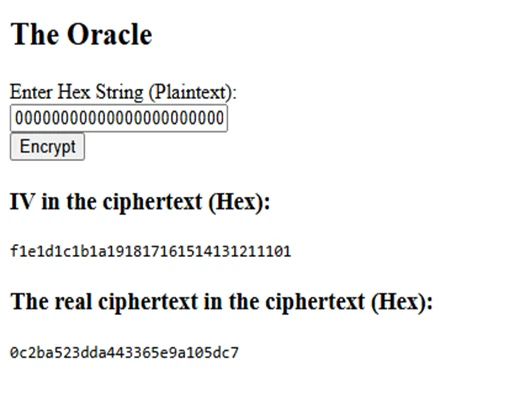
Output Feedback (OFB) coded output based on encrypting the key stream produced with initiation section, or initial velocity (IV). The IV need not be concurrent to render such a scheme safe and must be picked randomly with each encryption (Mehmood et al., 2024). It is defined by the programmer patching the IV and this was by mistake to cause the same potential keys stream being transmitted multiple times. Luckily, an encryption oracle enabled a deduction of the plaintext On account of this weakness.

(Source: Self-Created)
The alteration necessary to capitalize on the vulnerability is first to test the oracle with an input of a block of all zeros to identify any weakness. This generated the keystream in its purest form, as in OFB mode the keystream is dependent on the real plaintext. Slowly pulling the key stream, what followed was the ability to merge the ciphertext provided and the keystream using a basic XOR (Aumasson, 2024). This cancellation procedure actually faulted out the keystream and uncovered the original plaintext.

(Source: Self-Created)
This exercise represents that the reuse of a fixed IV invalidates the security of the fixed IV of the mode. When the keystream is disclosed in a one known query, it is possible to decrypt on the fly any ciphertext encrypted with the same IV, without knowing the encryption key (Sharma et al., 2022). The practice underlines the essence of random and unpredictable IVs of stream-based encryption modes in order to achieve confidentiality.
Task D Breaking Regev Encryption
Part 1: Theoretical Attack When m=n
The following principle is the hardest upon which the security of the Regev encryption scheme is founded; mmm number of equations is very large relative to the dimension nnn of secret analysis. By this supposition, the secret in the linear system is computationally difficult to reconstruct the plaintext of one of the ciphertexts; there are tiny error terms (Naser, 2021). However, a system of m= n becomes square, and the secret, or plaintext, can then be solveable by the common methods of linear algebra as an effect, in practice sabotaging the scheme. The attack exploits the invertibility of Latin square A and determinism of structure of the ciphertexts.
Part 2: Practical Attack on Provided Ciphertext
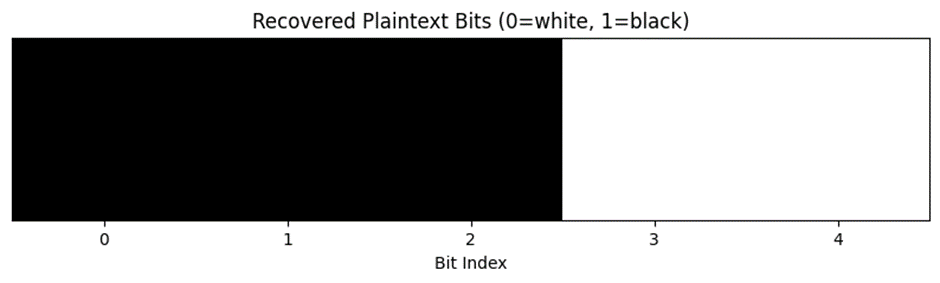
The corresponding ciphertext was removed out of the provided Word document in order to demonstrate the attack. The rows had been partitioned such that those which form the matrix A were made to be uncombined, and those which should form the text in the ciphertext be broken up as b (Yan, 2022). The matrix and the vector were converted into NumPy arrays after equalising row lengths. Some problems are solved by means of the suitable field that is q modulus adjusted to the needs of the assignment.
(Source: Self-Created)
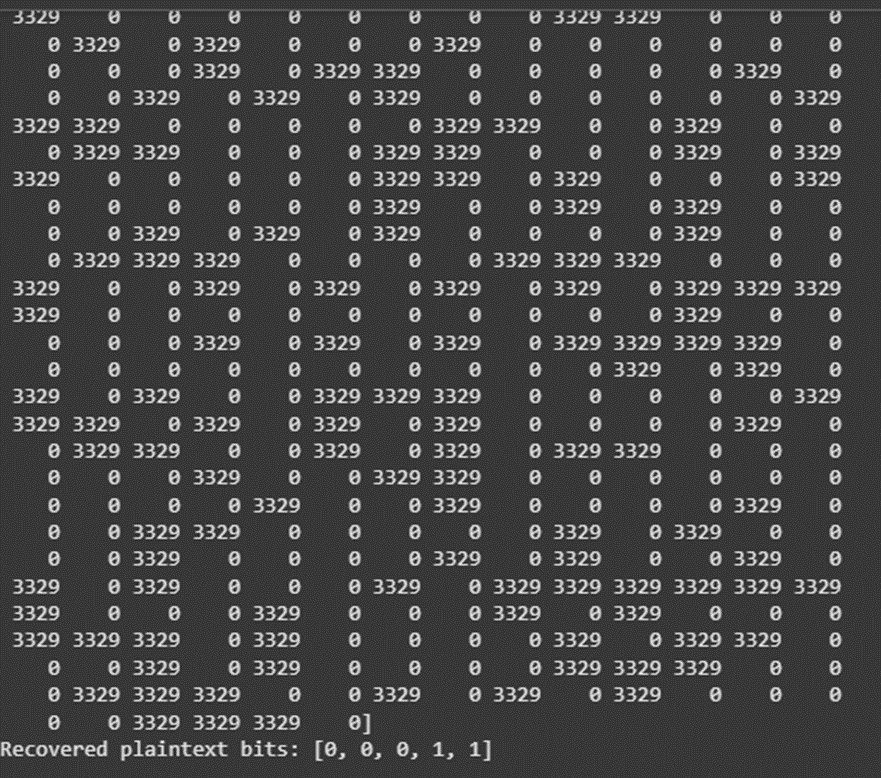
The system was isotoped to give an approximation of the secret to the inverse of Id. In the cases when A was single valued (or almost single valued), the pseudo-inverse was employed (Rudnytskyi et al., 2022). Thenres product A.s was matched with b modulo q in order to deduce the bits of message. Bit bit 0 was set to 0 and bit 1 set to values close to q/ 2. This resulted in a message-encoded in ciphertext that has been unmineable by the adversary.
(Source: Self-Created)
This way of cylindric realization provides the insight that the further subdivision of the Regev scheme under the condition of m=n is not only possible and easy (Naeem, 2023). It also raises concern on the fact that only a cryptosystem can be destroyed in case the encryption parameters have been incorrectly set.
Students exploring encryption algorithms, cryptographic vulnerabilities and information security concepts can also refer to Cyber Security Assignment Help for further academic guidance.
Conclusion
The weakness of the various cryptographic machinery between the classical ciphers and the up-to-date encryptions schemes has been demonstrated in this report and also its power. It discloses degree (intrinsically) based disentangle ease of monoalphabetic substitution, the centrality of nonlinear rounds functions, in Feistel networks, the Focalness of nonrandom IVs in the Feistel mode and the insecurity in the weak parameterization of Regev encryption. It narrows, in theory and with attack practicality, that the current system has the authority to provide the comparatively most important deliverable of design of any good cryptography and due implementation, namely the provision of data security.
Reference List
- Banoth, R., & Regar, R. (2023). An introduction to classical and modern cryptography. In Classical and Modern Cryptography for Beginners (pp. 1-46). Cham: Springer Nature Switzerland. Retrieve from: https://link.springer.com/chapter/10.1007/978-3-031-32959-3_1, Retrieve on: [28.08.25]
- Zheng, Z. (2022). Modern cryptography volume 1: A classical introduction to informational and mathematical principle (p. 359). Springer Nature. Retrieve from: https://library.oapen.org/handle/20.500.12657/54458, Retrieve on: [28.08.25]
- Mehmood, A., Shafique, A., Alawida, M., & Khan, A. N. (2024). Advances and vulnerabilities in modern cryptographic techniques: A comprehensive survey on cybersecurity in the domain of machine/deep learning and quantum techniques. IEEE access, 12, 27530-27555. Retrieve from: https://ieeexplore.ieee.org/abstract/document/10439158/, Retrieve on: [28.08.25]
- Aumasson, J. P. (2024). Serious cryptography: a practical introduction to modern encryption. No Starch Press, Inc. Retrieve from: https://books.google.com/books?hl=en&lr=&id=Wt9BEAAAQBAJ&oi=fnd&pg=PR15&dq=Modern+Cryptography&ots=wW06sL5pVW&sig=YxU1aoNFdb5Fg17TA5xckKQNi4w, Retrieve on: [28.08.25]
- Sharma, D. K., Singh, N. C., Noola, D. A., Doss, A. N., & Sivakumar, J. (2022). A review on various cryptographic techniques & algorithms. Materials Today: Proceedings, 51, 104-109. Retrieve from: https://www.sciencedirect.com/science/article/pii/S2214785321035094, Retrieve on: [28.08.25]
- Naser, S. M. (2021). Cryptography: from the ancient history to now, it’s applications and a new complete numerical model. International journal of mathematics and statistics studies, 9(3), 11-30. Retrieve from: https://www.researchgate.net/profile/S-Naser-2/publication/353999208_CRYPTOGRAPHY_FROM_THE_ANCIENT_HISTORY_TO_NOW_IT'S_APPLICATIONS_AND_A_NEW_COMPLETE_NUMERICAL_MODEL/links/611e47fc1e95fe241ae1008e/CRYPTOGRAPHY-FROM-THE-ANCIENT-HISTORY-TO-NOW-ITS-APPLICATIONS-AND-A-NEW-COMPLETE-NUMERICAL-MODEL.pdf, Retrieve on: [28.08.25]
- Yan, Y. (2022, December). The overview of elliptic curve cryptography (ECC). In Journal of Physics: Conference Series (Vol. 2386, No. 1, p. 012019). IOP Publishing. Retrieve from: https://iopscience.iop.org/article/10.1088/1742-6596/2386/1/012019/meta, Retrieve on: [28.08.25]
- Naeem, S. (2023). Network security and cryptography challenges and trends on recent technologies. Journal of Applied and Emerging Sciences, 13(1), 01-08. Retrieve from: https://www.researchgate.net/profile/Aqib-Ali-6/publication/372244622_Network_Security_and_Cryptography_Challenges_and_Trends_on_Recent_Technologies/links/64ac4286c41fb852dd62b076/Network-Security-and-Cryptography-Challenges-and-Trends-on-Recent-Technologies.pdf, Retrieve on: [28.08.25]
- Rudnytskyi, V., Korchenko, O., Lada, N., Ziubina, R., Wieclaw, L., & Hamera, L. (2022). Cryptographic encoding in modern symmetric and asymmetric encryption. Procedia Computer Science, 207, 54-63.
- Retrieve from: https://www.sciencedirect.com/science/article/pii/S1877050922009103, Retrieve on: [28.08.25]