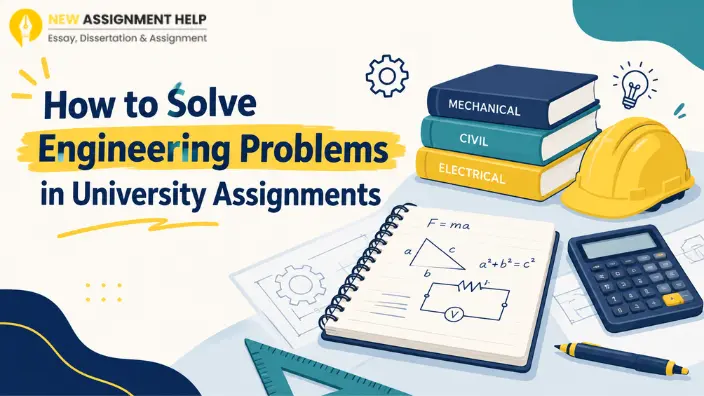
Engineering assignments at Australian universities feel tough because you are left on your own to choose the path. This catches many students off guard. But once you have a proven approach for this, these tasks become far easier. That’s exactly what this guide is here to do. You’ll get to learn a simple approach to solve engineering problems in university assignments. We’ll cover everything from the first read to the final check before you hit “submission”. But before that, let's look at why these tasks actually feel so different.
Why University Problems Feel Different
Many units at Australian universities use open-ended problems. That means there may be more than one valid method and even more than one acceptable answer. Your marker wants to see your thinking along with the final number.
Studies of engineering students show a pattern. Those who plan before calculating tend to do better than the ones who don’t. This leads them to spend just a few minutes choosing a strategy. Then they start the maths. That short pause saves time later. The first part of any plan is knowing exactly what the question asks. So, let’s begin with it.
Define the Problem First
Before you touch your calculator, read the question twice. Then restate it in your own words. A short checklist works well here. Try these steps before any calculation:
- List every given value, with its units
- Write down what you need to find
- Note any assumptions you are making
- Sketch a simple diagram
This list gives you a clear map of what this section of your engineering problem should cover. Many lost marks come from skipping it. Now that your map is ready and you know exactly what to do, it’s time you pick a method.
Choose a Method and Show Your Working
Match the problem to a theory from your lectures. A beam question may need equilibrium equations, whereas a circuit question may call for Kirchhoff's laws. And a fluid question may start with conservation of mass.
These differences require you to write the formula in symbols first and then put in the numbers. Always try to keep the units besides every value. This habit makes errors much easier to spot. Markers often give credit for the method, so show each step. If you get stuck, try a simpler version of the problem. Once you have an answer, many students stop. That is the moment to slow down and check. How to do that exactly? Keep reading to learn.
Check Your Answer Before You Submit
A quick review catches most errors. The table below lists four checks you can run in a few minutes to avoid losing marks.
| Check | Question to Ask |
|---|---|
| Units | Do the units match the quantity you wanted? |
| Size | Is the number realistic for this situation? |
| Limits | Is the number realistic for this situation? |
| Method | Does a second approach give the same answer? |
These four checks take very little time but they also show your marker that you care about accuracy the way they want you to. A checked answer is ready to be explained, so the next step is presenting it well.
Present Your Solution Clearly
Most engineering assignments follow a pattern. Start by stating the problem, listing the assumptions, showing the calculations and then moving straight to the result with units.
Add a short comment on what the answer means. Does the design hold up? Is the value safe? Many courses also expect a line on safety, ethics, or the environment. Even a few sentences can lift your mark.
Follow the referencing style in your unit guide, such as Harvard or IEEE. Label every figure and table. Keep paragraphs short and direct. Now, in case you get stuck, know where to turn.
Final Thoughts and Where to Turn When You Are Stuck
Engineering problems become easier with a routine. Define the problem, choose a method, solve it, check it, and explain it. Practice on many types of questions builds speed and confidence. Each assignment then feels less like a puzzle and more like a process you know.
But if you still get stuck, seek assistance from the people already around you. Tutors and lecturers run consultation hours for this specific reason. Tutorials are a good place to test your method and past exam questions give you more practice on varied problems. Study groups are useful for talking through ideas. Keep your final work your own, in line with your university's academic integrity rules. Ask early, because staff get busy close to due dates.
Some students also want extra guidance on structuring and writing up their solutions, and that’s when engineering writing support can be your option. This additional guidance can sit alongside your tutor consultations. With a clear routine and steady practice, your next assignment will feel much more manageable.