Evidence-based practice, often called EBP, sits at the heart of most nursing units in Australia. This lets your tutors see that your ideas come from research and not random guesswork. Many students understand EBP in theory but struggle to show it on the page. That is exactly what we will learn in this guide today. You’ll walk through a simple process you can use in essays, case studies and reflective tasks, so the next time someone asks you “how to use evidence-based practice in nursing assignments", you can guide them confidently.
What Markers Want to See in Your Nursing Assignment
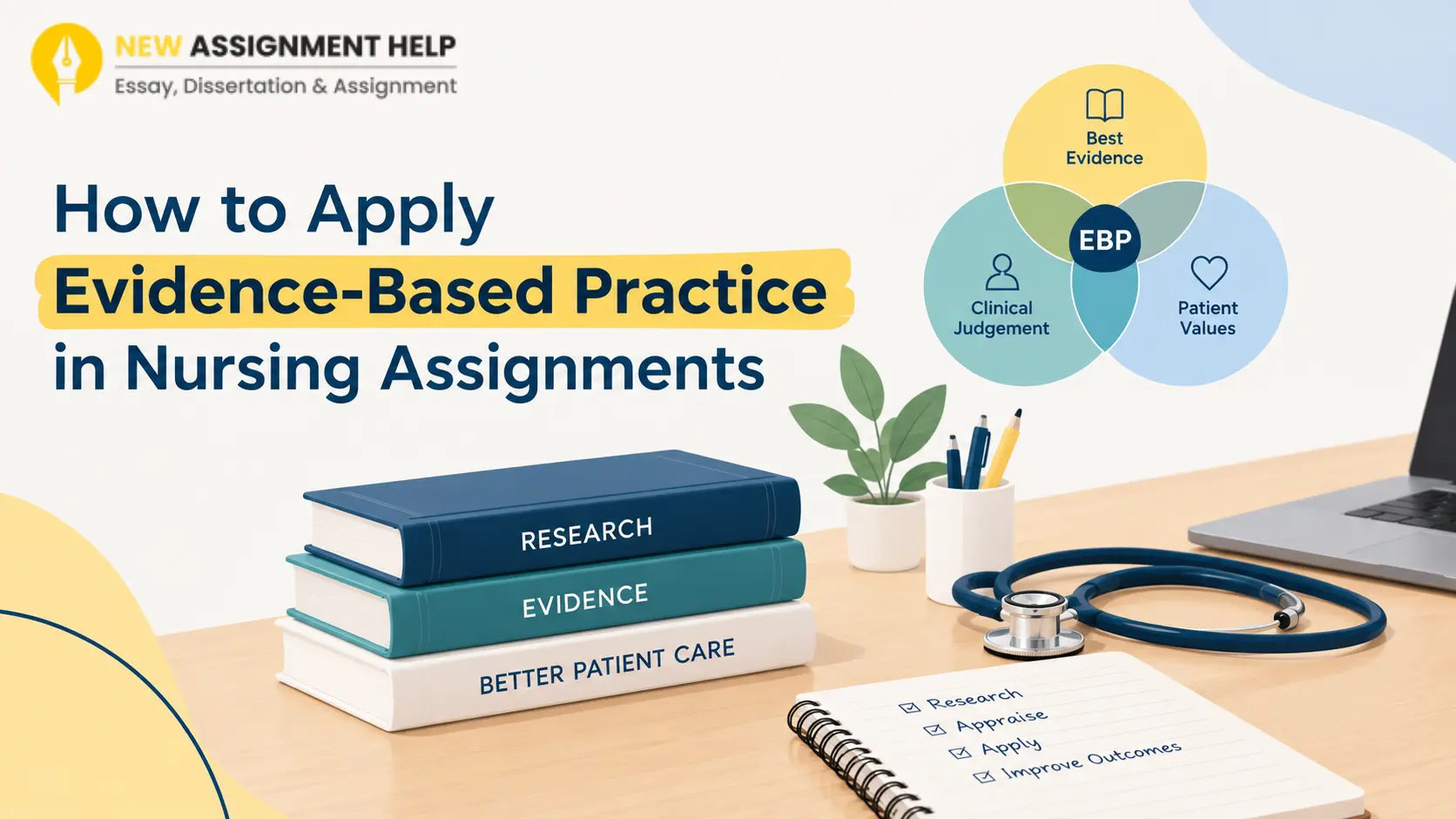
The first thing you must understand is the requirements. EBP brings together three things: best available research, your clinical judgement and the patient’s values. Markers check whether your answer reflects all three. A paragraph with only research can feel flat. Similarly, a paragraph with only opinion loses marks too.
Many Australian units also link EBP to the NMBA Registered Nurse Standards for Practice. Standard 1 covers thinking critically and analysing nursing practice. Keep that standard in mind as you plan. Once you know the target, build a clear question around it.
Build a Clear Clinical Question
The most important thing you must understand is that a vague topic leads to vague searching. As a fix, you can use the PICO framework to split your question into four parts:
- Population: the patient group, such as older adults in aged care
- Intervention: the action you want to test, such as a falls prevention programme
- Comparison: the alternative, such as standard care
- Outcome: the result you want to measure, such as fewer falls.
Together, these four parts turn a broad topic into a question you can search. For example: In older adults in aged care, do fall prevention programmes reduce falls compared with standard care? Each part here gives you a keyword for your database search. With keywords ready, the next job is finding sources you can trust.
Find Sources To Back Up Your Nursing Assignment
Start with your university library instead of a general search engine. CINAHL, PubMed and the Cochrane Library hold most nursing research. The Joanna Briggs Institute, based at the University of Adelaide, also publishes useful reviews you can use without hesitation. For local guidelines, check the NHMRC and the Australian Commission on Safety and Quality in Health Care. Most units prefer sources from the last five years, so check your unit guide. The table below shows a common ranking, from strongest to weakest.
| Evidence type | Strength | Typical use |
|---|---|---|
| Systematic review | Highest | Overall picture of a topic |
| Randomised controlled trial | High | Testing an intervention |
| Cohort or case-control study | Moderate | Links over time |
| Case report or expert opinion | Lower | Background or context |
Aim for sources near the top of this list but you still need a close look, which leads into appraisal.
Appraise Before You Use
This step is crucial, as your uni markers want to see that you questioned your practice for deeper analysis. Tools such as the CASP checklists and JBI critical appraisal tools give you a clear structure.
Ask a few simple questions as you read. Was the sample large enough? Could bias have shaped the results? Was the setting similar to Australian health care? Does the finding suit your patient group?
Write short notes on each question as you go. These notes become the critical analysis in your assignment. Now with your notes in hand, you are ready to write.
Weave Evidence Into Your Nursing Assignment Writing
Good EBP writing follows a steady pattern. Make a point, support it with evidence, then explain why it matters. For example: Early mobility lowers the risk of pressure injuries (Author, 2023). This suits patients with limited movement, so as a nurse, you must review mobility goals each shift.
Notice how the last sentence links research to practice. Paraphrase your sources instead of stacking long quotes. Compare two or three studies when they disagree. Add the patient’s preferences and your own clinical reasoning too. Lastly, check your unit guide for the referencing style, as many nursing schools use APA 7th. Even strong writing can slip, so watch for a few common errors before you submit your paper.
Common Mistakes to Avoid
These slips cost marks, so always check your draft against this list before you submit:
- Using outdated sources with no reason.
- Listing studies one by one with no comparison.
- Relying on websites with no named author.
- Skipping the link to patient care.
- Forgetting to cite guidelines you mention.
Fixing these five points can lift a draft quickly.
Final Thoughts
EBP gets easier when you follow the same steps each time. Ask a focused question, find strong sources, appraise them, and write with a clear link to patient care. Practise on a small task first, then scale up. If you want additional guidance on structure or referencing, online nursing assignment writing support can sit alongside your own study. Start your drafts early so you have enough time to proofread and ace your paper.