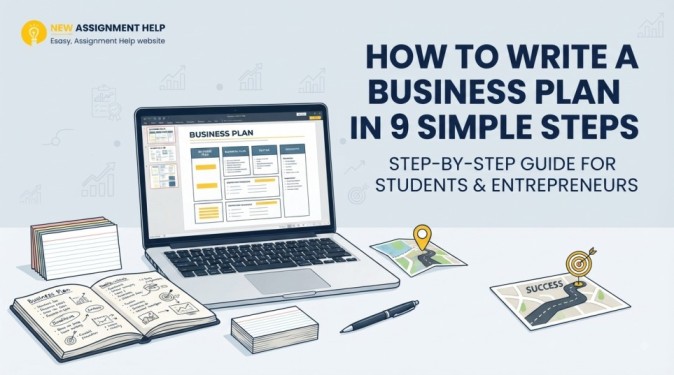
In order to write a business plan, one must explain what their business has to offer and how it profits the owner. The process usually involves executive summary, market analysis, marketing plan, and financial projections. Each part answers a different question, and together they form your full business planning roadmap.
Sounds like a lot, right? Don't worry, once you understand the structure, the whole thing gets far easier to follow. This guide breaks the process into clear steps, with real examples and a simple table you can save for later. Now, whether you're starting an actual business or writing one for a university assignment, here is how you approach it. If you're completing this as an assessment, our business plan assignment help can provide additional guidance on structure and requirements.
How to Write a Business Plan Step by Step
Here's the full process, broken into nine steps. Each one comes with an example and a format tip. You'll also get a note on what markers usually look for if this is for an assignment. Work through them in order because skipping may make your plan feel disjointed.
Write Down the Executive Summary
Although this is your very first part of the business plan, but it is recommended to be written at the end. Since this is the short overview of the whole plan, try framing it once your entire plan is done. So that you be focused on what your business does, who it serves, and why the idea holds up. Keep it tight almost around half a page.
Here's a rough example: "GreenLeaf Cafe will serve organic coffee and healthy snacks in Newcastle, NSW. We're aiming to reach students and young professionals who want quick, healthy food without the wait."
Lecturers tend to check whether your summary lines up with the rest of the plan. A vague or disconnected summary is one of the fastest ways to lose easy marks. Try to name your goal, your customer, and one solid reason the business will work, all in a few lines.
Describe Your Business
Now go a bit deeper. Cover your business name, structure, and location, plus what makes you different from the business down the street. If this is for a course, mention your structure type too. Sole trader, partnership, or company, whatever applies.
Example: "GreenLeaf Cafe is a sole trader business based in Newcastle. We focus on ethically sourced coffee and locally made food."
Two short paragraphs is usually all this section needs. Don't repeat what you already said in the executive summary. Markers want plain, direct language here. A one-line mission statement rounds this section off nicely, without padding it out. Think about what your business stands for, beyond just making money, and put that into a single honest sentence.
Conduct Market Analysis
This is where you research your industry, your customers, and your competitors. Who are you selling to, and why do they actually need what you're offering? Real data helps a lot here. The Australian Bureau of Statistics is a solid free source for demographic figures. Google Trends can also show you whether interest in your industry is rising or falling.
For example: "Newcastle has a growing number of young professionals. Local cafes in the area mostly lack healthy, quick lunch options."
Name two or three real competitors. Say what they're doing well and where your business can do it better. A SWOT analysis can also help you evaluate internal strengths and weaknesses alongside external opportunities and threats. Assessors reward analysis that's backed by sources, not guesswork dressed up as confidence. Can't find hard numbers for your exact niche? Look at the closest industry category instead, and note that it's an estimate. Want more practice with this kind of research? Our guide on How to Write a Case study explains how to structure research, analyse evidence and present your findings clearly.
Define Products or Services
List what you're actually selling, and spell out the benefit clearly. What makes it different from what's already out there? Bullet points work well if you've got more than one or two products. It's easier to skim, and skimming is exactly what a marketer does on their tenth plan of the day.
"GreenLeaf Cafe offers organic coffee, vegan pastries, and quick lunch options made fresh daily," is a decent starting point.
This section should connect directly back to your market analysis. If your target customer wants speed, say how your product delivers that. Naming your value proposition outright, in one clear sentence, does a lot of heavy lifting here.
Create a Marketing & Sales Plan
How will people actually find out you exist? Cover your channels, your pricing approach, and any promotions you're planning. If you're preparing this section for a university assessment, marketing plan assignment help can provide additional guidance on structuring your strategy. A simple budget table helps if your course asks for one. A focused plan reads as far more realistic than a scattered wish list. Think about where your customers actually spend their time. Local and online audiences respond to different things, and your plan should reflect that.
Example: "GreenLeaf Cafe will use Instagram, local flyers, and a loyalty card to build repeat customers."
Here the markers usually check whether your strategy actually fits the audience you described earlier. A mismatch here is one of the more common reasons marks slip. It's worth reading your marketing plan back against your market analysis section once you've written both. Make sure the two actually agree with each other.
Explain Management & Business Structure
This section answers, "Who's actually running this business day to day?" List the key roles here, even if it's just you wearing every hat. Assignment briefs often expect a level of formal structure that doesn't always match a small business reality. If you're stuck here, our business assignment help team can walk you through it properly.
A quick org chart or short list works if you've got a bigger team. Keep the staffing realistic for the size of the business you've described. A five-person management team for a single-owner cafe won't hold up under scrutiny.
You can write something like, "GreenLeaf Cafe will be run by the owner, with two part-time staff handling daily operations." That's enough detail for a small setup.
Create an Operational Plan
This part is all about the day-to-day stuff. Suppliers, equipment, location, and the actual processes that keep the business running. Therefore, stay practical here. Phrases like "efficient operations" mean nothing without detail behind them. What does efficient actually look like on a Tuesday morning is what your marker wants to see.
Example: "GreenLeaf Cafe will source coffee beans from a local roaster and operate from a leased shopfront in Newcastle."
A single sentence on quality control goes a long way too. It shows you've thought past the idea stage and into how the business actually functions. Suppliers, delivery times, and backup plans for when something goes wrong all belong here as well, even briefly.
Prepare Financial Projections
Show your expected costs, sales, and profit for the next one to three years. Students dealing with financial statements, costing or projections may also find accounting assignment help useful. A break-even estimate rounds this out nicely if you can manage it. Base your numbers on real research, even rough industry averages, rather than a figure that felt right at the time. A short cash flow forecast shows you understand timing as well as totals.
For example, "GreenLeaf Cafe expects $120,000 in sales in year one, with a break-even point by month eight." is the kind of specific figure markers like to see.
Tip: Simple tables or charts make financial data far easier to digest than paragraphs of numbers. Clear presentation matters across most university assessments. Our Business Report Writing Guide covers more on formatting figures for academic work.
Review & Finalise the Plan
Read the whole thing through before you submit it. Check spelling, formatting, and make sure nothing's missing. Referencing is another important aspect that matters more than students think. Harvard and APA are the two most common styles at Australian universities, so match whatever your course specifies. Our Australian Referencing Guide can also help you check the basic requirements before submission.
Messy formatting costs marks even when the content underneath is genuinely strong, which is a frustrating way to lose points. Get someone else to read it if you have the time. A classmate or tutor will catch things you've read past a dozen times without noticing.
That's the full process, start to finish. If you'd rather see it condensed, the table below covers the same ground in seven parts.
What are the 7 components of a business plan?
Some courses and templates use a simpler seven-part version to cover the same territory in fewer, broader sections, which suits a shorter assignment or an early draft. Use the table below as a quick reference or as a template to build from directly.
| Part | What it Covers |
|---|---|
| Executive Summary | A short overview of your business idea and goals |
| Company Description | What your business does, its structure, and its mission |
| Market Analysis | Your industry, target customers, and competitors |
| Organisation & Management | Who runs the business and how it's structured |
| Products or Services | What you're selling and how it benefits customers |
| Marketing & Sales | How you'll attract and keep customers |
| Financial Projections | Expected costs, revenue, and profit over time |
This doubles nicely as a business plan template you can adapt for your own idea. An online business assignment help service can look over your outline too. It's a solid way to get an expert opinion before you start writing properly. With the structure sorted, it's worth knowing where things tend to go wrong.
Common Mistakes to Avoid While Writing a Business Plan
Even a well-researched plan can lose marks over small, avoidable slip-ups. Here are the ones that come up again and again, along with a quick fix for each. Most of them take five minutes to correct once you know to look for them.
- Weak market analysis: The major issue arises when you start guessing your target audience instead of actually researching it. To get this right, pull in real sources like the ABS or an industry report to back your claims up.
- Ignoring the rubric: Even if you write a genuinely good business plan but miss the marking criteria, it won't get you marks. Therefore, check your draft against the brief before you submit and confirm that your business plan actually addresses each point on the rubric.
- Poor or inconsistent referencing: Missing citations or switching between styles halfway through is an easy way to drop marks. It's also simple to fix once you notice it. Pick one style, Harvard or APA usually, and stick with it from start to finish.
- Unrealistic financial projections: Big optimistic numbers with nothing behind them tend to undercut your credibility fast. So, always make sure that all your figures are based on some kind of research, even loose industry averages.
- Inconsistent formatting: Mismatched fonts, uneven headings, or sloppy spacing make a plan look rushed, even when it isn't. Set your formatting early on and keep it steady all the way through to the appendix.
- Skipping the review step: Plenty of students hand in their first draft without a proper read-through and eventually lose marks. A quick pass catches typos, gaps, and formatting slips before submission.
Sorting out these six alone can shift your grade more than another hour of extra research would.
Final Thoughts
Writing a business plan really comes down to structure and evidence. Follow the nine steps, or lean on the simplified seven-part table if your assignment calls for something shorter. Either way, work through it section by section. Check your draft against the common mistakes above before you hit submit. None of this needs to be perfect on the first go. Getting the structure right matters more than polishing every sentence. If you're short on time or want expert supervision, New Assignment Help Australia is here with its business experts.

 6 Years | MBA