Law assignments feel much more difficult than any other uni tasks as you're supposed to spot legal issues, apply rules, and back every claim with authority. That can seem like a lot for Australian students. However, the good news is that you can break it into small steps. This guide walks you through each one of how to write a law assignment so that by the end you have a concrete structure to work with.
Read the Law Assignment Question Closely
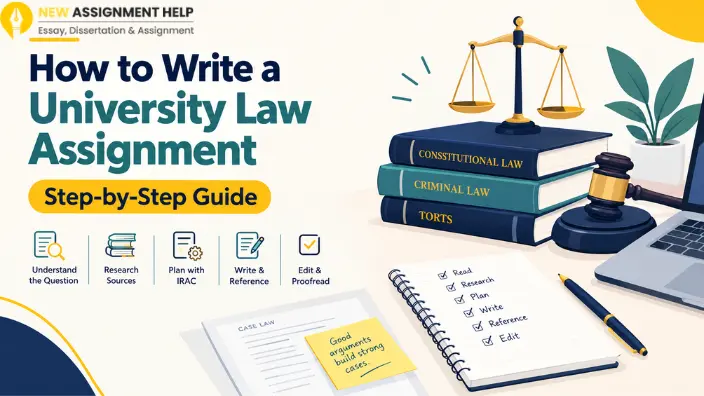
Before anything else, read your question twice and underline the task words, such as "advise", "discuss" or "critically evaluate". This tells you what kind of a framework is required to answer the question. A problem question wants you to advise a person, whereas an essay question wants you to build an argument.
Next, check the word limit, due date and marking rubric in your unit outline. Also note which jurisdiction applies. In Australia, the answer might sit in federal law, state law, or both. Once you know exactly what the question wants, you can start looking for sources.
Look for Primary and Secondary Sources For Your Law Paper
A good law paper is the one that is backed by enough credible sources. To get your sources, begin with your lecture notes and set readings. Then move on to primary sources, which are cases and legislation. AustLII is free and a good place to find these along with your library where you can access databases like Westlaw AU and LexisNexis.
After that, read secondary sources such as journal articles and textbooks. They show how courts and scholars view the law. Take notes as you read. Record the case name, court, year and key point. Do not forget to add the pinpoint paragraph or page number too. This small habit saves you hours during referencing.
With solid notes in hand, you are ready to build your outline.
Plan Your Answer With IRAC Method
Law units require you to analyse the problem question using the IRAC method. Here is how the four parts fit together:
- Issue: What legal question do the facts raise?
- Rule: Which statute or case sets out the law?
- Application: How does the rule apply to these facts?
- Conclusion: What is the likely outcome?
Repeat this pattern for every issue in the question, and since the application is where most marks sit, give it the most attention. Essay questions need a different plan altogether. Write down your thesis, your main arguments and the strongest counterargument. Basically, when you have a clear plan in front of you, the drafting stage gets much smoother.
Make the First Draft of Your Law Assignment
Open with a short introduction. Name the main issues and say how you will cover them. Then give each issue its own section. Start each paragraph with a clear topic sentence. This lets your marker follow your thinking at a glance.
Use plain English because long and tangled sentences don't help. You need something that makes your work skimmable. When you cite a case, say what it decided and why it matters to your facts. Avoid long direct quotes. A short paraphrase shows you understand the point.
Look at the other side too. If a court could reasonably decide the opposite way, say so and explain why. That kind of balance often separates a credit from a distinction. Close with a brief conclusion that answers the question directly. Once the draft is ready, you need to get your citations right.
Reference With AGLC
Most Australian law schools use the Australian Guide to Legal Citation 4th edition, known as AGLC4, for referencing. It uses footnotes instead of in-text brackets. A case citation looks like this: Mabo v Queensland (No 2) (1992) 175 CLR 1.
Add pinpoint references so your marker can find the exact passage. Many units also ask for a bibliography at the end. Check your unit guide, because rules vary between schools. Build your footnotes as you write to avoid piling it up till the end. After referencing, you still have one more job to do.
Edit and Proofread
Leave at least a day between finishing and editing because that is needed for a final check and it goes without saying that fresh eyes catch more mistakes. Read your work out loud to catch clumsy sentences that your eyes may have skipped. Then run through this short checklist:
- Does every paragraph answer the question?
- Is each rule backed by a case or section of an Act?
- Are all citations in correct AGLC format?
- Is the word count within the allowed range?
If you can tick every box, your assignment is in good shape. If not, fix the gaps before you submit.
Final Thoughts
Writing a law assignment gets easier once you follow a repeatable process. Read the question, research well, plan with IRAC, draft clearly, reference carefully and edit. Practise these steps on each task and they’ll start feeling natural. If you ever want a second opinion on structure or citations, law writing support from a qualified tutor can offer useful direction. A final tip is: start early, stay organised and give yourself time to polish the final version.