If you’re an Australian uni student, you probably know the struggle of losing an entire day just in search of a good law topic to write about. It isn’t just you. Most students get stuck when it comes to choosing the right topic because it must have a clear case, solid legislation and a real argument to work on. If you’re on the internet searching for such a topic, then your search ends here. In this blog, you’ll get lists of ideas categorised by their area of law. Each one links to a live debate in Australia. Also know that law changes fast in this nation, so always check the current status of any Act or case before you commit. Pick the area that suits your unit, then scan the ideas below. Once a topic appeals to you, you’ll learn to turn it into an assignment by the end of this article.
List of Law Assignment Topics by Category
Here are seven common law areas with three topic ideas each. Adjust the wording to match your unit outline and word limit and you’re all set to take your first step towards academic success.
Constitutional and Administrative Law
First up is this area that suits students who enjoy big questions about power and rights. This could be a good choice as it also has plenty of High Court material to make your work easy.
- The implied freedom of political communication, from Lange v ABC to Brown v Tasmania
- Judicial review of government decisions after the Robodebt Royal Commission
- The 2023 Voice referendum and how Australia changes its Constitution
Contract and Consumer Law
These topics work well because statute and case law meet in the same place. You can compare common law rules with the Australian Consumer Law and you have your outline ready.
- Unfair contract term rules and the stronger penalties introduced in 2023
- Online terms and conditions and whether users truly agree to them
- Penalty clauses and liquidated damages in commercial contracts
Tort Law
Tort topics often test how courts balance fairness and limits on liability. Civil liability Acts differ by state, so name your jurisdiction clearly.
- Duty of care in climate change cases, including the Sharma litigation
- Mental harm claims and the statutory limits on recovery
- Defamation reforms and liability for social media posts after Fairfax v Voller
Criminal Law
Criminal law topics are rich in policy debate and students who like weighing evidence on both sides happen to enjoy working on these.
- Mandatory sentencing and its effect on young offenders
- Coercive control offences now introduced in several states
- The ongoing debate over raising the age of criminal responsibility
Employment and Business Law
These ideas connect legal rules to everyday work and company life. When you opt for these topics, recent reforms will give you fresh material to discuss.
- Rights of gig workers under the employee-like worker reforms of 2024
- Directors’ duties under the Corporations Act 2001 (Cth) after major corporate failures
- The positive duty on employers to prevent workplace sexual harassment
Technology and Intellectual Property Law
Technology moves faster than legislation and that gap is exactly what makes these topics ideal for critical analysis. The topics you can pick under this head are:
- Who owns copyright in work made by artificial intelligence under the Copyright Act 1968 (Cth)
- Privacy Act reform after the Optus and Medibank data breaches
- Criminal laws on sexually explicit deepfakes
Human Rights and Indigenous Law
These topics ask you to look at law through history and fairness. They often reward careful use of case law and international sources.
- Native title and land rights since Mabo v Queensland (No 2)
- Legal protections for asylum seekers under the Migration Act 1958 (Cth)
- Human rights charters in Victoria, Queensland and the ACT
Coming to the end of this list, know that every idea above is just the starting point. Pick any one of these and shape it into a real assignment. The next section shows you how.
How to Turn a Law Topic Into an Assignment
Start by turning your topic into a question. Let’s take an example of “Mandatory sentencing”. Now, if you turn that two-word topic into a question like, “Does mandatory sentencing suit young offenders in Australia?”, it becomes much easier to argue. A clear question keeps your essay focused from the first paragraph.
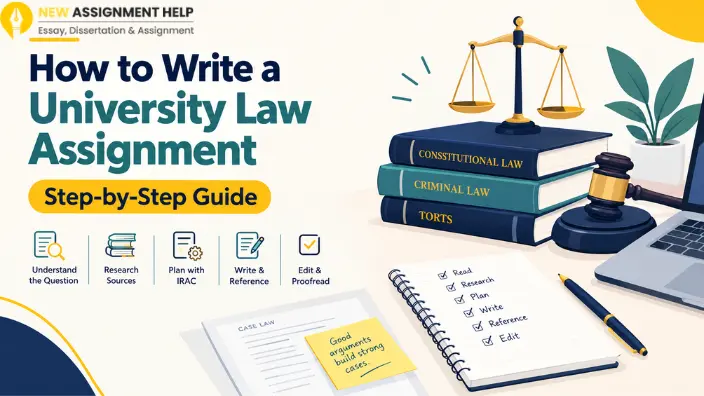
Next, gather your sources in the right order. Begin with primary sources, which means legislation and cases. Then add secondary sources such as journal articles and law reform reports. AustLII and your library database are good places to start. Markers value strong primary authority over general commentary.
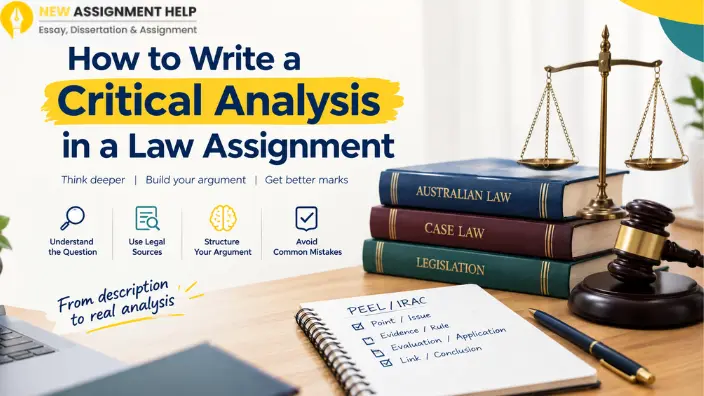
Then write a short plan. Set out your position in one sentence and list the main points that support it. Add one counterargument and your reply to it. For problem questions, a framework like IRAC (issue, rule, application, conclusion) keeps your reasoning tidy.
Finally, check the rules. Read your marking guide and the unit outline closely. Confirm your citation style too. Most Australian law schools use AGLC 4, the Australian Guide to Legal Citation, so check which edition your school expects. With the plan in place, drafting gets much easier.
Conclusion
Choosing a law topic gets simpler when you work by category. Pick the area that interests you the most and start your work as told above. Narrow it to one clear question. Check that enough cases, legislation and articles exist around it to support your assignment. Then build a simple plan before you write. If turning your topic into an assignment feels like too much for you, then know that a little extra guidance like law assignment writing support can be your best shot. It fits your own research and planning and makes every later step feel lighter.