Law lecturers often write “too descriptive” on student papers. It has become one of the most common comments in Australian law schools because many students lack this skill. In simple terms, a critical analysis asks you to judge the law but most students only write about it without their input. This blog here is going to teach you what your markers expect when it comes to critical analysis in a law assignment. You’ll also learn a simple approach to build your argument the way they expect and areas that often cost you marks.
What Critical Analysis Means in Law Units
Critical analysis means you question the law instead of only stating it. In simpler terms, you look at a case, a statute, or a rule and ask if it works, if it is fair, clear, and consistent with other decisions.
To do that in practice, you’re required to judge a High Court ruling, test a reform proposal and apply a rule to a set of facts and weigh both sides. This is important because markers want your own reasoned view, and that view must rest on evidence. Once you know the task, a clear process makes it easier to deliver. So let’s learn that.
A Simple Process for Critical Analysis to Follow
If you’re looking for the easiest flow, these six steps suit most law essays and case notes at Australian universities. Each one is built on the last, so move one by one and do not skip.
- Read the question closely and spot the task word, such as “evaluate” or “critically discuss”. Also, note the area of law.
- Find the key issue and pick the one or two points that need real debate.
- Research is very important because law is all about facts. So start with cases and legislation or use AustLII to find Australian material.
- Now it’s time to state your position. Write one sentence that sums up your argument and shows your claim.
- Analysis is incomplete without comparison. Therefore, weigh both sides and show the strongest opposing view. Then explain why yours holds up.
- Do not forget to reference. The widely used referencing style in Australian universities is AGLC4, yet it is always better to check your specific unit guide. This one step brings credibility to your work.
When you follow the above steps for your critical analysis, your work stays focused and on track. Now let us look at the sources that can give your argument weight.
Use Legal Sources to Back Your Claim
Strong analysis rests on good authority. Therefore, it is recommended to always use primary law first, such as High Court decisions and statutes. Then add secondary sources, such as journal articles and Australian Law Reform Commission reports. These secondary sources show how experts see the law. Compare their views with your own and if two writers disagree, explain “why”. That comparison is where many marks come from.
Try paraphrasing more than you quote. A short quote works best when the exact wording matters, such as stating a law or a court decision. With your sources ready, you can see a transformation of your writing from description to real analysis. Below is a table of differences using a real Australian case for you to evaluate whether your writing is heading in the right direction.
From Descriptive to Critical Writing
The table below shows how a plain sentence can become an analytical one. Use it as a quick guide when you edit your own draft.
| Descriptive | Critical |
|---|---|
| The court held that a doctor must warn of material risks. | The duty to warn in Rogers v Whitaker gives patients more control, yet the “material risk” test leaves room for doubt. |
| The Act sets a time limit for claims. | The time limit gives certainty to defendants, but it may shut out genuine claims. |
| Scholars disagree on this rule. | One scholar calls the rule outdated. Another offers stronger evidence that it still works. |
The right column adds judgement where each line gives a reason and tests it. With this shift in mind, you can now begin writing and shaping your paragraphs.
Structure Your Legal Paragraphs
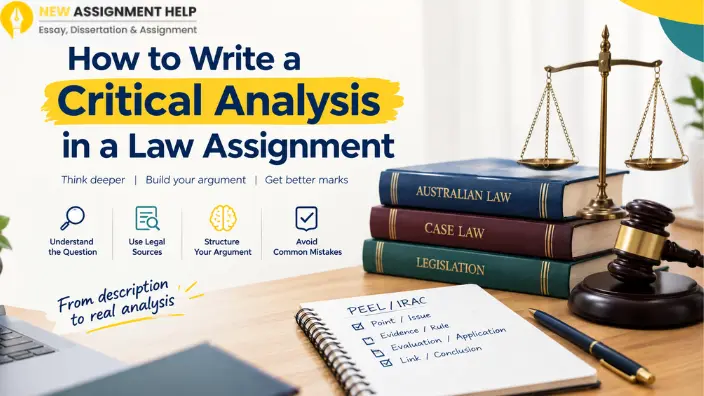
A simple layout for any legal analysis is PEEL: point, evidence, evaluation, link. For problem questions, IRAC works well, i.e. issue, rule, application, and conclusion.
Give the most space to evaluation or application. In a case note, keep the facts short and spend your words on analysis. Open each paragraph with a clear claim. Close it by linking back to your main argument. These short topic sentences will guide your marker well. Even with good structure, a few common slips can still creep in.
Common Mistakes to Avoid
Many students lose marks for the same few reasons.
- They retell the facts at length.
- They quote judges without comment.
- They ignore opposing views.
- They use vague words like “unfair” with no reason attached.
If you’ve been making the same mistakes, fix these by asking “so what?” after every point. If you cannot answer, add reasoning or cut the line. Run this check on your final read-through to avoid losing easy marks.
Conclusion
Critical analysis is a skill you must build with practice. Read the question, form a view, and test it against the other side. Then back it up with authority. If you want a second opinion on structure or argument, online law support can give you a fresh view on your draft. If you only follow the above structure, you’re good to go.