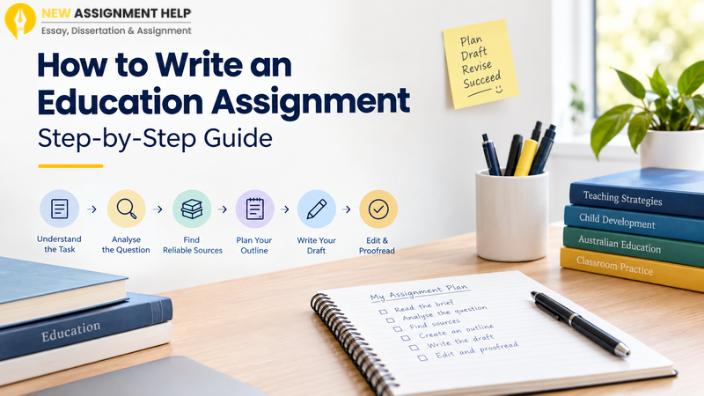
Finance assignments in Australian universities ask you to do two jobs at once. You work out the numbers, then you explain what they mean. Many students mostly find the second job harder than the first one. Tight deadlines and strict marking rubrics add to the pressure. A clear process takes much of that stress away. Here we have a step-by-step guide to writing a finance assignment from reading the brief to the final checks. This 6-step process suits the most Australian university finance units. Now let’s start with the step that sets up everything else.
Step 1: Read the Brief and the Rubric
Always start by opening your unit outline on Moodle or Canvas. Then look for the task sheet and the marking rubric. Note the word limit, the due date and the referencing style. Most Australian universities use APA 7th or Harvard. Check what is yours.
Highlight the command words, such as evaluate, calculate, compare or recommend. Because each one asks for a different kind of answer. Like ‘evaluate’ needs judgement, while ‘calculate’ needs clear working. After that, check how many marks each part carries. A section worth 30 per cent deserves about 30 per cent of your effort. Once you know what the marker wants, you can sort the task by type.
Step 2: Spot the Question Type
Most finance tasks fall into three groups. Calculation tasks cover things like NPV, WACC, bond pricing and the time value of money. Analysis tasks ask you to read financial statements or ratios. Report tasks ask for a recommendation to a fictional board or client.
Well, there are also a few assignments that mix all three. So, label each part of your brief with its type. Then you know when to open Excel and when to open a blank page. With that sorted, you can go and find your sources.
Step 3: Gather Reliable Sources
If you collect strong sources, you can make your arguments stronger. Weak ones cost marks fast. The table below shows where to look for each kind of information.
| Source | Best used for |
|---|---|
| ASX company annual reports | Real financial statements and ratios |
| RBA and ABS websites | Interest rates, inflation and economic data |
| Library journal databases | Theories and models, such as CAPM |
| Your unit textbook | Formulas and key definitions |
| AASB and ASIC pages | Reporting standards and regulation |
Try to use at least two of these in each major section. That shows the marker you looked at more than one view. Now you have the material to build a plan.
Step 4: Build a Simple Outline
Many students either try to start directly or keep staring at the blank screen. To avoid that, always design an outline; it will help your assignment flow better and stay logical.
Here is a layout that works for most finance reports:
- Introduction: state the purpose and your main finding.
- Assumptions: list your inputs, such as the discount rate or growth rate.
- Analysis: show your calculations and explain them.
- Discussion: link your results to theory.
- Recommendation: give a clear answer to the question.
- Reference list: include every source you cited.
With this layout, you always know what actually comes next. And now you can start drafting with confidence.
Step 5: Write the First Draft
Start with the section you feel most sure about. Momentum matters more than order at this stage. Show every step of your working. Markers often give method marks even when the final number is off.
Explain each result in one or two plain sentences. For example, say what a negative NPV means for the business. Add a chart only when it makes a point clearer. Keep your sentences short and define any jargon once.
Don't get stuck on polishing the draft until you have completed it. Once the complete draft exists, you can start to improve it.
Step 6: Check, Edit and Reference
Take a break after drafting. Even a few hours changes how you read your own work. Recheck every figure. Confirm that your Excel formulas point to the right cells. Keep units and rounding the same throughout.
Next, read the text aloud. This catches clumsy lines fast. Match each in-text citation to your reference list. And, if your university offers any similarity checker or demands it, run it and fix any weak paraphrasing. Finally, compare your work against the rubric one more time.
Additional Advice
Most students draft the intro at the beginning and never touch it again. That makes them lose grades unnecessarily. Better write it in the end so you can mention the additional updates made while writing the body content. It will make the beginning of your assignment accurate, well-informed and confident.
Final Thoughts
To make finance assignment preparation easier, split them into steps. Read the brief, spot the question type, gather sources, plan, draft and check. Also start early so the last step gets enough time.
Before submitting, you can also consider professional finance assignment support for feedback. They will help you align the weak areas, structure and format the content according to the Australian marking rubrics. Don’t rush, follow each step properly and cross-check all the sources before final submission.