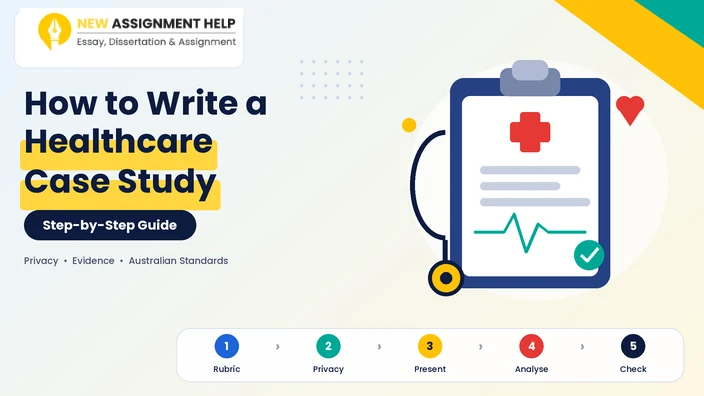
Clinical knowledge alone will not earn a high grade on a healthcare case study. As Australian universities mark these assignments against professional standards, privacy rules and critical analysis and referencing. So a strong patient story can still score poorly. To earn good marks, students have to complete the assessment structurally while demonstrating strong reasoning and evidence-led decision-making. This guide helps students cover five steps: reading the rubric, protecting privacy, presenting the case, analysing it with Australian evidence, and checking your draft. Follow them in order, and your case study reads as clinical reasoning, not a list of facts.
Students who need additional academic guidance can explore our healthcare assignments resources for support with healthcare-related assessments.
Step 1: Read the Brief and Match It to Your Professional Standards
Every strong case study starts with the marking rubric, not the patient. Australian healthcare schools, including those at Monash, UTS, Griffith and the University of Sydney, usually tie assessments to professional standards. Nursing units often map to the NMBA Registered Nurse Standards for Practice, while physiotherapy, paramedicine and occupational therapy units use the standards of their own boards. Find out which standard your unit lists, because markers look for evidence that you met it.
Next, note the word limit, referencing style and case source. Nursing units commonly use APA 7th, while some medicine and health science units prefer AMA or Vancouver. For additional guidance on academic citations, students can review different Australian referencing styles and their formatting requirements. If the case comes from placement, you need approval under your university’s policy before using it. Then note how marks are split between description and critical analysis, since most rubrics weight analysis heavily.
Step 2: Protect Patient Privacy Before You Write Anything
Privacy is the first thing Australian markers check, and the easiest place to lose marks. Australian privacy law, including the Privacy Act 1988 and state health records laws, applies to patient information. So, remove the name, date of birth, address, hospital, ward and treating staff. Use a pseudonym or “the patient”, and give age as a range if the exact number could identify them. Rare conditions or unusual events can also identify a person, so describe them in general terms. Add one sentence in your introduction confirming that details were de-identified. A breach can lead to academic penalties or a professional conduct process.
Once the patient is protected, you can build the case itself.
Step 3: Present the Case Using a Recognised Clinical Framework
A clear presentation gives your analysis something solid to stand on. That’s why keep the presentation to relevant facts only. A marker does not need every vital sign, just the findings that shaped your decisions. Cover these areas in order:
- Presenting problem → Why the patient sought care, and what the first assessment showed.
- Relevant history → Conditions, medications, allergies and recent results that affect care.
- Social context → Living situation, rural or remote access, cultural background, language and family support.
- Cultural safety → For Aboriginal and Torres Strait Islander patients, show how culture and kinship shaped the care plan.
Then start organising your reasoning with a framework. The Clinical Reasoning Cycle by Levett-Jones, developed in Australia, is widely taught because it moves from cues to problems, goals, actions and evaluation. ISBAR suits case presentations framed as a clinical handover, and ADPIE suits nursing care plans. Check which one your unit prefers.
With the case laid out, the real marks come from the analysis. Understanding how to organise evidence, evaluate information and develop a clear argument is also important when preparing a case study assignment.
Step 4: Analyse the Case With Australian Evidence and Guidelines
Analysis is where distinction and high distinction grades are won. So properly link the condition to your patient. For the diabetic foot ulcer, explain how poor circulation and a raised HbA1c slow healing, then tie it to this patient’s wound findings.
Support each intervention with current Australian sources, such as clinical practice guidelines approved by the NHMRC, therapeutic guidelines, and condition bodies like Diabetes Australia. Use AIHW data for prevalence, and link care to the National Safety and Quality Health Service Standards. Prefer peer-reviewed research from the last five to seven years.
Compare the options and mention limits too. If your evidence comes from a metropolitan hospital, say whether it works in a remote clinic. A Pass essay describes what the clinician did. A distinction essay explains why that choice beat another and what ethical issues, such as consent or capacity, shaped it.
Once the analysis is strong, the final steps are about structure and polish.
Step 5: Structure, Reference and Check Your Draft Before Submitting
A sound plan keeps a 2,000-word case study balanced. As a guide, use about 150 words for the introduction, 400 for the case presentation, 850 for analysis, 400 for the care plan and 200 for the conclusion. Before you submit, check these points:
- Privacy: No identifying detail remains anywhere, including the reference list.
- Rubric: Each criterion has a clear paragraph that answers it.
- Referencing: Every claim has a citation in your unit’s style, and every citation appears in the list.
- Originality: Run the similarity report and follow your university’s rules on generative AI use.
Read the draft aloud once. If a sentence needs two breaths, split it. A case study that is clear and evidence-led shows the marker you can think like a clinician, which is what the course is training you to do.
If you get stuck somewhere or feel like losing the case study, better ask for help than lose marks. Healthcare case study supporters will review your situation and assist you according to your requirements. So you can submit a structured and confident assessment on time.

 8 Years | MSc Nursing / BSc (Hons) Adult Nursing]
.webp)