Most Australian students struggle because they do not know that law assignments follow a set shape. But once you know it, planning gets much easier. Australian law units usually use the same core parts, even when the task type looks different. If you’re looking for a guide that covers the format, the sections and shows you worked examples in easy language, you’re at the right place. In here, you’ll see how problem questions and essays differ and how to present them clearly for your marker.
Australian Law Assignment Format
Your format depends on the task type. Therefore, checking your unit guide before planning anything is a must. Let’s discuss the three most common types you might encounter in your course.
- Problem question: You read a fact scenario and advise one or more parties.
- Essay: You argue a view on a legal rule, case or reform.
- Case note or memo: You summarise a decision or give formal advice.
Each type has a different goal. A problem question applies the law, an essay argues a view, and a case note explains a ruling. Picking the right type early keeps your plan on track.
Coming to the formatting rules, run through the given list before you start writing:
- Use AGLC4, the Australian Guide to Legal Citation (edition 4), for all sources.
- Add a footnote for every case, statute and article.
- Italicise case names and keep citations consistent.
- Match font, spacing and word count to the unit rules.
- Use headings only if your guide allows them.
These small items can cost marks fast. So always check them again at the end, as they only take a few minutes to fix but can save you marks easily. With the format settled, you can plan the sections next.
Sections to Include in Your Law Assignment
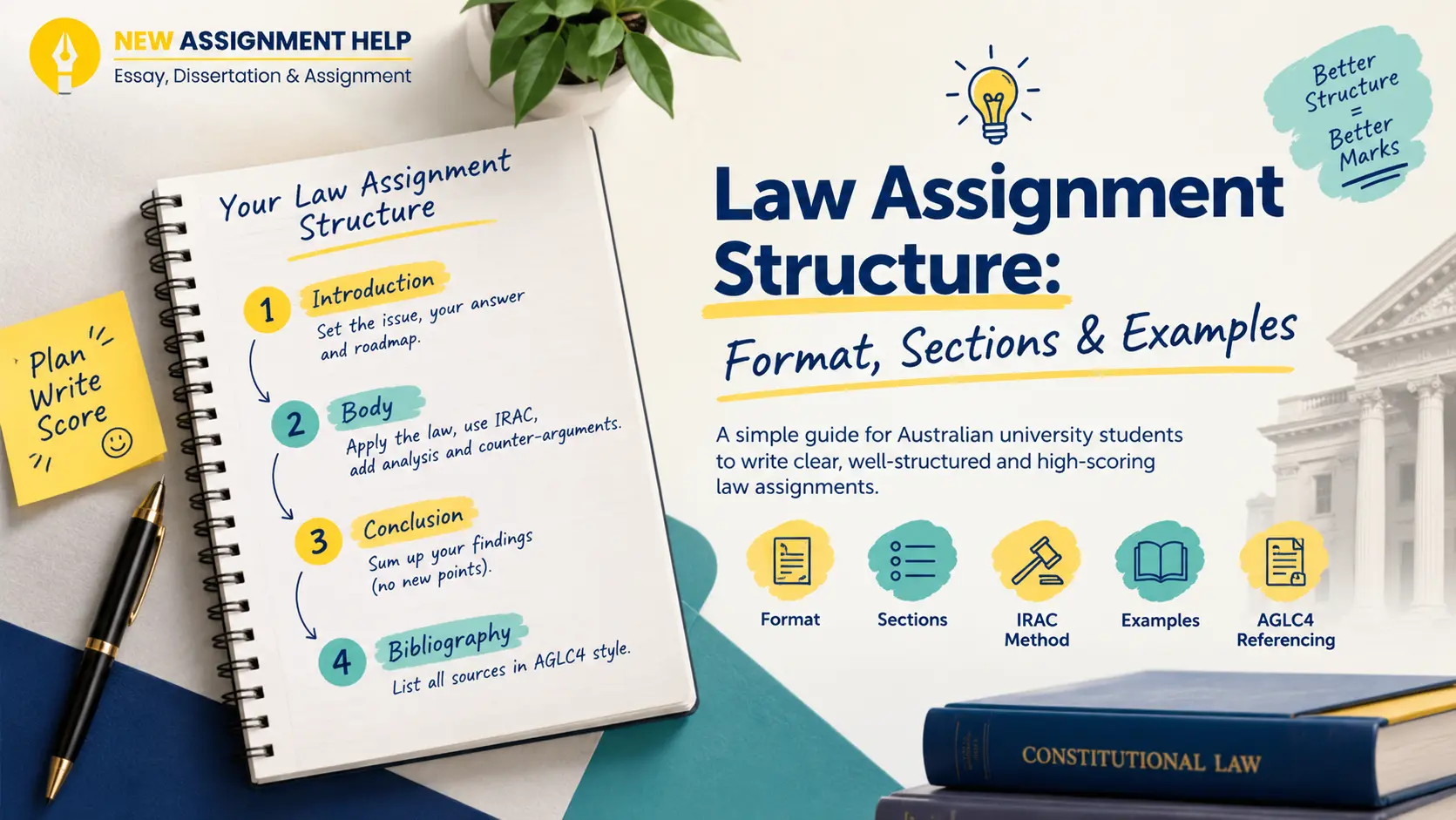
Most law assignments use three main parts plus a reference list. The table below shows what each part does and its usual length in a 2,000 word task.
| Section | Purpose | Approx Words |
|---|---|---|
| Introduction | State the issue, your answer and your roadmap | 150 to 200 |
| Body | Apply the law or build the argument | 1,500 to 1,600 |
| Conclusion | Sum up your findings with no new points | 150 to 200 |
| Bibliography | List every source in AGLC4 style | Often outside the count |
If we talk about each section in detail, you’ll get a better idea.
The introduction tells the marker where you are going. Name the legal issue, give your short answer and outline your steps. Most importantly, keep it direct.
The body carries most of the marks. In a problem question, each issue gets its own block using IRAC. In an essay, each paragraph supports your thesis with law, cases or academic views. Add one paragraph that tests the other side. Then explain why your view still holds.
The conclusion confirms what you found. Restate your answer in new words without bringing in fresh points or new cases.
The bibliography sorts your sources into the AGLC4 groups, such as articles, cases and legislation to give the credit where it is due.
Many students lose marks before they reach the analysis. Some skip the roadmap while others describe facts without applying the law. Reading your draft aloud catches most of these slips. Now let’s see how these sections look in practice.
Structured Examples of Law Assignment Writing
The three samples below show how each part reads on the page. Each one is kept short, so you can adapt it to your own topic.
Sample introduction (problem question)
“This answer advises Mia on whether a binding contract exists with Tom. It looks at offer, acceptance and consideration in turn. It concludes that a contract likely formed.”
This works because it names the task, lists the steps and gives the answer in three sentences without wandering around.
Sample IRAC block
- Issue: Did Mia make a valid offer to Tom?
- Rule: An offer shows a clear intent to be bound, as in Carlill v Carbolic Smoke Ball Co [1893] 1 QB 256.
- Application: Mia’s message named a price and a date. This shows she meant to sell.
- Conclusion: Mia likely made a valid offer.
In a real answer, each step gets its own paragraph. The Application step earns the most marks, so give it the most space. Compare your facts to cases and explain any differences.
Sample essay paragraph
“Current protections leave real gaps. The Constitution guards only a few rights, such as jury trial under s 80. This short list means many rights depend on ordinary statutes, which Parliament can change. A federal charter would close this gap.”
This paragraph follows a simple pattern. It opens with a claim, adds evidence, explains the point and links back to the thesis. This is exactly how your law assignment should look.
Conclusion
A strong law assignment starts with the right format, uses clear sections and shows its reasoning through examples. Plan the structure first, then write each part in the order given above. Check AGLC4 at the end and make a bibliography without fail. If you want a second pair of eyes on an outline or draft, law writing support can offer some useful guidance.