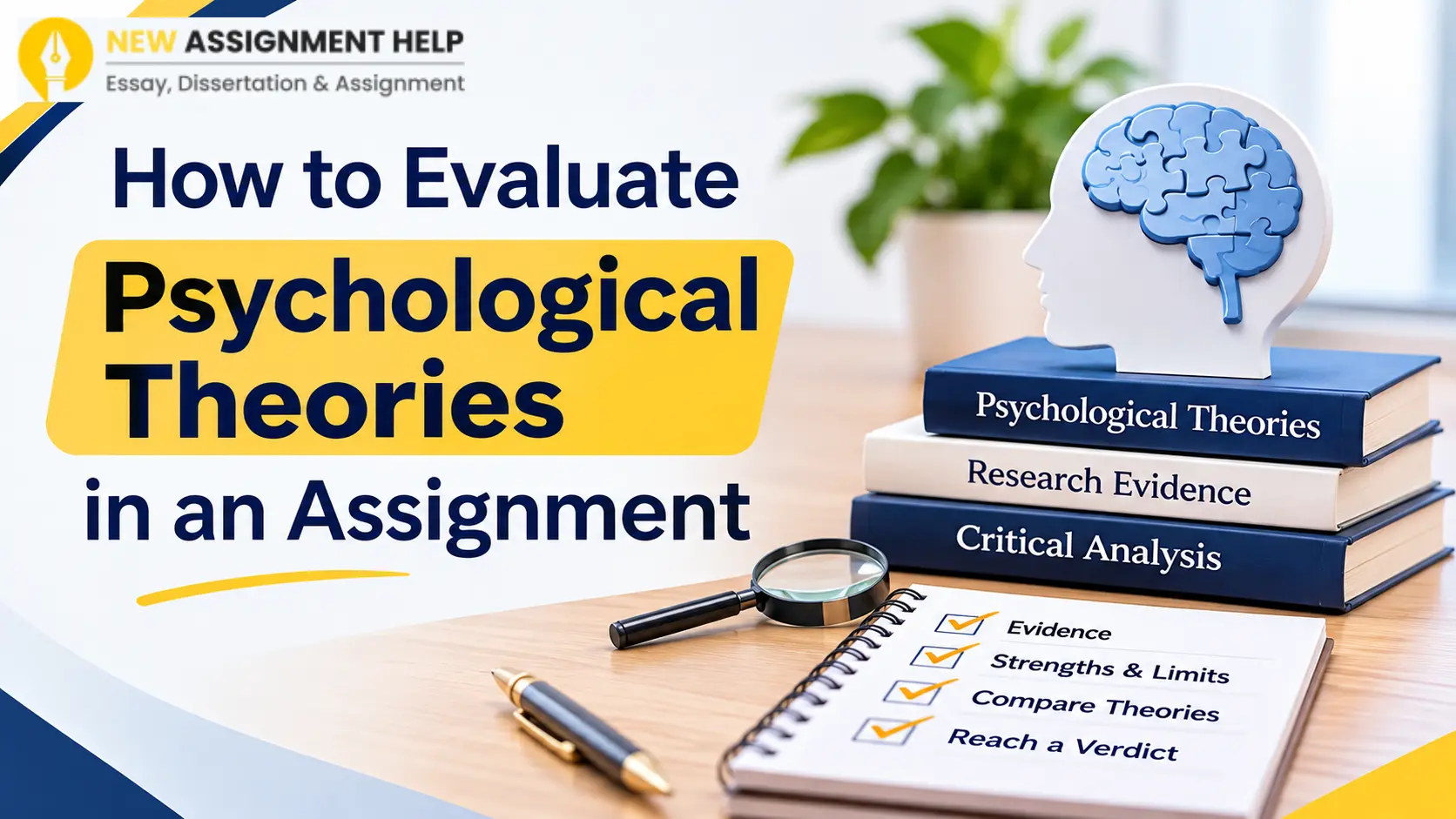
A student writes 1,100 words on Beck’s cognitive theory and gets the comment “too descriptive”. Every sentence explained the theory, but none tested it. That gap directly costs marks in most Australian psychology units, because evaluation separates a Credit from a Distinction. Evaluating a psychological theory means testing its claims against research evidence and judging how far they hold. Here our guide to evaluating psychological theories in an assignment shows you five tests that work on any theory. With that, a worked paragraph marked against Australian grade bands.
What Australian Markers Mean When They Ask You to Evaluate
Before starting, you should know how the rubric defines the word. Australian psychology rubrics usually list critical analysis as its own criterion, often worth a quarter to a third of the marks. Grade bands run from High Distinction (85 to 100) down to Pass (50 to 64). The table shows how evaluation changes across them.
| Band | What your evaluation looks like |
|---|---|
| Pass | Describes the theory and mentions one or two criticisms. |
| Credit | Backs each criticism with a named study. |
| Distinction | Weighs strengths against limits and compares a rival theory. |
| High Distinction | Reaches a clear, evidence-based verdict and states what it means for research or practice. |
For an evaluation question, aim for about 30% explanation and 70% judgement. A 2,000-word essay on Beck, for example, needs roughly 400 words on the theory and 1,400 on testing it, leaving 200 for the conclusion. Opinion without a cited study earns little credit.
That split only works if your judgement follows a consistent method, so use these five tests.
Five Tests You Can Apply to Any Psychological Theory
Each test maps to what markers look for under critical analysis.
| Test | Question to ask | Example you can use |
|---|---|---|
| Empirical support | Do replicated studies back the core claims? | Dual-task experiments support Baddeley and Hitch’s (1974) working memory model. |
| Testability | Can the theory be proven wrong? | Psychoanalytic ideas such as repression are hard to falsify. |
| Scope | Does it explain many behaviours or only one setting? | Skinner’s operant conditioning explains habits but struggles with language learning. |
| Sample and culture | Who was studied, and does it fit Australian populations? | Most classic studies used Western university students (Henrich et al., 2010). |
| Practical value | Has it shaped effective treatment or policy? | Beck’s model underpins CBT, which is widely used in Australian mental health services. |
The fourth test carries extra weight in Australia. Accredited programmes are expected to teach Aboriginal and Torres Strait Islander perspectives, so markers notice when you use them. In a depression essay, you could contrast Beck’s individual-focused model with the social and emotional wellbeing framework (Gee et al., 2014), which links wellbeing to family, community, culture and country.
Well, knowing the test is one skill. And writing them up is another, so here is a paragraph shape you can actually copy.
How to Write One Evaluation Paragraph With a Clear Verdict
Every evaluation paragraph needs the same four moves.
- Claim → State one strength or weakness in your first sentence.
- Evidence → Cite a named study with its year and what it found.
- Limit → Explain what that evidence cannot show.
- Verdict → Say what this means for the theory overall.
If you want to understand the complete writing process, explore our guide on how to write a psychology assignment step by step, covering everything from planning to final submission.
Here is the formula applied to a working memory assignment:
Baddeley and Hitch’s (1974) working memory model is well supported, because dual-task studies show that a verbal and a visual task interfere less than two verbal tasks. However, the central executive remains vaguely defined, and Baddeley (2000) later added an episodic buffer to explain findings the original model could not. Cowan’s (1999) embedded-processes model offers a simpler alternative. Overall, the model explains short-term storage well but remains incomplete as an account of attention.
The order is claim, study, limit, and verdict. This is a high distinction paragraph, and it ends with a judgement, never a summary. However, remember one thing: even well-built paragraphs lose marks when they fall into the habit below.
Five Mistakes That Keep Essays Stuck at Credit Level
These are the pattern markers most often circled.
- Criticism without evidence: Calling a theory “reductionist” with no study or source behind the claim.
- Retelling under a new heading: Repeating the theory in a section titled “Evaluation”.
- Treatment as proof: Writing “CBT works, so Beck is right”. Effective treatment does not prove the cause of a disorder.
- One-sided writing: Listing only weaknesses, which reads as opinion instead of evaluation.
- No verdict: Ending with a summary when the question asked for a judgement.
Fixing these takes minutes, so finish with one final check.
Final Checks Before You Submit Your Evaluation Essay
Run this list after you complete your draft or when you’re ready to submit the draft.
- Rubric → Match each paragraph to the critical analysis criterion in your unit outline.
- Evidence → Confirm every strength or weakness has a cited study.
- Sources → Include recent research alongside classic studies, since markers expect current work.
- Verdict → Check that your conclusion states a judgement and does not simply summarise.
- Word split → Confirm you are close to 30% explanation and 70% evaluation.
- Referencing → Verify APA 7th in-text citations against your reference list, and follow your unit’s generative AI rules.
If you feel stuck on any level or feel like you need professional guidance, call out psychology assignment support for help. They will help you understand the problem and help you fix it according to your rubric's requirements. This will help you submit your assignment on time with complete confidence.

 8 Years | MBA (Marketing & HR)


.webp)