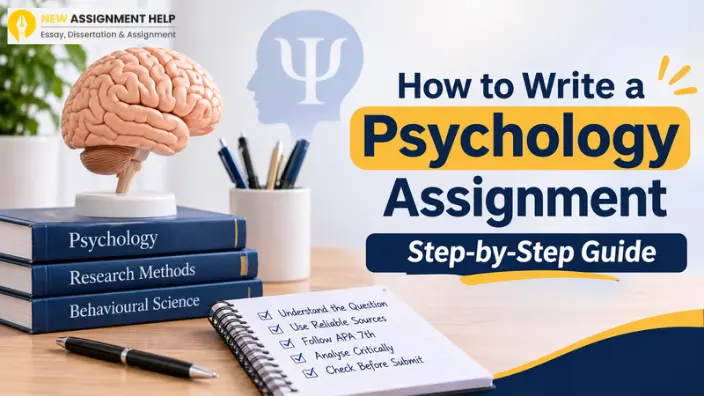
A first-year student submits a 1500-word memory essay and six sources and only receives 58%. A second-year loses marks on a lab report because the results section contained interpretation. Both understood the psychology, but neither of them matched the unit’s marking rubric closely enough. A psychology assignment is structured academic work. Where students answer a set question using peer-reviewed evidence, APA 7th referencing and the conventions of scientific writing. Here, this guide gives you six steps built around what Australian psychology schools actually mark with a final checklist to run before you submit.
What Australian Psychology Departments Expect From Your Assignment
Psychology programmes in Australia are accredited by the Australian Psychology Accreditation Council (APAC). Its standards expect graduates to show scientific knowledge, research skills, ethical practice and clear written communication. Your assignments are designed to test those attributes, which is why rubrics reward critical thinking and evidence use above the description.
Most universities grade on High Distinction (85 to 100), Distinction (75 to 84), Credit (65 to 74) and Pass (50 to 64). Most also require APA 7th referencing and Turnitin submission. Rules on generative AI differ from unit to unit, so read your unit outline first. Word limits usually allow a 10% margin, but some units stop reading at the limit.
With those expectations clear, the first step is to decode your task.
Six Steps to Write a Psychology Assignment That Earns a Distinction
Each step below targets a point where Australian students commonly lose marks.
Step 1: Identify Your Assignment Type and Read the Rubric
Australian psychology units mainly use essays, lab reports, literature reviews, research proposals and reflective journals. Each of them has their own structure. So start by highlighting the command word in your question and note the rubric weightings. If critical analysis carries 30%, aim for roughly 30% of your words there. For example, “Critically evaluate attachment theory in adult relationships” asks you to judge the evidence, not retell Bowlby’s work.
Step 2: Find Sources Your Marker Will Respect
Start with the unit reading list, then search PsycINFO or Google Scholar through your university library. Prefer peer-reviewed journal articles from the last ten years, plus landmark studies where relevant. And for topics like depression or anxiety, add Australian data from the Australian Institute of Health and Welfare or the Black Dog Institute. Skip Wikipedia, blogs and general health websites.
Step 3: Plan Around Your Word Limit
Divide the words before you write. For a 2,000-word essay, use about 200 words for the introduction, three body sections of roughly 500 words each, and 300 words for the conclusion. Give each section one clear claim and two or three supporting studies. This stops you spending 800 words on description and leaving evaluation thin.
Step 4: Follow the Right Structure for Your Task
Structure is where psychology differs from many other subjects. Match your format to the task.
- Essay → Open with a thesis. Build each paragraph as a claim, evidence, evaluation, and then a link back to the question.
- Lab report → Use APA sections: Abstract, Introduction, Method, Results, Discussion and References. Report statistics in Results, for example, t(48) = 2.31, p = .025, and keep the interpretation for the Discussion.
- Literature review → Group studies by theme or debate, not one source at a time.
- Research proposal → Justify your design and address ethics under the National Statement on Ethical Conduct in Human Research.
- Reflective journal → Link your experience to a named theory, since purely personal accounts rarely reach the higher bands.
Step 5: Show Critical Evaluation With Real Evidence
This step separates a Credit from a High Distinction. A credit paper states that Loftus and Paler (1974) found leading questions change speed estimates. A High Distinction paper adds that participants were students watching film clips, which limits how far the results apply to real crashes. It then compares this with later eyewitness research. Always ask what the study found, who was tested and what it cannot tell us.
Step 6: Reference in APA 7th Edition
Use author-date citations, such as (Loftus & Palmer, 1974), and an alphabetical reference list with hanging indents. Include DOIs as links. Paraphrase more than you quote, because psychology markers expect your own synthesis, and direct quotes are rare. Check that every in-text citation appears in the list and the reverse.
Once the draft is complete, run the final checks.
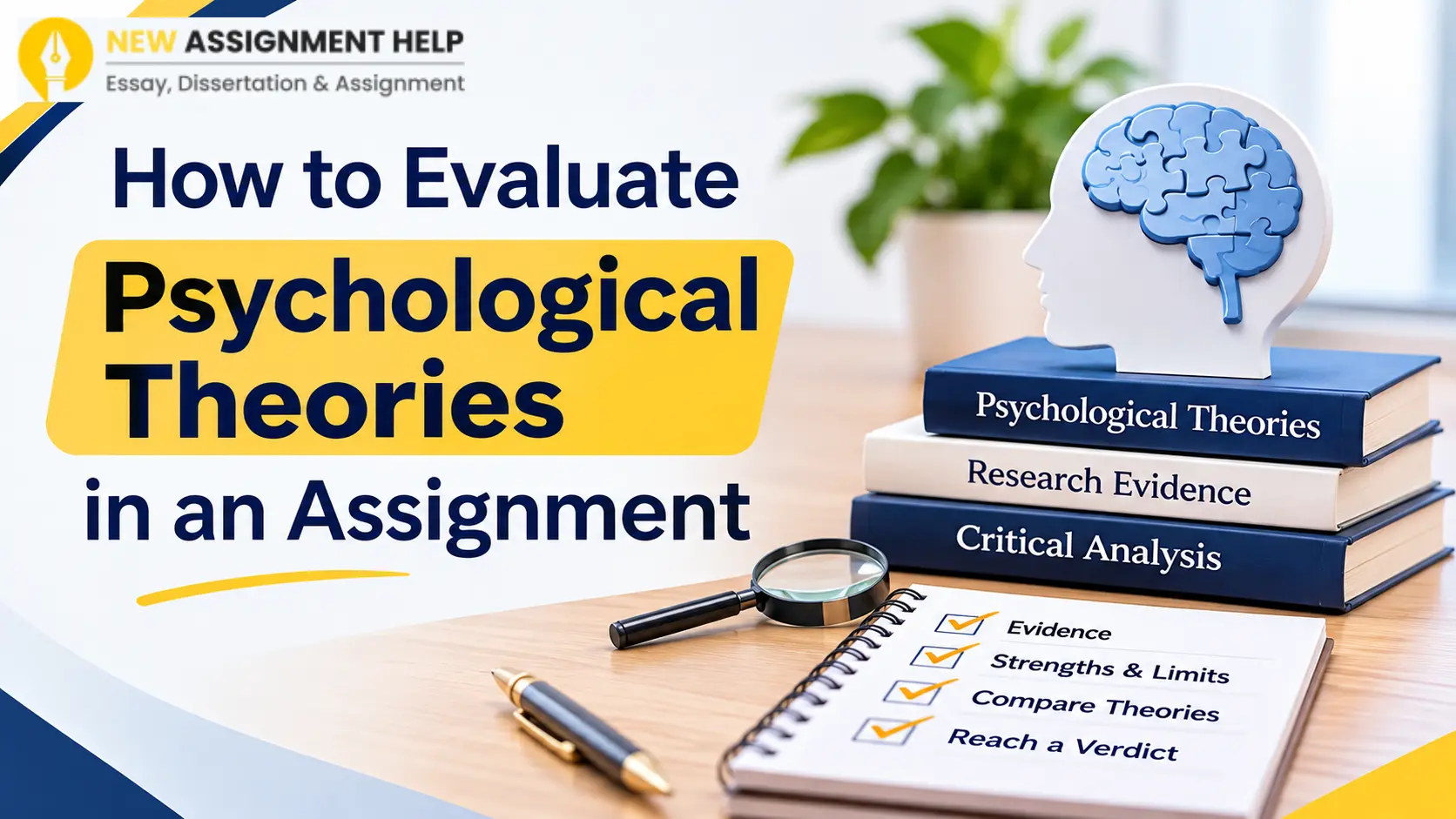
Understanding how to assess evidence and identify the strengths and limitations of a theory is an important part of critical thinking. Read our guide on how to evaluate psychological theories in an assignment to learn how to analyse psychological concepts more effectively.
Final Checks Before You Submit
Use this list once, in this order, before submitting your assignment.
- Rubric match → Compare your draft against each criterion and mark where it is met.
- Word count → Confirm you are inside the limit. Check whether your unit counts in-text citations and excludes the reference list.
- Turnitin → If your unit allows a draft check, review the similarity report and rewrite heavily matched passages.
- Referencing → Verify every DOI and year against the original source.
- AI and integrity → Follow your unit’s generative AI rules and add any required declaration.
- Deadline → Check the time zone, and apply for special consideration before the due date if you need an extension.
Always read your final draft aloud. It will help you catch unclear sentences that spell-check misses. If you have less time or get stuck, do not struggle alone, as your result is on the stake. Get professional help for psychology assignments and prepare your project in time aligned to your university standards.

 8 Years | MBA (Marketing & HR)
.webp)