How to Write a Good MBA Assignment: Guide With Examples & Templates
MBA assignments aren’t difficult because of the workload but because most students misunderstand what is actually being assessed. They spend hours researching, writing, and formatting their assignments, only to receive vague feedback. And that is exactly what happens when you do not know how to write a good MBA assignment.
The goal of MBA assignments is not to see how well you can write, as it is with undergrad essays, but to see how well you can think like a decision-maker. You are expected to analyse data, evaluate alternatives and make justified recommendations.
This guide walks you through exactly how to write a good MBA assignment, step by step. You will learn to read the rubric, to build arguments and to critically analyse. You’ll also learn what not to do before you submit.
Step 1: Understand the Rubric of the MBA Assignment
Before you start your research for your MBA assignment, make sure you understand what your assignment is really asking of you.
- Whether you're asked to compare, assess or just describe.
- How many sources and what type of evidence are required?
- Is there a requirement for a specific model or framework?
- Are you required to propose solutions or simply assess a situation?
Example
Let’s say you need to ‘analyse the competitive strategy of Company X and recommend improvements.’ Now, this is not a single task; this is three.
- Here, you need to analyse the situation using frameworks (e.g., SWOT, Porter’s Five Forces).
- You have to identify the strengths, weaknesses and gaps of the company.
- Then at last, you'll be suggesting realistic, evidence-based improvements based on the evidence.
Practical Tip
Before you start writing, rephrase the assignment question in your own words and underline the action words, like "analyse", "evaluate", "compare", and "recommend". These verbs will tell you the in-depth knowledge you have to demonstrate.
Step 2: Begin With Your Research
MBA research is about finding the right sources and using them strategically. Turn to academic journals, industry reports (IBISWorld, Statista, etc.) and real-world case studies. You can also check out trustworthy business magazines like Harvard Business Review, McKinsey Insights, etc.
How to Research an MBA assignment
- Start by choosing the correct framework or model (e.g., SWOT or Porter’s Five Forces).
- Keep your research intentional. Use specific queries, like:“Competitive Strategy Analysis of Company X”
“Porter’s Five Forces of the [sector]” - Once you have the sources, select a few and organise them based on the points you want to make.
- Lastly, look for evidence, not definitions, because MBA assignments pay off on application, not textbook explanations.
Practical Tip
Go for a 40-60 ratio: 40% theory to establish frameworks and academic concepts and 60% application to draw on real data, company examples and case insights. In case you find this hard to achieve, you can look for assignment help from us.
Step 3: Structure your MBA assignment
A strong MBA assignment presents ideas in a clear, logical structure that reflects how business decisions are made. Below is a standard format for how to structure a good MBA assignment.
1. Introduction
- Summarise the purpose of the assignment
- Define the scope (what will and will not be included)
- State your main argument and/or approach
Tip: Make it short. Do not write long background descriptions.
2. Review of Literature
- Introduce key concepts, models or theories
- Refer to scholarly sources
- Build the framework you will use later
Tip: Don't just summarise theories; link them to your case or topic.
3. Analysis / Discussion
- Use frameworks (e.g., SWOT, Porter's Five Forces)
- Analyse company performance, data and trends
- Compare different perspectives
Tip: Try to use the structure of Point → Evidence → Evaluation → Link in your paragraph.
4. Recommendations
- Offer clear, actionable solutions
- Support each recommendation with your analysis
- Make them realistic and relevant
Tip: Be specific; do not use vague suggestions like “improve marketing”.
5. Additional: Visuals & Referencing
Where to use Visuals:
- Framework application (e.g., strategy models, process flows)
- Data interpretation (charts, graphs)
- Comparisons (tables, matrices)
Tip: Only use when relevant and try to keep them clean with proper labelling.
6. Conclusion
- Summarise your key findings
- Strengthen your main argument
Tip: Do not introduce new information here.
Example structure in use
For an assignment on competitive strategy:
Introduction → Company and Purpose Defined
Framework → Introduces Porter’s Five Forces
Analysis → Runs model on the industry
Recommendations → Suggests strategic enhancements
Conclusion → Summary insights
Typical mistakes in MBA assignments (and how to avoid them)
Most students lose marks not because they don't know how to write a good MBA assignment. This usually happens because of avoidable structural and analytical issues. So, let's see how to fix them before submission.
| Mistakes | Why It Loses Marks | How to Fix It |
|---|---|---|
| Analysis, not description | Shows memorisation, not critical thinking | Evaluate and apply your findings to real cases and include limitations or implications |
| Poor or no link to the question | Irrelevant content demonstrates a lack of understanding of task requirements | Break the question into keywords and map each paragraph to them. |
| Poor flow and structure | Reduces clarity and weakens the argument's progress | Use logical structure (Intro → Framework → Analysis → Conclusion) and clear signposting |
| No evidence or examples | Undermines academic integrity | Back up your arguments with recent case studies, reports or academic sources. |
| Absence of critical evaluation | MBA grading rewards balanced analysis | Add counterpoints, limitations, and trade-offs |
| Informal style and bad referencing | Decreases academic quality and could impact integrity | Use a consistent referencing style (APA/Harvard) throughout and also maintain a formal tone |
| Skipping a final review | Avoidable mistakes go unchecked | Save time to do a final check yourself or take guidance from New Assignment Help Australia experts. |
Good MBA assignments are not about writing more but writing with clarity, structure and critical depth. Most errors happen because of rushing. Solving these problems always results in an immediate increase in grades.
Use of Responsible AI in MBA Assignments (2026 Guide)
AI tools are now being widely used in academic work. But MBA programmes in top universities like UNSW, Monash, and UniMelb are getting stricter about how they must be used.
What Constitutes Ethical AI Use?
- Idea Generation
- Structuring and language support
- Conceptual clarification
- Draft feedback
When is the use considered unethical?
- Submitting work produced by AI as final work
- Copying the entire content without any personal input
- Using AI-generated data or citations without verification
- Excessive dependence on AI for analysis
How to use AI to write a good MBA assignment
- First, understand the question yourself
- Only use AI to generate ideas/structure
- Do your own research using academic resources
- Create your own interpretation
- Use AI to edit, clarify and polish
- Check all data and references manually
Quick Checklist: How to Write a Good MBA Assignment
We want you to end this read with something you can save and use anytime you have an MBA assignment to work on. So here is a checklist to quickly assess your assignment.
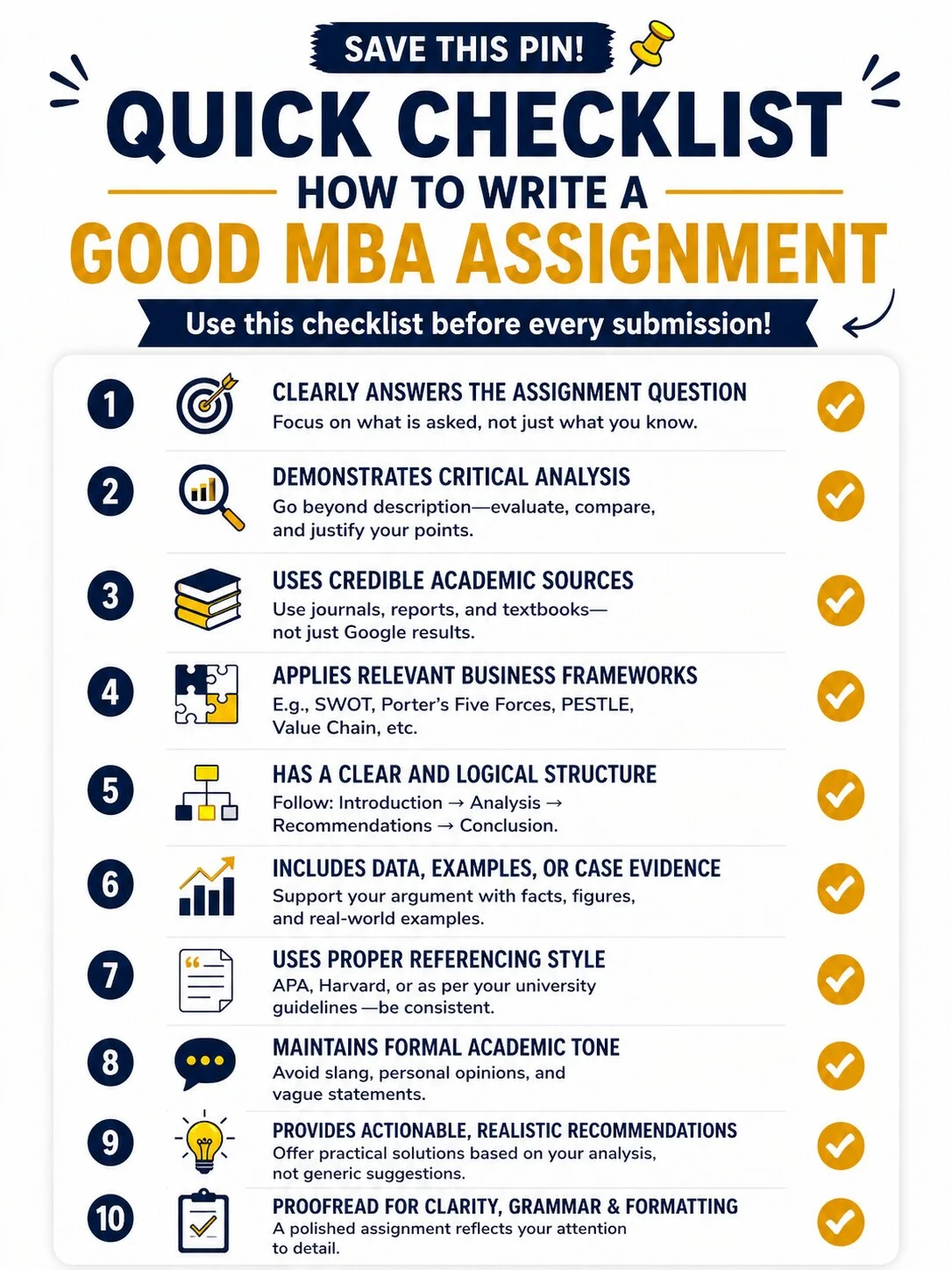
Save this in your photos and use it every time before you hit “submit”.
Footnote
The next time you get an assignment to complete, hopefully, you know exactly how to write a good MBA assignment. First things first, it's not about quantity but quality, structure and critical thinking. Writing a good MBA assignment requires you to align with the question, use relevant frameworks and support your arguments with credible evidence.
To make things simpler, download our Free MBA Assignment Checklist & Structure Template to help you check your work before handing it in. If you need more help, our academic experts can also help you with topic guidance, improving your structure, proofreading and reviewing your assignment according to the MBA standards of Australian universities. And if you ever catch yourself thinking, "Can you do my assignment for me?", our experienced MBA experts are here to provide the academic support you need. Finally, we want you to use this guide to write a good MBA assignment and see your scores soar high!

 6 Years | MBA