Ever wondered why some writing pieces stand out while yours get skipped? There are so many essays, blogs, articles and other reading material available online, but a good introduction decides whether your reader is going to stay or simply skip.
An introduction is the opening paragraph of your writing. It does three things: it hooks your reader, sets the context, and tells them what your piece is about. Get those three things right, and the rest of your writing will have a strong foundation and a smooth flow.
If you keep struggling to write a good opening for your write-up, here is a step-by-step breakdown on how to write an introduction for an essay. Whether you're tackling a NAPLAN writing task (assessed under ACARA's national framework), drafting your HSC essay (marked against NESA's English syllabus criteria), working through a VCE analytical piece (aligned to VCAA's Study Design), or writing a blog, the goal stays the same. Stop the reader and make them want more. Let's see how.
The 3 Must-Haves of Every Great Introduction
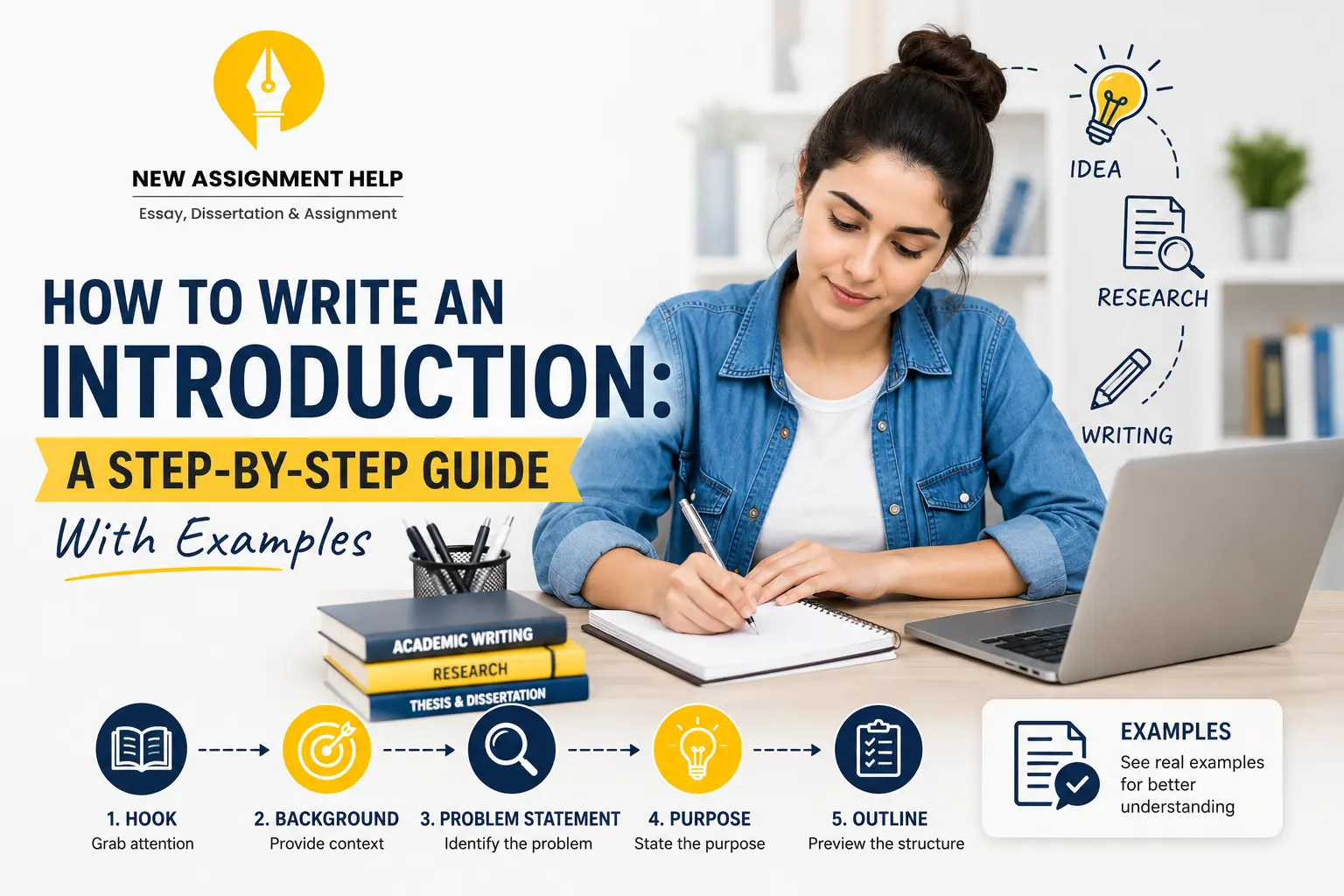
When you wish to learn how to write an introduction, you must know that there are 3 non-negotiable parts:
- A hook that makes the reader stop and read for more
- Background context that explains why you chose to write about it
- A thesis statement that helps the reader understand the topic
That's it. Three parts, working together. Now let's break down each one in detail.
Part 1: The Hook
The hook is your first sentence. Its only job is to make the reader want to read the next sentence. Simple as that. A good hook is short, specific, and connected to your main point. A bad hook is a vague something that starts with "Since the beginning of time, humans have…" Nobody wants to read that. And in a high-stakes context like HSC English, where NESA markers are trained to assess engagement from the very first line, or a VCE essay where VCAA rubrics explicitly reward analytical clarity upfront, a weak hook can cost you marks before the marker even reaches your argument.
Part 2: Background Context
After the hook, give your reader just enough context to understand why this topic matters. This is not the place to go deep. One to three sentences are usually enough. This isn't the body of your content. Think of it like a basic introduction of your chosen topic to your reader.
Part 3: The Thesis Statement
Your thesis statement is the most important sentence in your introduction. It tells the reader exactly what your piece is going to argue or talk about. Keep it to one sentence. Make it specific and put it at the very end of your intro paragraph. It must spark the curiosity of the reader to get to the answer. In VCE and HSC assessments, markers working under VCAA and NESA frameworks are specifically trained to look for a clear contention or thesis, which is a graded criterion in both syllabuses, not an optional element.
How to Write an Introduction for an Essay Step by Step
Now let's put it all together. Here's a simple process you can follow every time you start writing one.
Step 1: Write Your Thesis First
This sounds backwards, but it works. Before you write a single word of your intro, figure out what your main point is. Write it as one clear sentence. Everything else in the introduction will point towards that sentence. This is especially useful in timed conditions like NAPLAN, HSC and VCE exams, where you don't have time to figure out your argument mid-exam.
Step 2: Choose Your Hook Type
Understand your audience. Write a hook that best suits them and their tone. Formal academic writing, as expected in HSC Module B responses or VCE extended analytical tasks, usually calls for a statistic or a bold declarative statement. Blogs and personal essays can open with a relatable scenario or a question.
Step 3: Add Background Context
Tell your reader why your topic matters. This will help in bridging the gap between your hook and your thesis. Keep it short. If it's more than three sentences, you're probably giving away too much too early.
Step 4: State Your Thesis Naturally
Your thesis shouldn't feel like it came out of nowhere. The background context should flow right into it. By the time the reader hits your thesis, it should feel like the natural conclusion of what you've set up.
Pro Tip: Give it a rest. Read it after 2–3 hours. This gives you a whole new perspective you'll read it the way your reader actually will. If it sounds awkward or boring, change it right away. Revise until it flows like normal conversation.
After learning this, the most common question students ask next is:
How Long Should an Introduction Be?
The general rule states that your intro should be about 10% of your total word count.
For example, if you're writing a 500-word essay, your intro should be around 50 words.
1,000-word essay → ~100 words
2,000-word blog post → ~150–200 words
Research paper (5,000+ words) → 2–3 short paragraphs
For NAPLAN writing tasks, which ACARA structures around shorter total responses, one tight paragraph of three to four sentences is enough. For HSC and VCE extended responses, aim for a full paragraph that includes all three elements without spilling into the body.
Introduction Examples for Different Types of Writing
After all the explanations, it's time to look at a few examples. Different types of writing call for different intro styles. Here are three that you can adapt directly.
Essay Introduction Example
Essays are argumentative, so their introductions should be too. The following example works well for HSC Module B responses (assessed under NESA's English Advanced and Standard syllabuses) and VCE Language Analysis tasks (assessed under VCAA's English and EAL/D Study Design).
"Social media platforms now reach over five billion users worldwide, and they've changed the way we think about privacy forever. Most people accept data collection as a fair trade for free services. But few stop to ask what happens to that data when companies are bought, hacked, or dissolved. This essay argues that stronger federal privacy laws are the only realistic way to protect users in the current landscape."
It opened with a statistic hook, moved to context about the problem, and ended with a clear thesis. This is how to write an introduction for an essay that holds up under formal academic pressure.
Blog Post Introduction Example
This type of writing calls for an informal, or rather, catch,y hook. Here is an example of a good blog post introduction.
"You've written 800 words, but you've been staring at that blank first paragraph for 20 minutes. Sound familiar? The introduction is where most writers get stuck, and it's also where most readers decide if they're staying. Good news: once you know how to write an introduction using the three key elements, writing one gets a lot faster. Here's exactly how to do it."
It started with a relatable scenario, framed the problem, signalled expertise, and promised a solution. That's what keeps a reader going.
Research Paper Introduction Example
For a research paper intro, a statistic hook anchored in an identifiable knowledge gap is the most effective approach.
"Antibiotic resistance is now considered one of the greatest threats to global public health, affecting an estimated 1.27 million people annually. Whereas earlier studies emphasised infections acquired in the hospital setting, many neglected to consider the outpatient communities in which resistance spreads quietly. This study aims to investigate the contribution of outpatient prescribing practices to the development of resistance in the community, based on results obtained from five longitudinal studies carried out from 2018 to 2024."
Identify a gap, show awareness of prior work, and state a clear scope. That's the formula.
Across all three, the pattern is identical. Hook → context → thesis. Now let's look at where most students and writers get stuck when asked to write an introduction.
Common Introduction Mistakes to Avoid
Knowing what not to do is just as useful as knowing what to do. And if you've ever sat through an Australian English class, some of these will look very familiar. The hooks below will take you nowhere:
- "In today's society…" This is the most complained-about opening line in Australian secondary schools. It says nothing and stalls. Start with your actual point.
- "Since the dawn of time…" No marker, teacher, or reader wants to go back to the dawn of anything. The broader you open, the less interested your reader gets. Drop straight into the specific topic.
- "The dictionary defines [word] as…" This one turns up constantly in Year 10 essays and seldom works. It's a waste of a sentence.
- "In this essay, I will discuss…" This is the written version of clearing your throat before you speak. Skip the announcement and make the point directly.
Other than the hook, if you're hiding your thesis statement inside a long sentence, it won't land. Markers reading HSC, VCE, or university assignments are looking for it at the end of the introduction. So put it where they expect it.
If your introduction runs longer than 10% of your total word count, you're writing body content in the wrong section. Cut anything that doesn't hook your reader or contextualise your coming argument.
And if you've read this guide and you're still unsure how to open a specific assignmen, a nursing reflective essay, a business law analysis, or an accounting case study, the introduction is even more discipline-specific than most students realise. Our assignment help service pairs you with writers who understand exactly what Australian university markers are looking for from the first paragraph.
Conclusion
Writing a good introduction doesn't have to be the hardest part of your piece. All you need to know is where and how to place the hook, context, and thesis statement effectively. Once you know this, it becomes a repeatable formula.
To sum up how to write an introduction for an essay: start with your thesis, pick a hook that fits your audience, and keep it short. Whether you're sitting for a NAPLAN task, pushing for a Band 6 in HSC English, aiming for a strong ATAR through VCE, or writing a university assignment, the rule stays the same. Get the introduction right, and the rest of your writing has a far stronger foundation to build on.

 6 Years | Msc



.webp)
.webp)