How to Write Strong Nursing Research Questions Using the PICO Framework
You had homework to write a nursing research question using the PICO framework this morning. But when you decide to do that, you find yourself staring at a blank screen for hours. Does this sound like you? If yes, then you’re not alone.
A lot of nursing students struggle with PICO. Not because it's hard, but because most explanations make it sound way more complicated than it is. But here's the truth: PICO is just a way to organise your thinking. It helps you turn a complicated clinical question into something sharp and searchable. In this guide, we'll break it down in steps to understand easily.
What Is the PICO Framework in Nursing?
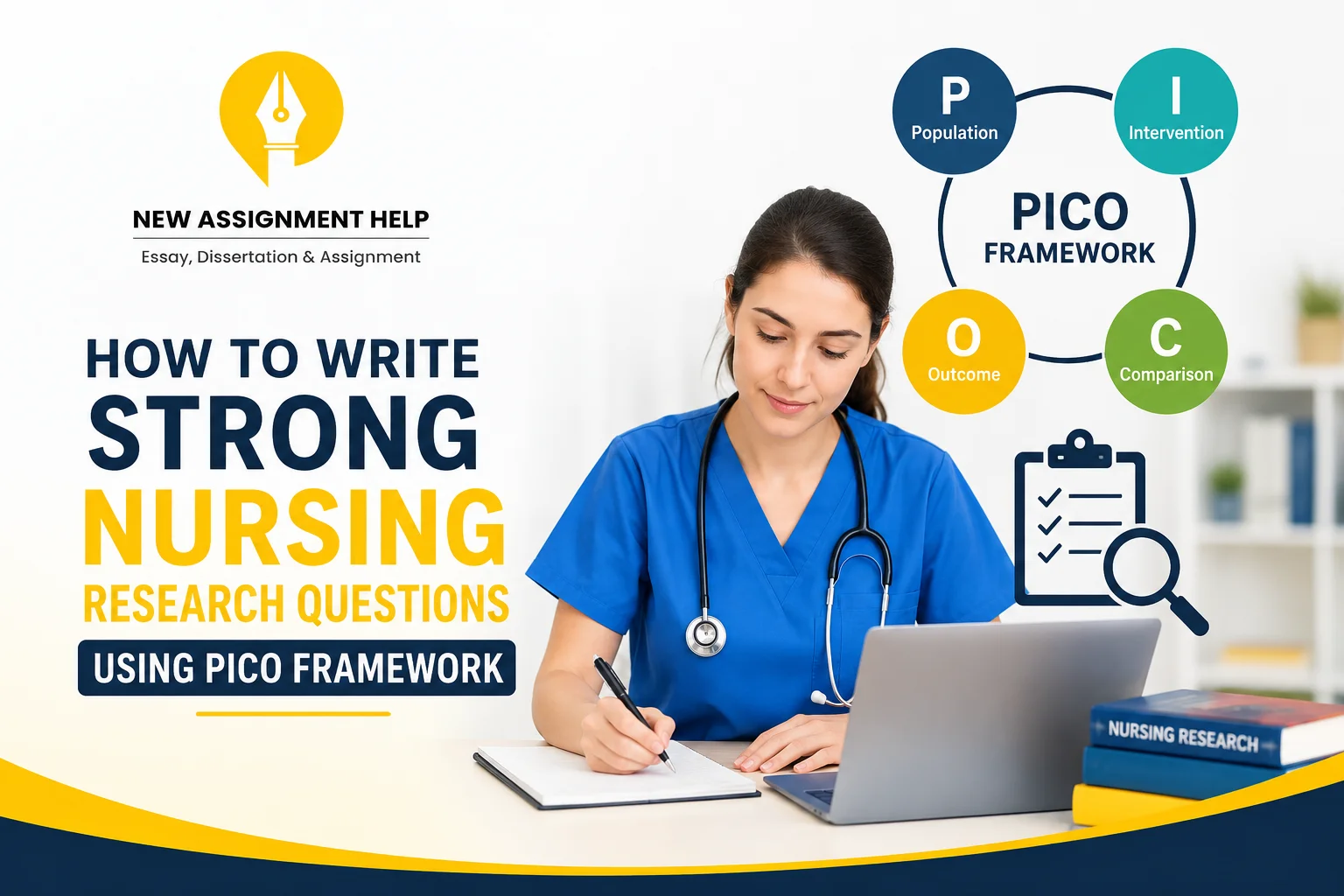
PICO is basically a formula that is used to write a clinical research question. It stands for:
P → Population or Patient
I → Intervention
C → Comparison
O → Outcome
When you put all four together in the right order, you get a question that's clear, focused, and ready to search in databases like CINAHL or PubMed.
Breaking Down Parts of PICO in Detail
- P is who you're studying. You must be very specific here. Don't just say "patients". Say "adult women over 60 with type 2 diabetes" or "paediatric patients in the ICU."
- I is what you're doing. It could be a treatment, a medication, a procedure, a nursing practice, or even a type of education. For example: hourly rounding, compression stockings, early ambulation, and hand-hygiene training.
- C is what you're comparing your intervention against. It could be another treatment, a placebo, or the current standard of care. But note that not every PICO question needs a comparison. If there's nothing to compare to, you can skip this part.
- O is what you're measuring. Think about things like reduced falls, lower infection rates, shorter hospital stays, and improved patient satisfaction scores. Make sure that your outcome is measurable. Vague outcomes make weak PICO questions.
Many students know this already, but they get stuck when it comes to using it in an assignment. They prefer looking for nursing assignment guidance for additional support from real experts. But let's break it down in simple steps today.
Step-by-Step Guidance on How to Write a Nursing Question Using PICO
Let's take up an example of a real clinical scenario. You're a nurse on a med-surg floor. You've noticed that patients who stay in bed all day after surgery seem to take longer to go home. So you start wondering if getting patients up and walking sooner could help them recover faster. Now you need to put your observation through a nursing question using the PICO framework. Here is how you'll do it.
Step 1: Identify Your Population
Mention who you are interested in. Let's say "Adult patients who have just had abdominal surgery".
Step 2: Define Your Intervention
What are you going to study? Early ambulation (walking within 24 hours of surgery).
Step 3: Choose a Comparison (or Skip It)
What's the alternative? Bed rest for the first 48 hours.
Step 4: Name Your Outcome
What result are you hoping to see? Shorter hospital stays and faster discharge.
Step 5: When you put it all together, it should look like: "In adult patients following abdominal surgery, does early ambulation within 24 hours compared to bed rest for 48 hours reduce length of hospital stay?"
That's it. You now have your own nursing research question that is clean, focused and searchable for better grades. Many students seek nursing assignment support for this.
PICO Question Examples in Nursing
In case you're getting confused about writing a PICO question for therapy and writing it for diagnosis, here are a few more examples divided into categories.
- Therapy Example: In elderly patients with urinary tract infections (P), does cranberry supplementation (I) instead of no supplementation (C) reduce the recurrence of UTIs over 6 months (O)?
- Diagnosis Example: In adult patients presenting with chest pain (P), is a high-sensitivity troponin test (I) more accurate than a standard troponin test (C) in diagnosing acute myocardial infarction (O)?
- Prognosis Example: In patients diagnosed with heart failure (P), does daily weight monitoring (I) predict hospital readmission within 30 days (O)?
- Harm/Etiology Example: In adult ICU patients (P), does prolonged use of indwelling urinary catheters (I) increase the risk of catheter-associated urinary tract infections (O)?
Now, the next question that needs to be addressed is about its relevance.
Why PICO Matters in Evidence-Based Practice
PICO matters in practice because nurses have to make hundreds of decisions every shift. These can't be random; they must be backed by research. But to get there, you first need to have a solid question. PICO gives you a map that tells you where to look and what to look for.
If you wish to know about its origin, PICO was initially developed to be used in medicine, specifically to help doctors find the best treatment options for patients. Over time, nursing adopted it as a core part of evidence-based practice (EBP), and today it's used everywhere from BSN coursework to DNP capstone projects.
What's the Difference Between PICO & PICOT?
It's the same with a little addition: the T that stands for Time. You can use this framework when time is a key part of your question. For example:
"...within 30 days of discharge"
"...over a 6-month treatment period"
"...during the first 48 hours of hospital admission"
If time doesn't matter much to your question, you can leave it out. Simple.
How to Use PICO for Qualitative Research in Nursing?
When you do qualitative research, you are basically looking for a person's experiences, feelings, and perspectives. So instead of asking "Does X reduce Y?" you're asking "What do patients feel about X?"
For example: In adult cancer patients receiving chemotherapy (P), what are the lived experiences of fatigue management interventions (I) as described by patients (O)?
- The Comparison (C) often gets dropped in qualitative questions.
There are also alternative frameworks like SPIDER and ECLIPSE, specifically for deeply qualitative or service-focused evaluation. Here is an overview:
- SPIDER → Sample, Phenomenon of Interest, Design, Evaluation, Research type. Good for qualitative systematic reviews.
- ECLIPSE → Expectation, Client Group, Location, Impact, Professionals, Service. Good for health services or policy questions.
After learning much about the PICO framework and how to write a strong nursing research question in detail, it's time to understand why students often lose marks on this.
Common PICO Mistakes Nursing Students Make
Being Too Vague With the Population.
If you're writing "In patients with diabetes...", it isn't strong enough. But if you're writing, "In adults aged 40–65 with newly diagnosed type 2 diabetes in outpatient settings..." that will save you from marks deduction.
Forgetting to Define the Outcome
A lot of students write great P, I, and C elements but forget to say what they're actually measuring. Your outcome needs to be clear and measurable. "Better health" is not an outcome. "Reduced HbA1c levels at 3 months" is.
Forcing a Comparison That Doesn't Exist
Not every clinical question has a comparison group. If yours doesn't, just say "no intervention" or "usual care". Don't invent a comparison just to fill in the box.
Ready to Write Your PICO Question?
Here is a table for you to easily access the PICO framework when in need. You can either save this in your notes or take a screenshot.
| PICO Element | What It Means | Tip |
|---|---|---|
| P — Population | Who are you studying | Be specific: age, setting, condition |
| I — Intervention | What action are you examining | Be precise about dose, frequency, or method where relevant |
| C — Comparison | What you're comparing against | OK to skip if there's no comparison |
| O — Outcome | What you're measuring | Must be specific and measurable |
| T — Time (PICOT) | How long until you measure results | Add when the timeframe matters |
At last, we can conclude that writing a strong nursing research question as per the PICO framework is a skill that gets better with practice. So, keep coming back to this guide or bookmark it to come back every time you get a nursing research question to build.

 10 Years | Ph.D. in Nursing