How to Use the Gibbs Reflective Cycle in Nursing Essays
Reflective essays can feel really overwhelming, especially when your tutor says, "Just use Gibbs." But what does that actually mean? And how do you turn a clinical experience into a structured essay to get marks?
If you are also having the same dilemma, here you go. In this blog today, we are going to discuss what using gibbs cycle means to a nursing essay, how to actually use it step by step and what queries students usually have around it. We'll also look at some examples for a better understanding. So, let's begin with the definition.
What Is the Gibbs Reflective Cycle?
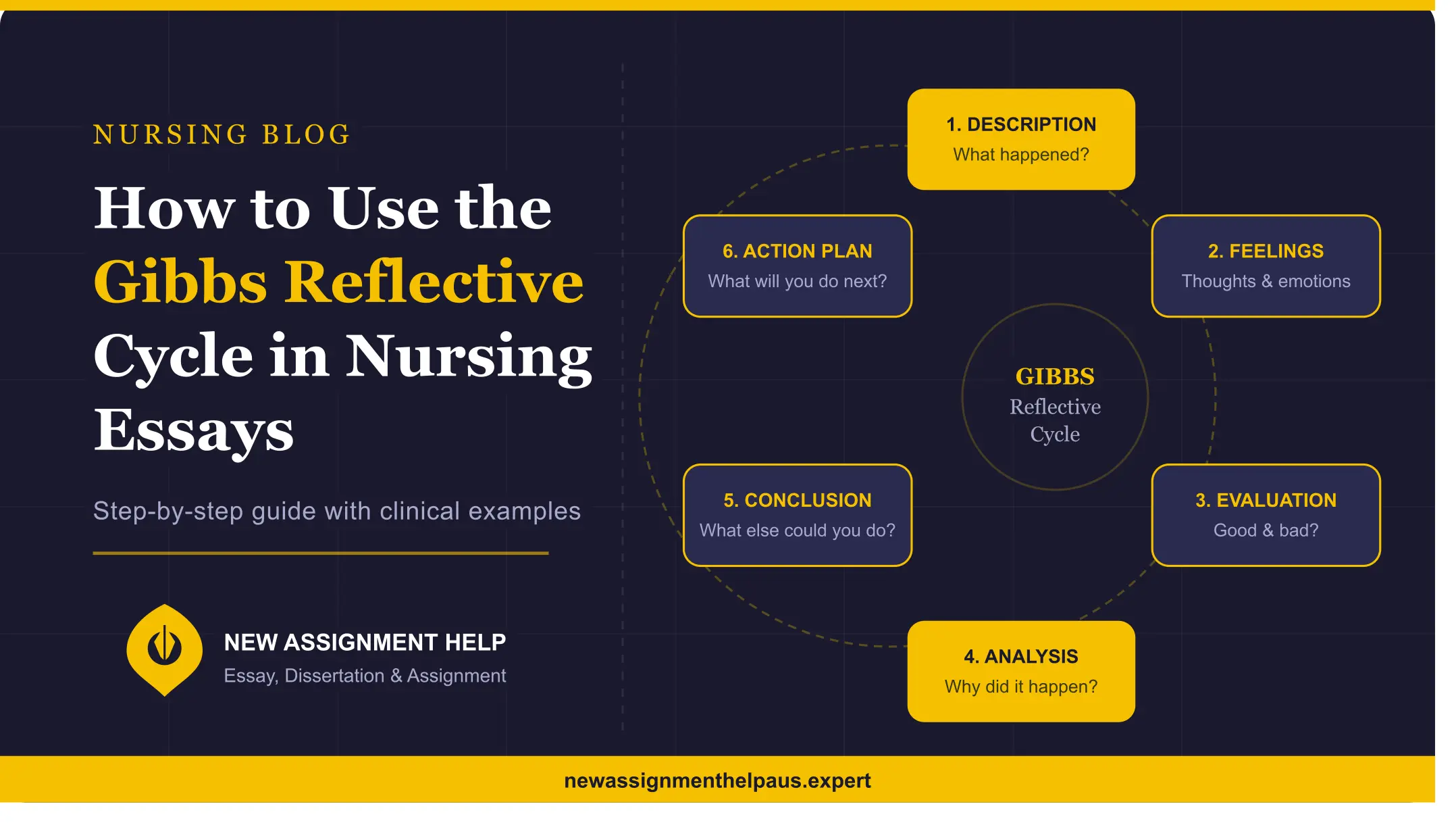
The Gibbs Reflective Cycle was created by Professor Graham Gibbs in 1988. He built it to help people learn from their own experiences using the 6 stages. These stages are: Description, Feelings, Evaluation, Analysis, Conclusion, and Action Plan.
In nursing, this model is used everywhere. From university assignments to NHS CPD portfolios. Why? Because it pushes you past "here's what happened" and asks the harder question: what did I learn, and what will I do differently?
The NMC Code (2015) expects nurses to reflect on their practice, and Gibbs gives them the structure to do that effectively. But one thing that students often ask is if Gibbs can be used for a positive experience. And the answer is yes, absolutely. A moment where everything made sense is just as worth analysing as a mistake. When you understand the "why" of a success, you'll bring that naturally into your work.
How to Choose the Right Clinical Incident
A good Gibbs reflection needs a moment with complexity. Something where you felt uncertain, made a call, or walked away thinking differently about your practice.
Good choices include:
- A communication breakdown with a patient
- A medication administration moment where you had to make a judgment
- A situation involving informed consent or patient dignity
- A team conflict during a high-pressure shift
Avoid picking something too straightforward, like taking a blood pressure reading. Because this will leave very little room for analysis and will eventually drop your marks. Look at the nursing assignment guidance to understand on what grounds experts choose their clinical incidents.
The 6 Stages of Gibbs Reflective Cycle Explained With Nursing Examples
It's time to look at the main part of this blog. Let's understand what
the 6-stage framework of the famous Gibbs Reflective Cycle is, along with nursing examples.
Stage 1: Description: The "What Happened?" Scenario
At this stage, you need to set the scene. Answer questions like Who was there? What happened? Where and when? Keep it short and factual, but description often gets the fewest marks. Therefore, two to three short paragraphs are enough.
Example: "During my second clinical placement on a medical ward, I was asked to assist a senior nurse in administering medication to Mr T. He had recently been diagnosed with Type 2 diabetes."
Stage 2: Feelings: What Were You Thinking and Feeling?
This stage trips a lot of students up. Some write one line ("I felt nervous") and move on. Others go full diary mode. But a sweet spot is to treat your feelings as professional data. Something that shows how your emotions shaped your actions.
Example: "I felt uncertain about the correct dosage and hesitated before checking the medication chart. That hesitation made me realise that I need to work on my confidence."
Most students get confused over which person's language to use. So let's get this clear. Always write in first-person language as it will reflect your own experience. It looks genuine, and most university guidelines actively require it.
Stage 3: Evaluation: What Went Well? What Didn't?
Be honest here. Point out everything good about the experience and also what wasn't. Both sides matter, and marketers want to see the balance.
Example: "What went well was that I pointed out my uncertainty to my senior before proceeding. What didn't go well was that I hadn't reviewed the patient's medication plan before starting, which slowed things down and added unnecessary stress."
Stage 4: Analysis: Why Did It Happen?
This is the most important stage. It is where you use nursing theory and evidence to make sense of what happened. This section should take up the most words in your essay.
Ask yourself: What does the research say about situations like this? Then link your experience to frameworks like Benner's Novice, person-centred care and NMC standards.
Example: "According to Benner (1984), novice nurses often struggle with prioritisation because they lack the contextual experience to make quick judgements. My hesitation reflects this stage of development. The NMC Code (2015) also highlights the need for nurses to recognise and work within the limits of their competence, which is exactly what checking with my supervisor demonstrated."
A lot of students confuse Evaluation and Analysis. Simple version: Evaluation is your judgment (good or bad). Analysis is the reason behind it, backed by evidence. They are two different things, and mixing them is one of the most common mistakes markers catch instantly.
Stage 5: Conclusion: What Else Could You Have Done?
This is a reflective summary, not the essay conclusion. Here you have to focus on what you have really learnt and what you would do differently next time.
Example: "I could have reviewed the patient's medication chart before the shift began. That would have reduced my uncertainty and helped me feel more prepared. I also realise that asking for help is not a weakness but rather a part of safe nursing practice."
Stage 6: Action Plan: What Will You Do Next Time?
This is where students lose marks. Not because they often skip it, but because they write vague things like "I will improve my communication skills," etc. This isn't a plan. To be relevant, use the SMART framework: keep your plan Specific, Measurable, Attainable, Relevant and Time-bound.
Example: "Within the next four weeks, I will review BNF guidelines for common diabetes medications and complete one online medication management module. I will also request a supervised medication round with my mentor each week."
Since we now know how to use the Gibbs Reflective Cycle in our Nursing Essays, it's time to understand one more thing. The most common hurdles students face that lead them to seek nursing assignment support from experts.
Students' Common Mistakes in Using Gibbs Reflective Cycle
- Over-describing the event: If your description goes past 150 words in a 1,200-word essay, cut it down.
- Writing the Feelings stage like a diary: Don't stretch it. Keep it professional and try to connect your actions to your learning.
- Forgetting to anonymise: Always protect the patient's identity. Add one clear sentence at the start of your essay stating that names have been changed in line with the NMC Code (2015).
- Writing a vague Action Plan: Name the specific action, the timeframe, and how you will measure your progress throughout.
- Skipping references in the Analysis stage: For a 1,200-word essay, aim for 5–8 references or as per your uni. Without citations in your analysis, it reads like a personal opinion rather than an evidence-based reflection.
Final Thoughts
Reflective writing gets easier with time and practice. Once you learn to use the Gibbs reflective cycle in your Nursing Assignment essay, the most challenging part is done. Your nursing assignment should sound like a real reflection, not a random clinical summary.
If you feel stuck on structure, theory, or getting the balance right between stages, New Assignment Help Australia provides the support you wish you had. And if you ever catch yourself thinking, "Can you do my assignment for me?", our academic experts are here to provide personalised guidance and support throughout the writing process. So whether you're on your first Gibbs essay or your fifth, having the right guidance makes the whole process a lot less stressful.

 11 Years | Master of Nursing Practice