Financial statements look scary the first time you open them. Pages full of numbers, tables and terms you've never heard of. You feel confused, but once you know what each part does, you can break down any company's finances in simple steps.
To help you learn those steps, here is your comprehensive guide. This will walk you through the whole process. In this, we will cover everything from reading the basic statements to writing an analysis that your professor expects and looks forward to. So, let's get started.
What Is a Financial Statement in Australian Academic Assignments?
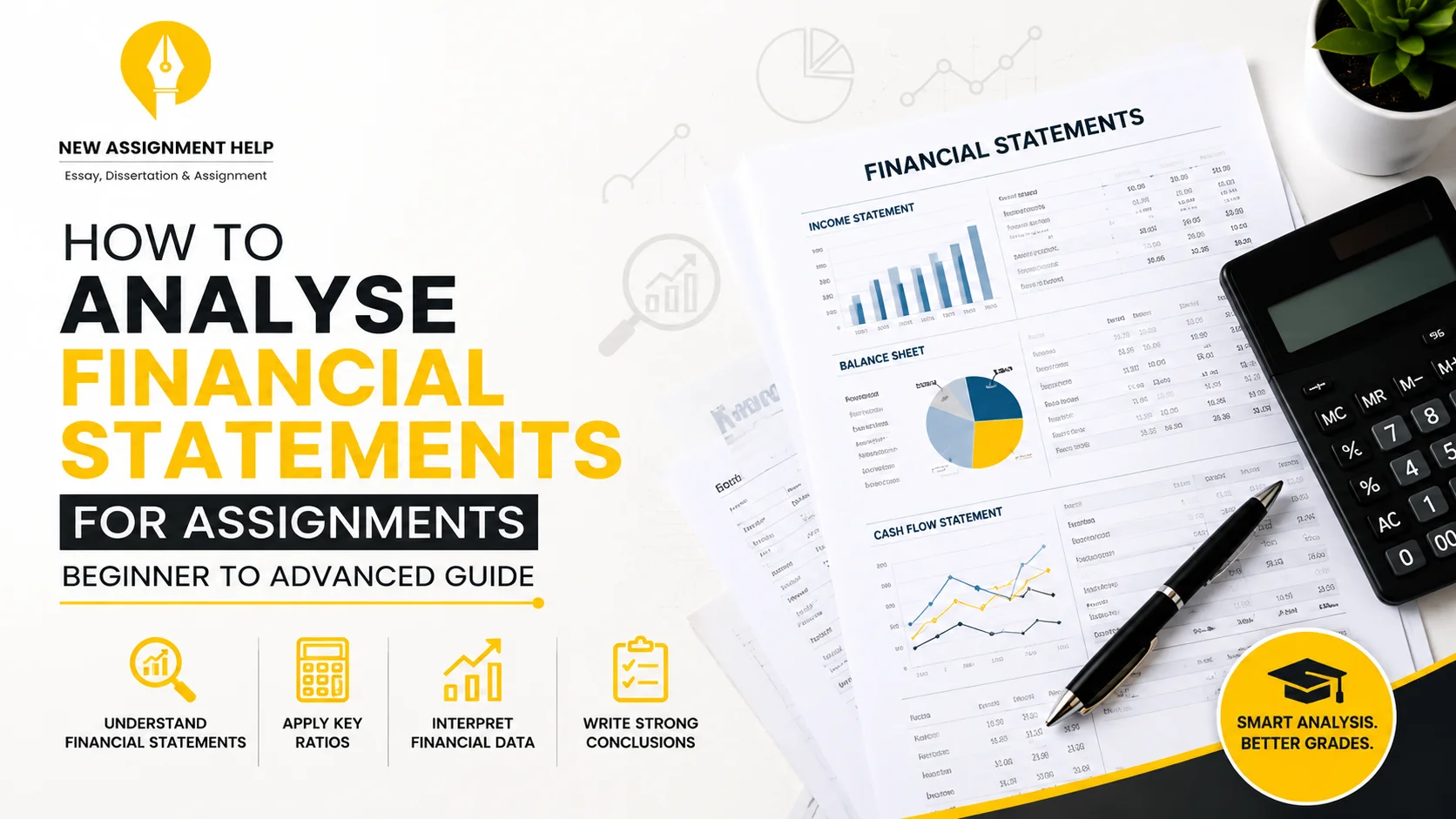
In academic assignments, a financial statement is the official record that shows the company’s financial health over a specific period of time. To study the full story, you need to have 3 documents:
- The Income Statement, which calculates profit and loss. If the net profit after excluding all the expenses is positive, it is said that the company has made money, and if not, the company is at a loss.
- The balance sheet tells what the company owns (assets), what it owes (liabilities), and what's left for the owners (equity). The golden rule here is to balance using a simple formula: Assets = Liabilities + Equity.
- The cash flow statement, which tracks the actual cash moving in and out. This is analysed through three ways: operating activities (day-to-day business), investing activities (buying or selling assets), and financing activities (loans, dividends, share issuances).
One more thing that most students miss but can be of help: read the notes on the accounts. They're given at the back of the annual report and explain the accounting methods, risks, and details behind the numbers. Referencing them in your assignment shows depth.
What Are the Types & Ratios Used for Financial Statement Analysis?
If you're wondering what financial statement analysis is and how it differs from financial statements, then the answer is simple. Where a financial statement is the record, a financial statement analysis is the process of reviewing and evaluating those records. For this process, you usually need three methods, which are explained below.
- Horizontal analysis
In this analysis, you compare the same figures across two or more years. You're basically looking for trends. If revenue grew from $50,000 to $55,000, that's a 10% increase. Calculate it as: (Current Year − Prior Year) ÷ Prior Year × 100. This can be used to answer if the company is improving or declining over time.
- Vertical analysis
This expresses every line item as a percentage of a base number. On the income statement, the base is usually revenue. On the balance sheet, it's total assets. This makes it easy to compare companies of different sizes if your assignment asks you to.
- Ratio analysis
This is one of the biggest analysis types as it uses specific formulas to measure how well the company is doing in specific areas.
Let's understand the ratios now.
Key Ratios to Include in Your Assignment
There are four primary types of ratios used to evaluate a company's financial performance. They are categorised by what they measure: short-term debt capacity, long-term stability, operational speed, and profit generation. Let's understand each one better.
- Liquidity ratios are used to measure whether the company can pay its short-term bills or not. The current ratio (Current Assets ÷ Current Liabilities) is the go-to. A figure above 1.5 generally means the company is in decent shape.
- Profitability ratios show whether the company is actually making money. Gross profit margin (Gross Profit ÷ Revenue × 100) tells you production efficiency. Net profit margin (Net Profit ÷ Revenue × 100) shows the bottom line.
- Solvency ratios study a company's long-term survival. The debt-to-equity ratio (Total Debt ÷ Shareholders' Equity) under this head shows how much the company relies on borrowed money. A very high ratio means high financial risk.
- Efficiency ratios look at how well the company uses its resources. Asset turnover (Revenue ÷ Total Assets) measures how much revenue is generated for every dollar of assets held.
Tip: Compare your present ratio to the last year's figure, an industry average, or a competitor because a ratio on its own means nothing.
Most students could write the financial statements, but when it comes to their analysis, they often look for finance assignment support from experts. Under their guidance, they learn all aspects of a good finance assignment.
How Do You Interpret Financial Ratios for an Assignment?
After knowing about the different ratios to be used in a financial report, the next genuine query is "How to interpret them?" This is also what trips most Australian finance students. Because what they usually do is they calculate the ratio, write down the number, and move on. But that's not true analysis. That's just arithmetic. To convert it into a real analysis, follow the four-step approach:
- Talk about what the ratio measures
- Show the formula and figure used
- Compare it to the prior year's data or industry average
- At last, explain what this difference means to the company
For example: "The current ratio improved from 1.2 in 2022 to 1.8 in 2023, suggesting the company has strengthened its ability to meet short-term obligations."
That's the kind of sentence experts at online finance assignment guidance set as examples. Moving on, let's talk about the structuring.
How Do You Structure a Financial Statement Analysis Assignment?
Just like any other assignment, financial statement analysis has its very own structure.
- Start with a short introduction: Two or three sentences naming the company, the time period, and the purpose of your analysis. Before any ratio, build the context first.
- Move through your analysis: Create a logical order using the income statement, balance sheet and cash flow statement. Under each one, run your horizontal and vertical analysis, then apply the relevant ratios.
- Write a brief interpretation: You're not supposed to simply put facts here. You need to give justification. You can't say "the ratio is X". You must tell what X means for the company's health.
- For advanced assignments, add a qualitative layer: Look at the MD&A (Management, Discussion and Analysis) section of the annual report. It tells you whether the numbers match the story they're telling.
How Do You Write a Strong Conclusion?
A conclusion in a finance assignment is as important as your analysis. It should do three primary things: summarise the company's overall financial health, identify one key strength and one key weakness, and make a clear judgement.
Don't repeat every ratio. Synthesise the evidence. Something like, “Overall, the company demonstrates solid profitability and improving liquidity. However, its rising debt-to-equity ratio warrants close monitoring, as increasing leverage may pose long-term solvency risks."
That's a conclusion right there. It shows you've done the analysis and formed a view, which is exactly what your professor is looking for to mark good grades.
Common Mistakes to Avoid
Most students lose marks in the same ways. Here's what to watch for:
- Don't stop after analysing the single statement. All three reveal something different, and you need all three to get a clear picture.
- Stop presenting ratios without benchmarks. It gives no value. Always compare to prior years or industry averages.
- Start paying more attention to the notes to accounts. That's where you'll get the explanation for your numbers.
- Always interpret. If you're only pointing out what the figures are instead of justifying what those figures mean, then you're just halfway through.
- Make your conclusion strong by presenting the evidence to give a recommendation. If you're only listing ratios, you're making a weak conclusion.
- Final Thought
Financial statement analysis is a skill, not a talent. The more assignments you do using this structure, the faster and sharper you'll get at it. It's simple: read the statements, apply horizontal and vertical analysis, calculate and interpret key ratios and write a judgement.
Use this guide as your checklist every time you sit down with an annual report, and your assignments will be in solid shape. In case you get stuck at any point, feel free to reach out to New Assignment Help Australia for better guidance.

 9 Years | Master of Applied Finance