Published On 1 January 1970

How to Write an Essay: Step-by-Step Guide with Examples

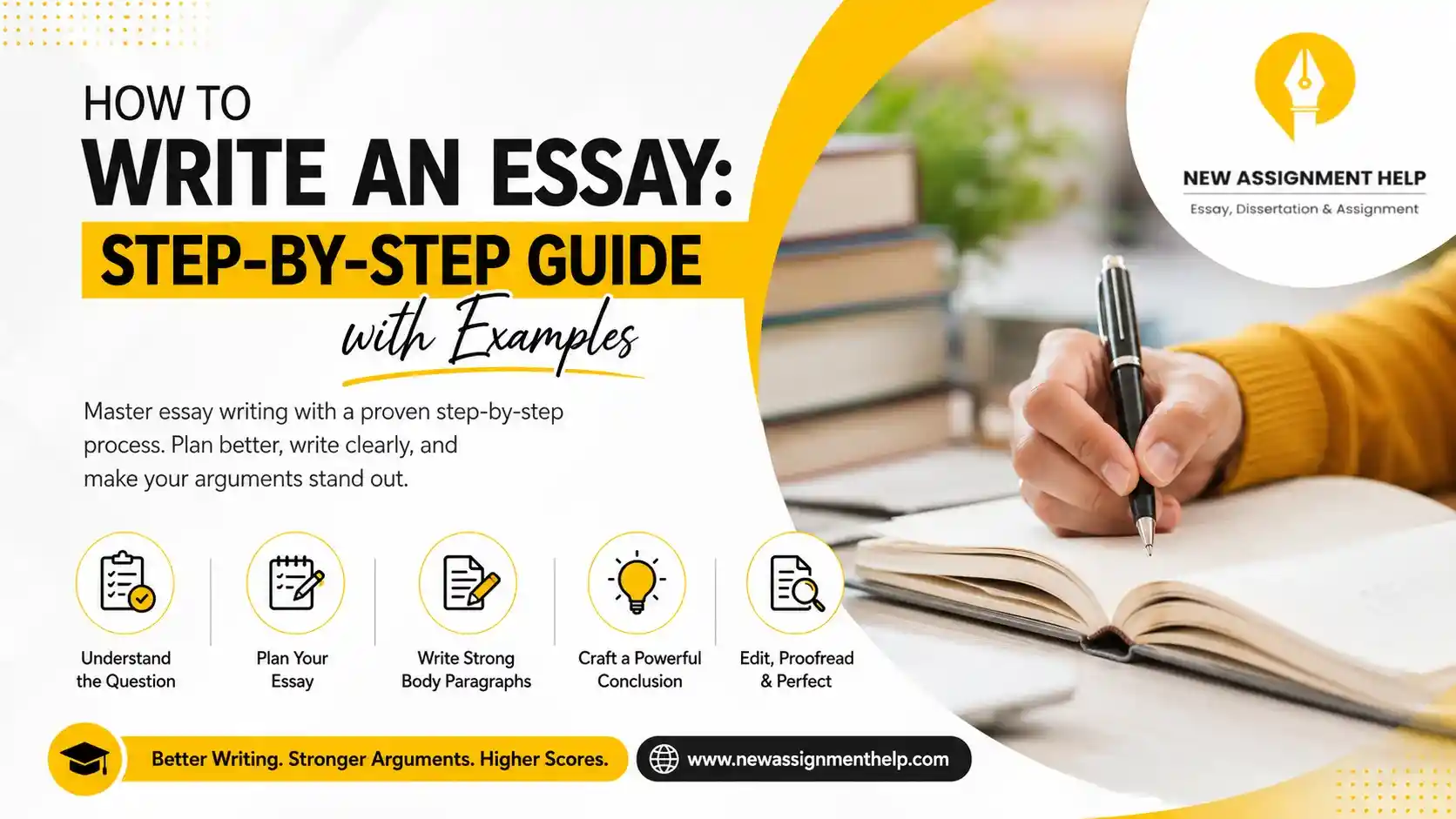
Educational banner on how to write an essay, featuring a student writing in a notebook, essay-writing steps
Special OfferSale
- +
1 Page
55% Off
AU$ 14.82
Estimated Cost
AU$ 6.67
Prices Start From
AUD 10.00AUD 16.50

Writing an essay is like constructing a bridge between your thinking and your reader's understanding. When the bridge is well-built clear argument, solid evidence, clean structure, your reader crosses it effortlessly. When it's not, they get halfway and fall through.

If you're asking yourself how to write an essay that actually lands, whether it's for high school, university, or a competitive admissions process, this guide covers every stage of the process. Not vague advice, but concrete steps: from reading the question and planning your argument, through to writing an introduction that hooks, body paragraphs that convince, and a conclusion that sticks. You'll also find worked examples you can use as direct models.

Let's build the bridge.

Step 1: Understand the Essay Question Before You Write a Word

Most students lose marks before they write a single sentence by misreading the question. Essay questions are not suggestions. They're precise instructions. Before you plan or draft anything, break the question down into three parts:

  • Content terms the key concepts the essay must address
  • Limiting terms the scope or boundaries of the topic (what's in and what's out)
  • Directive terms the action you're being asked to perform: discuss, analyse, compare, argue, evaluate, explain

Each directive term demands a different approach. Analyse means you must break something into parts and examine how they work. Discuss means you must weigh multiple perspectives. Argue means you take a position and defend it with evidence.

Practical tip: Underline the directive term first. Then underline the content terms. Write them both out on a separate line before you open a planning document. Students who do this step spend less time going off-topic and more time writing what the question actually needs.

Step 2: Plan Your Essay Before You Start Writing

Planning is the step most students skip and the reason most essays underperform. A 10–15 minute plan at the start saves an hour of confused rewriting at the end.

A good plan includes four things:

  1. Your thesis your central argument in one sentence (not a topic, an argument)
  2. Your main points typically three to five, one per body paragraph
  3. Your evidence the key facts, examples, or quotes that support each point
  4. Your conclusion angle what will the essay's overall finding be?

You don't need to plan in full sentences. A few bullet points per section is enough. The goal is to know where you're going before you start driving.

Step 3: Master Essay Structure for Clear and Effective Writing

Every essay, regardless of type, topic, or length, has three core sections: the introduction, the main body, and the conclusion. Each has a specific job, and none of them is interchangeable.

How to Write an Essay Introduction

The introduction is the most read section of your entire essay. Markers form their first impression here, and first impressions carry weight. A weak introduction signals a weak essay before the argument has even begun.

A strong essay introduction has four components:

  1. Hook: an opening that earns attention (a surprising statistic, a bold claim, a precisely posed question)
  2. Context: two to three sentences of background that frame the topic for the reader
  3. Thesis statement: your central argument in one clear sentence (see Step 4 below)
  4. Roadmap: a brief guide to the structure of the essay that follows

What to avoid in introductions:

  • Opening with "In this essay, I will..." it's weak and passive
  • Writing only two or three sentences it signals a lack of preparation
  • Introducing evidence or examples that belong in the body

Worked example annotated introduction:

Students across Australia are leaving secondary school unable to construct a clear written argument a gap that has measurable consequences for university completion rates and graduate employability. [HOOK + CONTEXT] Despite widespread recognition of this problem, structured essay writing remains inconsistently taught and rarely explicitly assessed in Years 7–10. [CONTEXT] This essay argues that essay writing should be a core, formally assessed component of secondary education from Year 7, because doing so develops analytical thinking, improves performance across all subjects, and equips students for the demands of higher education. [THESIS] The essay will first examine the evidence linking structured writing practice to academic outcomes, then consider practical implementation models, before addressing the most common objections to mandatory essay teaching. [ROADMAP]

Every sentence has a specific purpose. Notice how the thesis doesn't just state a topic, it states a position and signals the grounds on which it will be argued.

How to Write the Main Body of Your Essay

The main body is where your argument takes shape and is tested. Each body paragraph makes one point, proves it with evidence, and connects it to your thesis. A common mistake is writing body paragraphs that summarise information rather than build an argument. A paragraph that describes what happened is not the same as a paragraph that argues Why it matters.

Use the PEEL structure for every body paragraph:

LetterWhat to write
P Point Your topic sentence: the main idea of this paragraph
E Evidence A fact, statistic, quotation, or example that supports the point
E Explain Your analysis: why does this evidence support your argument?
L Link A closing sentence connecting this paragraph back to your thesis

How to Write a Topic Sentence in an Essay

The topic sentence is the first sentence of every body paragraph. It has one job: tell the reader exactly what this paragraph will argue. A paragraph without a clear topic sentence forces the reader to guess your point, and markers rarely guess in your favour.

Weak vs. strong the difference

Weak topic sentenceWhy it failsStrong topic sentence
"Social media is popular with young people." States a fact, not an argument "The algorithmic design of social media platforms actively reinforces social comparison in adolescents, making them a primary environmental contributor to rising anxiety rates."
"Shakespeare uses many literary devices." Vague and non-committal "Shakespeare's use of soliloquy in Hamlet functions not merely as a dramatic device, but as the primary means through which the play destabilises the audience's trust in perception itself."

Worked example full body paragraph (PEEL):

One of the most consistent predictors of essay quality is the time a student spends planning before they write. [POINT] Research in educational psychology shows that students who outline their argument before drafting consistently produce more coherent, higher-scoring essays than those who begin writing immediately (Graham & Harris, 2016). [EVIDENCE] This is because planning externalises the cognitive load of organising an argument, freeing working memory to focus on expression and precision. Without a plan, students repeat points, lose their thread mid-essay, or arrive at a conclusion that quietly contradicts their introduction. [EXPLAIN] For this reason, essay planning should be explicitly taught and formally assessed as a stage of the writing process, not treated as optional preparation that stronger students happen to do. [LINK]

How to Write an Essay Conclusion

A conclusion is not a summary; it's a synthesis. That distinction matters enormously. A summary restates what you already said. A synthesis shows what your argument, taken as a whole, means.

Three-part structure for a strong conclusion:

  1. Restate your thesis, not word-for-word, but in light of the evidence you've now laid out
  2. Synthesise your key points, show how your arguments connect and build on each other, rather than listing them again
  3. Closing thought, a final reflection, implication, or call to action that gives the essay broader significance

What not to do in a conclusion:

  • Introduce new evidence or arguments; the conclusion is not a second body section
  • Write "In conclusion, this essay has shown..." It's redundant and weakens your close
  • End abruptly, the last sentence should land with weight, not trail off

Worked example annotated conclusion:

The evidence presented in this essay makes a compelling case for essay writing as a core, formally assessed component of secondary education. [RESTATE THESIS] The research confirms that planning improves coherence, that explicit structure instruction raises attainment, and that writing skills built in secondary school transfer directly into performance at university. [SYNTHESISE] Rather than treating essay writing as an occasional task bolted onto the curriculum, schools should invest in scaffolded, regularly practised writing programmes from Year 7 onwards. The long-term payoff graduates who can think critically, argue precisely, and communicate with confidence is one no education system can afford to leave to chance. [CLOSING THOUGHT]

Step 4: How to Write a Thesis Statement for an Essay

Your thesis statement is the most important sentence in your essay. It is the spine that holds everything together. Every body paragraph exists to support it. Every conclusion returns to it. Without a clear thesis, you do not have an essay; you have a collection of loosely related observations.

What a strong thesis statement does:

  • Makes a specific, arguable claim, not a fact, not a question, not a topic description
  • Fits in one to two sentences
  • Directly answers the essay question
  • Signals the grounds on which the argument will be built

Thesis formula: [Topic] + [Your position] + [The basis for that position]

Weak vs strong side by side:

Weak thesis Why it fails Strong thesis
"Social media affects mental health." Not arguable, almost everyone agrees "Social media platforms, by design, exploit comparison psychology and dopamine-driven engagement loops, making them a structural contributor to the rise in adolescent anxiety disorders."
"Renewable energy is a good thing." Opinion, not argument; no grounds "Transitioning to renewable energy within the next decade is both economically viable and environmentally necessary, provided governments address infrastructure investment and workforce retraining simultaneously."
"This essay will discuss climate change." Announces a topic, not an argument "Climate change represents the defining policy failure of the 21st century, one that markets, left unregulated, will not solve, requiring systemic governmental intervention on a scale not yet seen."

When to write your thesis: After your plan, before your first draft. You may need to refine it once you've written the body; that's not failure, that's how good writing works.

Types of Essays and Their Unique Purpose

Understanding the essay type determines your entire approach, structure, tone, evidence, and how you handle opposing views. Here are the five most common types, each with a clear structural template.

Argumentative Essay

You take a defined position on a debatable topic and defend it with evidence, while directly engaging with counterarguments.

Structure: Introduction (strong thesis) → Arguments supporting your position (with evidence) → Counterargument → Rebuttal → Conclusion

Example topic: "Social media does more harm than good for adolescent wellbeing."

Key tip: The most common mistake in argumentative essays is ignoring the other side. Engaging with a counterargument and clearly defeating it is what separates a persuasive essay from a one-sided rant. Acknowledge the strongest version of the opposing view, then show why your argument holds.

Analytical Essay

You break a topic, text, event, or concept into its parts and examine how those parts work together to produce meaning or effect.

Structure: Introduction (thesis identifying what you will analyse and what it reveals) → Body paragraphs (each analysing one component in depth) → Conclusion (synthesising what the analysis reveals overall)

Example topic: "Analyse the use of symbolism in George Orwell's 1984."

Key tip: Analysis is not description. Describing what the Ministry of Truth does is a summary. Analysing why Orwell named it that, what it reveals about the novel's argument concerning language and power is an analysis. Push every observation to its "so what?" conclusion.

Discursive Essay

You explore multiple perspectives on a complex topic without necessarily advocating for one side. The goal is balanced examination, not persuasion.

Structure: Introduction (presenting the topic and its complexity) → Point → Counterpoint (alternating through the essay) → Conclusion (balanced, nuanced, or tentatively positioned)

Example topic: "Should schools ban social media during school hours?"

Key tip: Your own opinion is not the point balanced presentation of each perspective is. Every time you present one side, represent it as strongly as possible before presenting the counterpoint.

Comparative Essay

You examine similarities, differences, or both between two or more subject texts, events, ideas, systems, or people.

Structure: Introduction (what is being compared and why the comparison is revealing) → Point-by-point or block comparison → Conclusion (what the comparison reveals beyond the obvious differences)

Example topic: "Compare the effectiveness of online learning and traditional classroom learning for secondary students."

Key tip: The conclusion of a comparative essay must go beyond listing differences. The reader wants to know: what does this comparison reveal that we couldn't see by looking at each subject in isolation?

Cause and Effect Essay

You explore the causal relationships between events, policies, or phenomena, why something happened (causes), what resulted (effects), or both.

Structure: Introduction → Causes section (with evidence) → Effects section (with evidence) → Conclusion (significance of the relationship and any broader implications)

Example topic: "Examine the causes and effects of social media use on student mental health."

Key tip: Be disciplined about causation vs. correlation. "Social media contributes to anxiety in adolescents who show certain usage patterns" is defensible. "Social media causes anxiety" overreaches. Precision here signals academic maturity.

How to Research and Use Evidence in Your Essay

Your argument is only as strong as the evidence behind it. Knowing where to find credible sources and how to use them effectively is what separates a good essay from a genuinely impressive one.

Where to find credible sources:

  • Academic databases: Google Scholar, JSTOR, your university or school library portal
  • Government and institutional websites (.gov.au, .edu.au domains)
  • Peer-reviewed journals relevant to your subject
  • Books by recognised scholars and practitioners in the field

How to use evidence correctly in your essay:

  • Quote sparingly, use a direct quote only when the exact wording matters (a legal definition, a key concept, a precise claim from a primary source)
  • Paraphrasing often restates ideas in your own words, which shows genuine understanding rather than copying
  • Always explain after every piece of evidence, explain in your own words why it supports your specific argument, not just the general topic

Citing your sources: Every idea, fact, or quote taken from someone else requires a citation, regardless of whether you quote them directly or paraphrase. Use your institution's required style: APA, Harvard, MLA, or Chicago.

A standard in-text citation looks like: Research confirms that structured writing practice significantly improves academic performance across subjects, not only in English (Graham & Harris, 2016).

When in doubt, over-cite. No marker has ever lost marks for too many citations. Many have lost marks for too few.

Essential Tips for Writing an Efficient Essay

The team at New Assignment Help Australia has worked with thousands of students across Australia. These are the principles that consistently separate students who improve from those who plateau:

  • Read the question more than once. Identify the directive term, content terms, and limiting terms separately before you start planning.
  • Plan before you write. Even a ten-minute plan produces more coherent essays than an hour of unplanned drafting.
  • Write your thesis first. Every paragraph in your essay should connect back to it. If a paragraph doesn't support your thesis, it doesn't belong.
  • One idea per paragraph. Open with a topic sentence, support with evidence, explain the relevance, and link back to your thesis.
  • Keep sentences clear. If a sentence requires two reads to understand, rewrite it. Complexity in ideas is good. Complexity in sentence structure is not.
  • Cite as you write. Don't leave citations for the end; you will forget sources and spend an hour hunting them down.
  • Leave time to edit. Read your essay aloud. Awkward sentences, repeated words, and missing transitions become immediately obvious when you hear them.

Common Mistakes That Cost Students Marks

Knowing the structure is half the work. Avoiding these specific errors is the other half:

  • No clear thesis is the most common and most damaging mistake. If a marker can't find your central argument, your essay has not done its job.
  • Body paragraphs without topic sentences. Every paragraph must open with a sentence that declares its main point. Without one, the paragraph appears disorganised even if the ideas are good.
  • Summarising instead of analysing, narrating what happened in a text or historical event is description, not analysis. Push every observation to its "why does this matter?" conclusion.
  • Under the word count, essays significantly shorter than the target are almost always underdeveloped. Aim for at least 90% of the word count.
  • Editing while writing, write your full first draft before editing. Stopping to perfect sentences mid-draft kills momentum and leads to half-finished sections.
  • Weak final sentences ending a conclusion with "In conclusion, this essay has shown..." is the written equivalent of trailing off mid-sentence. Your last sentence should be your strongest.

Frequently Asked Questions About Essay Writing

How do I start writing an essay?

Start with a plan, not a blank page. Write a rough thesis statement, map your body points, and note your evidence for each. Your introduction should be written after you've drafted the body you'll know exactly what you're introducing.

How long should an essay introduction be?

For a 1,000-word essay, aim for 100–150 words. For a 2,000-word essay, 150–200 words is the right range. Long enough to establish context and a thesis; short enough that the argument begins quickly.

What is a thesis statement in an essay?

The central argument of your essay in one to two sentences. A strong thesis is specific, arguable, and directly answers the essay question. It is not a topic description or a statement of intention; it is a claim.

How do you write a topic sentence in an essay?

A topic sentence is the first sentence of a body paragraph. It states the paragraph's main point and connects it to the essay's thesis. Think of it as a mini-thesis: it makes a specific claim that the rest of the paragraph will prove.

What should an essay conclusion include?

A restated thesis (in new words), a synthesis of your key arguments (not just a list), and a closing thought, a reflection, implication, or call to action that gives the argument wider significance. Never introduce new evidence in a conclusion.

What are the main types of essays?

The five most common are argumentative, analytical, discursive, comparative, and cause-and-effect. Each requires a different structure, tone, and approach to evidence; always identify your essay type before you start planning.

How many paragraphs should an essay have?

For most academic essays: one introduction, three to five body paragraphs (one idea each), and one conclusion. The number of body paragraphs should reflect the number of distinct points your thesis requires, not a fixed rule.

How do I cite sources in an essay?

Use your institution's required style APA, Harvard, MLA, or Chicago. Include an in-text citation every time you use someone else's idea, quote, or data. Provide a full reference list at the end of the essay.

Final Word

Writing an essay well is a process, not a talent. The students who improve fastest are not necessarily the most naturally gifted writers; they're the ones who treat essay writing as a set of learnable steps and practise each one deliberately.

Master your thesis statement. Build your body paragraphs around evidence and analysis, not description. Write an introduction that signals confidence, and a conclusion that earns its final sentence.

If you're working through a challenging assignment and need expert guidance, whether it's structuring an argument, reviewing a draft, or understanding a question, the experienced team at New Assignment Help Australia is here to help at every stage of the writing process.

Author Bio

author
Amelia Hawthorne   rating 8 Years | Doctoral Degree in Literature
Hello, everyone. I am Amelia Hawthorne, a seasoned educator and an accomplished writer in academic essay writing. I have a deep understanding of various essay types and structures. Therefore, I am here to provide practical advice to help you overcome challenges in essay composition. My approach combines technical expertise with innovative strategies, highlighting the importance of clear communication and critical thinking in academic writing.

Recent Blogs

Get Your Academic Paper Today!

Are You Looking For Reliable and Efficient assignment writing services? Then we're here to help you out. Our team of expert writers has years of experience crafting high-quality, original papers that meet the strictest academic standards. With our affordable pricing, timely delivery, and 24/7 customer support, you can trust us to deliver the best possible results every time.

Up to 60% OFF on all academic services

© Copyright 2026 | New Assignment Help | All rights reserved

DMCA Protected Website Badges