Real Programming Assignment Examples Explaining Data Structures & Algorithms
Let's be honest. If you typed "data structures and algorithms explained" into Google, you're definitely stuck with an assignment right now. Maybe it's due tomorrow. Maybe you just want the concepts to finally click. Either way, you're in the right place.
Most guides out there explain the theory fine. But they rarely show you how to actually answer a question on paper. That's the gap we're closing here. We'll explain each idea in plain words. Then we'll walk through a real assignment example for it, the kind you'd actually see in a unit outline. Think of this as programming assignment guidance without the fluff or charges.
What Is a Data Structure and Algorithm?
This is one of the most searched questions on this topic, so let's get it out of the way first. A data structure is a way to store and organise data. An algorithm is a set of steps you follow to work with that data. Practically, you need both to get anything done, and that's also exactly what your lecturers want from you.
They want proof you picked the right storage method and that your steps actually solve the problem. Once this idea gets clear, everything else in this guide will make a lot more sense. Now, let's move on to the details and sub-concepts.
What Are Arrays in Data Structure?
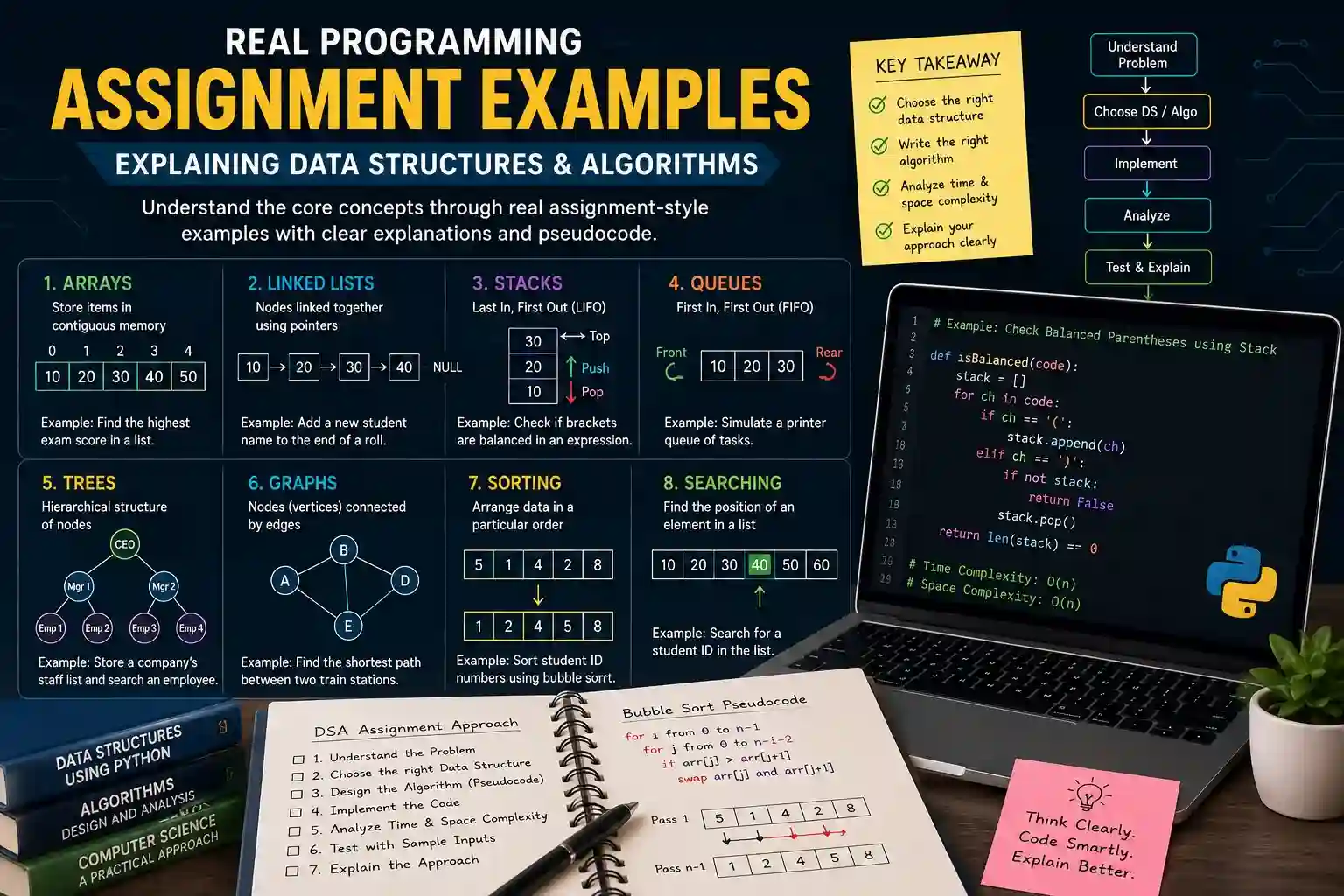
Those who aren't familiar with this term, let's get through it. This one is the simplest of data structure which is used to store items in contiguous memory locations. This sorting is done on the basis of data type and memory size. This helps the computer to instantly calculate the exact location of any item based on its index.
Let's look at an assignment example.
You need to find the highest exam score in a list. So the code will go something like:
function findMax(scores):
max = scores[0]
for each score in scores:
if score > max:
max = score
return max
This example forces you to move through a fixed, ordered list one step at a time, without skipping or repeating a spot. That is the whole point of an array, and this task tests it directly. Once you get comfortable with them early on, the rest of this guide will feel a lot easier.
Linked Lists: When Order Matters More Than Speed
A linked list is a chain of items. Each item points to the next one. Unlike an array, you don't need to know the size before you start here.
If you get an assignment to add a new student's name to the end of a class roll. Highlight that this takes O(n) time, as it needs a thorough check from start to finish.
This example exists to highlight the one big trade-off of linked lists. You can grow the list easily, but you cannot jump straight to the end like you would with an array. You have to walk through every node first. You stop once you reach the last item. Then you attach the new name right after it.
Linked lists trip a lot of students up at first. But if you draw the chain out on paper, it stops feeling abstract and starts feeling obvious.
Stacks and Queues: Order of Operations
A stack works like a pile of plates. The last plate you put down is the first one you take off. This is called Last In, First Out.
A queue works the other way round. Here, the first person in line gets served first. This is called First In, First Out.
Wanna see an assignment example?
Use a stack to verify whether the brackets in a programming statement are matched properly, for example, (a+b).
function isBalanced(code):
stack = []
for character in code:
if character == "(":
stack.push(character)
if character == ")":
if stack is empty:
return false
stack.pop()
return stack is empty
This example is used constantly because it shows a real reason to use a stack, instead of just describing one. The order in which brackets close only makes sense if you track them Last In, First Out. That is exactly what a stack does, so this task proves you understand the concept, not just the definition.
This example alone shows up in dozens of programming assignment help requests every semester, because it connects the idea of a stack to a problem you can actually picture.
What Are Trees in Data Structure?
Tree is a data structure that is not linear but hierarchical in nature and comprises nodes that are connected through edges. Each node stores information and is referred to by its child nodes. Tree is different from linear data structures such as arrays, linked lists, stacks, and queues.
An assignment example to work here: Store a company's staff list, where each manager has employees under them. Now you have to search for that 'one' employee's name. So how will you tackle this?
You'll start at the root and check each branch as you go. If the name matches, you stop right there. If not, you keep moving down the tree. As per programming assignment help online, this is a faster approach, especially when you have large lists to work with.
What are Graphs And How It Connect Things In Data Structure
A graph is a non-linear data structure which represents networks. Graph comprises a finite number of vertices or nodes linked by edges to form a network model of complex relationships. It is used to study social networking, web pages, and global positioning systems.
Assignment example: Find the shortest path between two train stations on a small network.
Since train stations connect in loops and shortcuts, we would use something like Breadth-First Search here. Using graphs, you'll check nearby stations first, then move outward one node at a time until it reaches the destination. In your answer, explain that this method avoids skipping over a shorter path by accident.
Graphs feel like the hardest topic in most units, but they're really just arrays and lists wearing a different outfit.
Sorting and Searching: The Algorithms You'll Use Most
Sorting puts data in order. Searching finds one piece of data inside a bigger set.
Assignment example: Sort a list of student ID numbers from smallest to largest using bubble sort.
function bubbleSort(list):
for i from 0 to length(list):
for j from 0 to length(list) - i - 1:
if list[j] > list[j+1]:
swap list[j] and list[j+1]
return list
Bubble sort is a step-by-step method, perfect for explaining how a sorting algorithm behaves. Here, you compare each pair of numbers and swap them when they're out of order. It keeps repeating until nothing needs swapping anymore.
How to Get Full Marks on a DSA Assignment
Most students lose marks for one simple reason. Their code runs fine, but they never explain it. A strong answer usually follows this order:
- Restate the problem in your own words.
- Explain which data structure or algorithm you picked, and why.
- Show your pseudocode or code clearly.
- State the time and space complexity, and explain how you worked it out.
Skipping step four is the most common mistake students make. Markers are grading your reasoning, not just your final output. So even when your code runs perfectly, always explain why it works and how fast it runs. This one habit is often the real difference between a pass and a high mark.
Final Thoughts
Data structures and algorithms aren't just exam topics you forget after the semester ends. They're the building blocks behind every app, game, and website you use daily. Once you see how each structure solves a real problem, the theory starts making sense on its own.
Try picking one example from this guide right now. Rewrite it using your own sample data or look through the sample papers available at the programming assignment support online. That one habit will help your grades more than reading ten more tutorials.

 9 Years | M.Sc. Computer Science