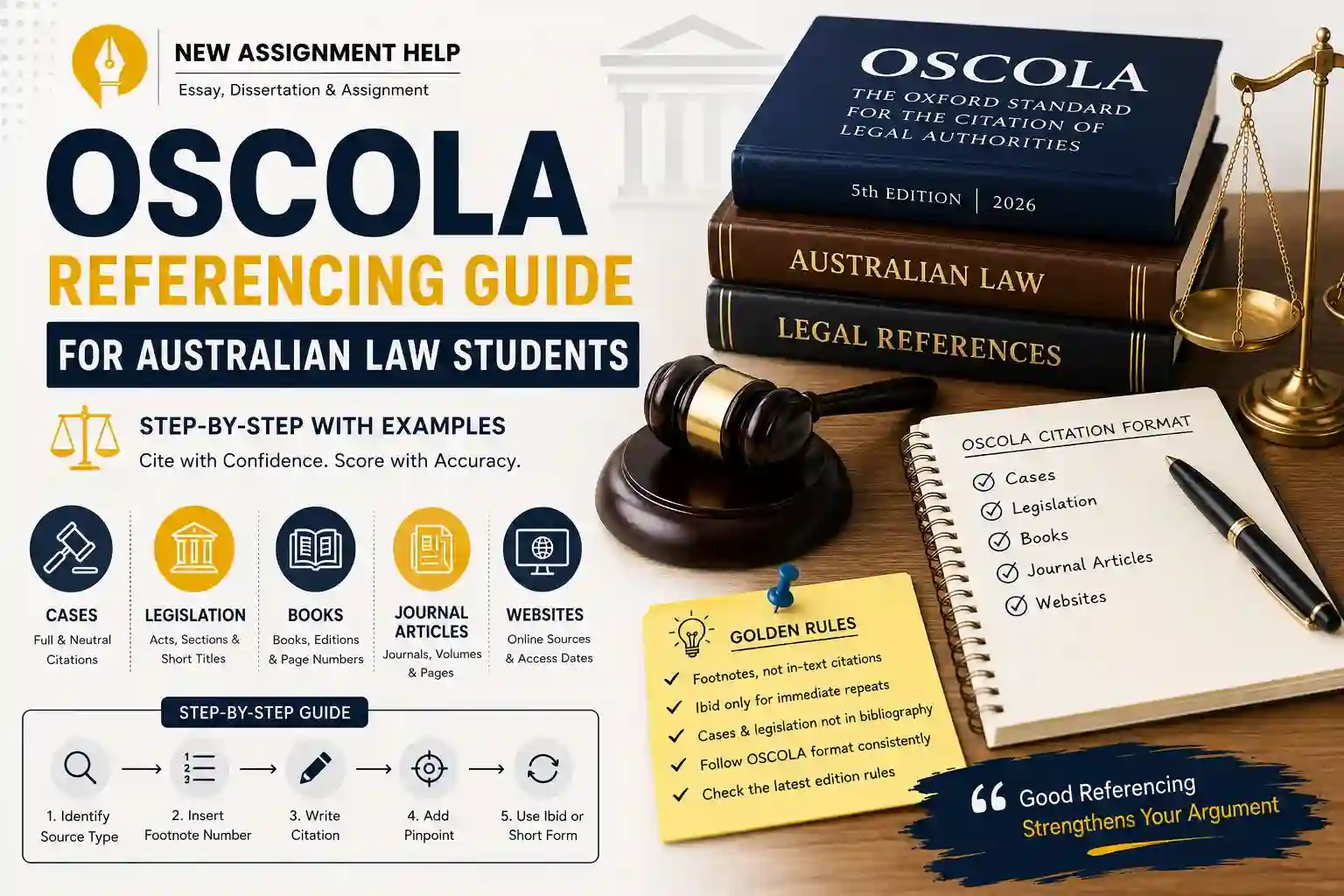
OSCOLA Referencing Guide for Australian Law Students (Step-by-Step with Examples)
OSCOLA stands for the Oxford Standard for the Citation of Legal Authorities. It is a footnote-based citation style used across UK law schools. But if you're an Australian law student, you'll typically meet it in international or comparative law units. Especially when your course leans on old English cases, transnational degrees with a UK partner institution. Or else in moots like the Vis or Jessup.
This guide walks through exactly how to build an OSCOLA reference, in order, with the worked examples. We will also cover the most recent edition in circulation. Now if you already know AGLC4, here's what's different.
AGLC4 vs OSCOLA
Australia's default law referencing style is the AGLC4 (Australian Guide to Legal Citation 4th Edition). But if you're asked to use OSCOLA. You need to know that though both styles use footnotes and keep citations out of the body text, they differ in a few things:
Bibliography structure differs: AGLC4 separates Articles/Books/Reports, Cases, Legislation, and others into lettered categories. OSCOLA calls its source list a table of authorities, split into a table of cases, a table of legislation, and a bibliography of secondary sources. Cases and legislation never appear in the bibliography itself.
No jurisdiction tag on legislation: Where AGLC4 requires (Cth), (NSW), (Vic) and so on after every Act, OSCOLA has no such equivalent. Because UK statutes are simply Short Title Year.
Author order flips between footnote and bibliography in both styles. But the abbreviations and punctuation conventions for journals, reports, and online sources differ enough that copy-pasting AGLC4 habits into an OSCOLA footnote will read as inconsistent. This is the one thing OSCOLA's golden rules explicitly warn against.
If your unit outline says OSCOLA, don't default to AGLC4 muscle memory. The rules for OSCOLA is different. It explicitly requires you to reference a source in two places:
- Footnotes are where you use a superscript number in the text, with the full citation at the bottom of the page. This is standard for every time you quote, paraphrase, or rely on a source.
- Bibliography, which is a single alphabetised list at the end of your work. It gathers every source cited in your footnotes (cases and legislation are usually listed separately from books and articles).
The two aren't identical in format. In footnotes, an author's name appears as written (forename then surname). In the bibliography, it flips to surname first and initials only. This is a very small detail, but it often trips up a lot of students.
Step-by-step guide on building an OSCOLA footnote
Step 1: Identify the source type. Whether it's a case, legislation, book, journal article, or website, each has its own template.
Step 2: Insert your superscript number at the end of the relevant sentence, after any punctuation.
Step 3: Write the citation following the template for that source type (you'll find examples below, just keep reading).
Step 4: Add a pinpoint if you're citing a specific paragraph or a section. If it's a case, use square-bracketed numbers. And for books, simply mention the page number.
Step 5: Decide on subsequent citations. If you cite the same source again immediately, use ibid. If something else has been cited in between, use a short form with a cross-reference: Austin (n 1).
Examples by source type
- Case (older law report):
Donoghue v Stevenson [1932] AC 562 (HL).
- Case (neutral citation, 2001 onwards):
R (Miller) v Secretary of State for Exiting the European Union [2017] UKSC 5, [2018] AC 61 [26].
The neutral citation ([2017] UKSC 5) comes first; the law report citation follows if one exists; a paragraph pinpoint goes in square brackets at the end.
- Legislation:
Human Rights Act 1998, s 7.
After the first full citation, you can introduce a short title in brackets. For example, (HRA 1998) and use it going forward without cross-referencing.
- Book:
Catherine Elliott and Frances Quinn, Criminal Law (10th edn, Pearson 2016) 45.
- Journal article:
Fiona Cownie, 'Legal Academics: Culture and Identities' (2004) 31(3) JL Soc 419, 421.
- Website:
Author, 'Title of Page' (Site Name, date) <URL> accessed [date].
In the bibliography, the same book entry becomes:
Elliott C and Quinn F, Criminal Law (10th edn, Pearson 2016)
The surname first, no page number, alphabetised by surname.
Footnotes vs bibliography: the differences that matter
- Author order: forename-surname in footnotes; surname-initials in the bibliography.
- Page numbers: included as pinpoints in footnotes; omitted in the bibliography.
- Grouping: the bibliography separates cases, legislation, and secondary sources into their own sections. Make sure not to run them together alphabetically as one list.
Catching Up on Updated OSCOLA Rules
The 5th edition of OSCOLA was published in spring 2026, edited by Professor James Goudkamp. It expands coverage of international law sources and, notably, adds guidance on citing generative AI output. Most UK law schools are running a transition year: the 4th edition (2012) still applies for assessments through the 2025/26 academic year, with the 5th edition becoming standard from 2026/27 onwards. If your unit outline doesn't specify an edition, ask. Don't assume the OSCOLA examples you find online automatically apply because most are still written for the 4th edition.
A word of caution on citation generators
Free OSCOLA generators can save time for straightforward sources like books, but several university libraries specifically warn that generators handle case law and database sources like Westlaw or Lexis+ poorly. Treat generated citations as a first draft, not a final answer. Always check them against the rule for that specific source type or get an expert's advice through a law assignment helpservice online.
Common mistakes that cost marks
As Australian students, no matter how thoroughly you understand OSCOLA in theory, you will make a few mistakes while doing it on paper. Some of them are:
- Forgetting the bibliography needs separate sections for cases, legislation, and secondary sources.
- Using ibid when another footnote has come in between (it should only follow the same source immediately).
- Mixing AGLC and OSCOLA conventions out of habit.
- Citing a source in the text but never adding it to the bibliography, or vice versa.
- Leaving out pinpoint references when quoting or paraphrasing a specific passage.
If you keep getting stuck on these errors, a good solution would be to look at how online law assignment support works. They often provide sample papers that could be of great help.
Now there are two more queries that most students come up with.
What is a "table of authorities"?
It's the OSCOLA's term for your source list. Instead of putting the sources together in a single alphabetical list, you split them into tables. Table of cases, table of legislation, and bibliography of secondary sources.
How to recite a case name?
The first citation comes in full. And later citations come in short form of the case name with a cross-reference to the footnote where the full citation appears, e.g. Austin (n 1).
Hopefully, you’ve got all your queries right. So, now let’s end this guide with a ready-to-use template.
Quick-reference template (bookmark this)
| Source | Footnote Format |
|---|---|
| Case (law report) | Case Name [Year] Vol Report Page (Court). |
| Case (neutral citation) | Case Name [Year] Court No, [Year] Vol Report Page [Pinpoint]. |
| Legislation | Short Title Year, s Section. |
| Book | Author, Title (Edn, Publisher Year) Pinpoint. |
| Journal article | Author, 'Title' (Year) Vol Journal Abbreviation Page, Pinpoint. |
| Website | Author, 'Title' (Site Name, Date) <URL> accessed Date. |
Either bookmark this guide or save this in your file. This will help you more than anyone or anything else.
Conclusion
It's safe to say that OSCOLA isn't difficult once you know the rules. Five of them carry the whole system: cite in footnotes, build citations using the template above, use ibid only for back-to-back repeats, keep cases and legislation out of the bibliography, and don't let AGLC4 habits slip into an OSCOLA footnote. If you get stuck, seek New Assignment Help Australia and their experts will get everything aligned.

 10 Years | Ph.D. in Finance