How to Use SWOT and PESTLE in Strategic Management Assignments
You’re sitting with your strategic management assignment that needs to be submitted in the next 48 hours, with two frameworks to work on. A case study about a company you've never heard of and a rubric that says "critical analysis". Now you have no idea what that actually means and how to apply SWOT and PESTLE to these. Does this sound like you?
That’s because nobody has taught you to use them together in a way that boosts your marks. We all think that these are two separate tasks that we need to tick off and submit. But in reality, they're a two-step thinking process. When you use them in the right order, your whole assignment clicks into place. This guide shows you exactly how to do that, with a real Australian example. We’ll also look into frequent mistakes to avoid so you don't lose easy marks.
What Are SWOT and PESTLE? A Quick Explainer
Think of them as two lenses for looking at a business.
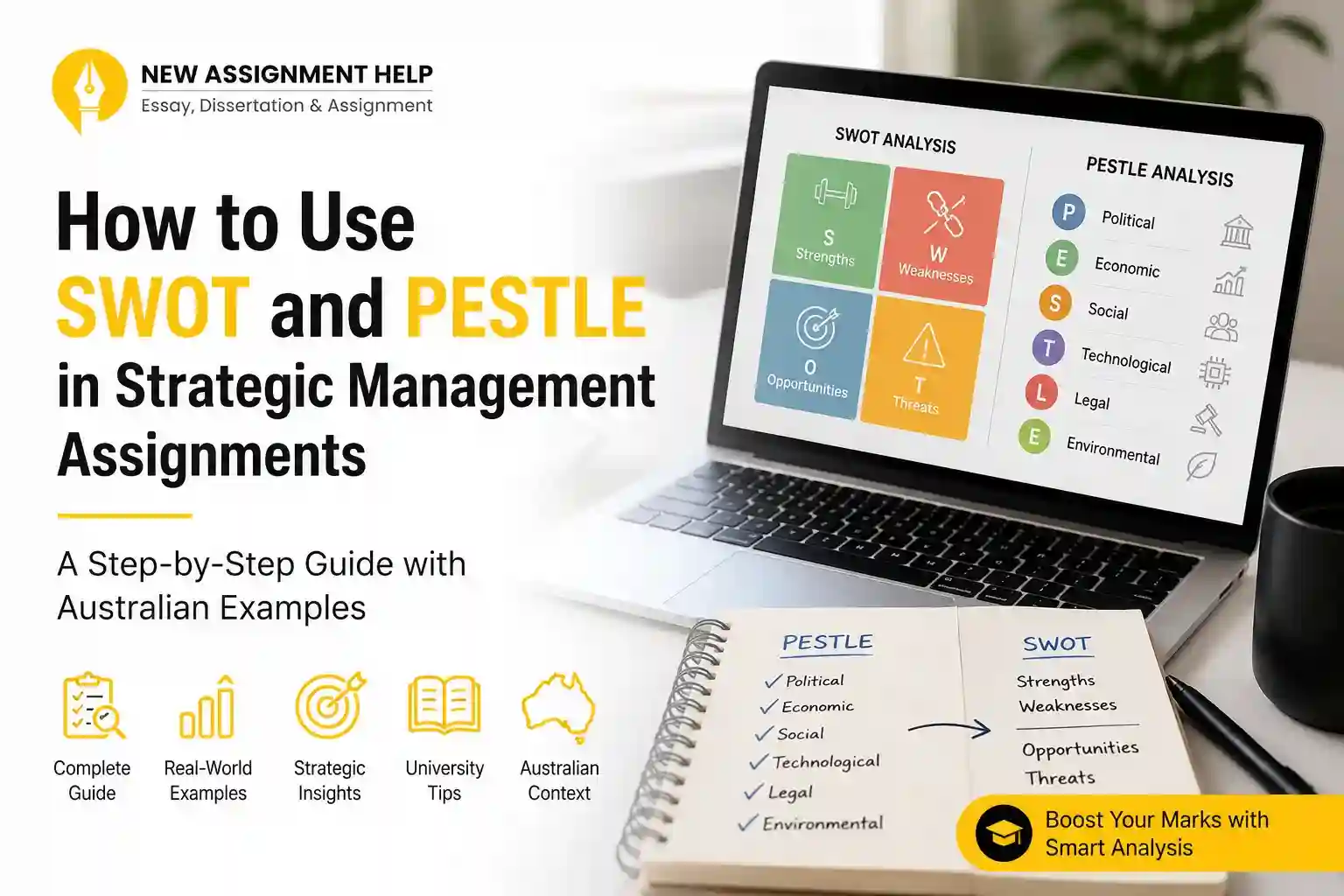
SWOT looks at the inside and the outside of a business. Things like a strong brand, skilled staff, or outdated tech are all considered strengths and weaknesses that live inside the company. Whereas opportunities and threats that the business can’t control come from the outside world.
PESTLE only looks at the outside world, but it goes much deeper. It breaks the external environment into six parts: Political, Economic, Social, Technological, Legal, and Environmental.
Basically, it’s easy to say that SWOT gives you the full picture, whereas PESTLE zooms in on one part with a lot more detail. That's the reason why you should never treat them as two separate tasks.
What comes first: PESTLE or SWOT?
PESTLE always. The reason is that your PESTLE findings become your SWOT Opportunities and Threats. If you do SWOT first, you're basically guessing, but if you do PESTLE first, your SWOT is backed by evidence. Think of PESTLE as the research phase and SWOT as the analysis phase. Do them in that order every single time, and you’ll get an assignment that your teachers love to see.
How to Use PESTLE Analysis for Your Assignment
Work through each of the six factors. For every one of these, ask: what's happening out there, and how does it affect this specific business?
- Political: Governmental policies, trade policies, tax policy. For instance, in Australia, the Fair Work Act, industry regulations, and priorities of the federal budget could be considered here.
- Economic: Look at the inflation, interest rates, consumer spending and foreign exchange rates. The RBA’s cash rate is an example of a factor that impacts the cost of borrowing.
- Social: Population shifts, lifestyle changes, educational attainment, and consumer behaviour changes. The demographic ageing of Australia and the health-conscious trend of consumption are examples of such factors.
- Technological: Here you need to analyse technological innovations, automation, artificial intelligence and even R&D investments to understand whether it's impacting your business positively or negatively.
- Legal: Here, you must study labour law, consumer protection and competition law for better analysis. You can use ACCC decisions and Safe Work Australia regulations as sources of information.
- Environmental: Climate change policy, environmental concerns, carbon emission reduction targets. This category is especially important for Australia because of bushfire risks, commitment to net zero, and ESG investment.
As is commonly observed, students usually need help with a management assignment to find the best sources of Australian data for PESTLE analysis. Here they are: ABS (Australian Bureau of Statistics), Productivity Commission, ACCC, IBISWorld, and AustLII for legislation.
How to Apply SWOT Using PESTLE Findings
Once your PESTLE is done, your SWOT becomes much easier to write. As your Opportunities and Threats are already in front of you. So, here is how it flows:
- Strengths and Weaknesses → look inside the company. Think resources, capabilities, brand, operations, and culture.
- Opportunities and Threats → pull directly from your PESTLE. Each factor you identified can slot into either column.
For example, if your PESTLE flagged that Australia is pushing renewable energy subsidies (Political), this could be an Opportunity for a company in the clean energy space. If it flagged rising interest rates (Economic), this is likely a Threat for a business carrying a lot of debt.
Always explain the connection. Don't just list the same point twice. Show why it belongs in your SWOT and what strategic response it suggests. That's the difference between a pass and a distinction.
Woolworths Group Example
Let’s take up a real-world example to see a simplified version of how this analysis looks in practice. PESTLE highlights:
- Political: Increased ACCC scrutiny on supermarket pricing power
- Economic: Cost-of-living pressures are driving consumers towards private-label products
- Social: Growing demand for local and sustainable sourcing
- Technological: Rapid expansion of e-commerce and app-based grocery shopping
- Legal: Potential regulation on retail supplier contracts
- Environmental: Scope 3 emissions reduction targets under pressure from investors
Those PESTLE points feed into SWOT like this:
| SWOT | Pulled from PESTLE |
|---|---|
| Opportunity | Grow private-label range (Economical) |
| Opportunity | Invest in sustainability branding (Social + Environmental) |
| Threat | Regulatory action on pricing practices (Political + Legal) |
| Threat | Competitors scaling e-commerce faster (Technological) |
See how the frameworks connect? That's the kind of integrated thinking that most strategic management assignment help services bring in their assistance.
What University Markers Actually Want to See
If you're stuck on how to structure your thinking, knowing what will get you marks will help you. Here is a short version of what most Australian university rubrics reward:
- Specificity: company-specific facts and data, not generic statements
- Evidence: cite credible sources (ABS, IBISWorld, peer-reviewed journals)
- Integration: show that your PESTLE and SWOT are connected, not two separate sections
- Critical thinking: challenge assumptions, not just describe them
- Recommendations: end with a clear strategic direction based on your analysis
When you frame your assignment as per these, you don’t fear losing easy marks. Another thing that could be of great help is knowing:
When to Bring in Other Frameworks?
SWOT and PESTLE are often just the start. Once you've done both, your assignment may also ask you to use:
- Porter's Five Forces to dig into industry-level competition
- BCG Matrix to assess a company's product portfolio
- Ansoff Matrix for growth strategy questions
Now, don’t get it wrong. These frameworks don't replace SWOT and PESTLE; they build on them. If your brief asks for multiple tools, treat PESTLE as your foundation and let the others layer on top.
Final Thoughts
SWOT and PESTLE aren't complicated. Students just use them wrong. The key is the order: PESTLE first to scan the external environment, then SWOT to bring it all together with internal factors and strategic implications.
Be specific, cite real data, and always connect your analysis to a recommendation. That's what separates a list from actual strategic thinking and gives your marker what they want.
In case you're feeling overwhelmed by the scope of your assignment, remember that New Assignment Help Australia is here to guide. Getting early feedback on your framework application can make a big difference in your final grade.

 8 Years | Ph.D. in Business Administration