Accounting ratios show up in almost every finance and business unit. Your lecturer hands you a balance sheet and an income statement. Then you get one line of instruction: analyse the ratios. That single line can feel confusing if nobody has shown you what a good analysis actually looks like. This guide breaks the process into clear steps. It shows you what ratios really tell you, how to group them, and how to write about them without just listing numbers.
What Accounting Ratios Actually Tell You
A ratio is just one number divided by another. On its own, a ratio does not mean much. But the real skill shows up when you start comparing it. That comparison can be between a ratio and last year's figure. Or you can compare it to a competitor or to the industry average.
For example, a current ratio of 1.5 sounds fine. But if the industry average is 2.0, that same number suddenly looks weak. Bringing in the context can turn a plain number into an insight that the markers actually want to see in your assignment.
Once you understand that ratios only make sense side by side, you’re up for the next step. This is to look at the main types you will be asked to use while calculating.
The Four Main Accounting Ratio Categories
Most Australian university courses group ratios into four buckets. Knowing these groups helps you structure your accounting assignment logically instead of jumping between random formulas.
- Liquidity ratios: Here you compare the current ratio and quick ratio to check whether a company can pay its short term bills or not. These are mostly used by suppliers and short term lenders.
- Profitability ratios: These ratios let you measure how well a company turns sales into profit. Gross profit margin and net profit margin are common examples here. Investors watch these closely, as it’s the most useful way of analysis for them.
- Efficiency ratios: These are used to show how well a company uses its assets. Inventory turnover and receivables turnover fall into this group. A higher number often means better asset management.
- Solvency ratios: By using these ratios, you look at the long term debt and financial stability of a company. The debt to equity ratio is the classic example here. Lenders use this group to judge long term risk before lending money.
Each group answers a different question about the business. Once you know which group a ratio belongs to, it becomes much easier to explain why that ratio matters in your analysis.
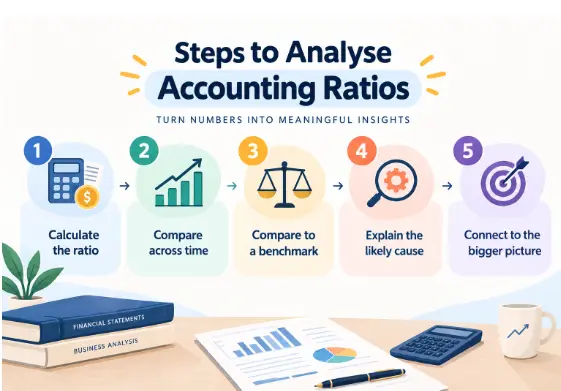
Steps to Analyse Ratios in Your Assignment
Calculating the ratio correctly is only the first step. The interpretation is where most marks are actually earned. Follow this order to keep your analysis structured and easy to understand.
- Calculate the ratio carefully. Double-check your formula and your source figures from the financial statements. A small error here throws off everything that follows.
- Compare it across time. Look at the same ratio over two or three years. This shows whether the company is improving or declining.
- Compare it to a benchmark. Use an industry average or a direct competitor for the comparison. This will give you a sense of scale for better analysis.
- Explain the likely cause. Do not just state that a ratio dropped. Instead, link it to a real business reason, such as rising costs or slower sales. This moves your assignment from descriptive to analytical.
- Connect it to the bigger picture. Tie your finding back to the assignment question, whether that is company performance, investment risk, or financial health. This often goes skipped but it gives a professional sense of completion.
Following these steps keeps your writing focused and stops your assignment from turning into a list of disconnected numbers. Now, since we are on it, let us also look at the common mistakes that often pull down students’ marks.
Common Mistakes While Analysing Accounting Ratios
Even strong students lose marks on ratio assignments for small reasons. Watching for these issues before you submit can protect your grade.
- Ignoring accounting policy differences among different companies. Make sure you adjust them before using them as the competitor for your analysis.
- Another common mistake is when you treat a ratio as a fixed rule. You must know that a low current ratio is not always bad. It all depends heavily on the industry the company operates in.
- When you forget that ratios use historical data, you make a major mistake. Financial statements reflect the past, not necessarily where the company is heading now. So, do not take it otherwise.
- Skipping the "why" is where most students lose marks because your markers actually wants to see your reasoning, not just a table of results copied from a spreadsheet.
These small habits separate a basic pass from a strong grade. A short check against this list before submission can genuinely lift your final score. So go ahead and save this in your notes or bookmark this blog for future reference.
Footnote
Ratio analysis rewards students who think past the calculation stage. Once you calculate a ratio, ask what story it tells about the business. Compare it, question it, and link it to a real cause. That habit alone will lift the quality of almost any accounting assignment you write. If you want a second pair of eyes on your structure or your interpretation, a bit of accounting assignment writing service can help you sharpen the final draft before it is due.