To prepare the best accounting report for your university assignment, you need to have clear sections, real financial data, and a recommendation at the end. Before anything else, you must know that an accounting report is not the same as an essay. Your lecturer does not want a flowing argument with a thesis statement. They want to see how well you can solve a real company scenario using data and numbers. This guide is here to tell you exactly how you can prepare your upcoming accounting report this semester. You’ll learn some common formatting habits that Australian markers expect to see.
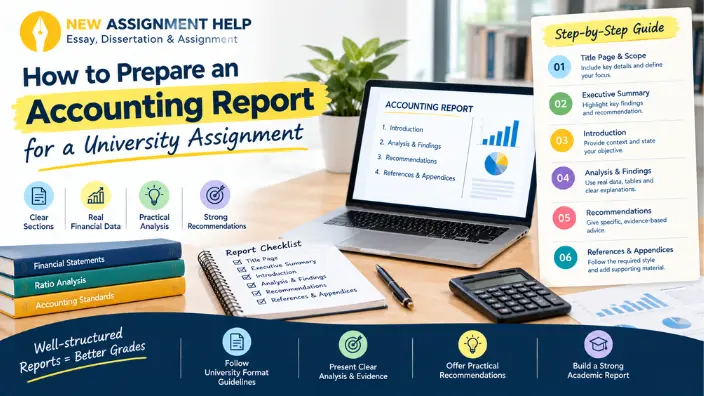
Start With the Title Page and Scope
The first thing about your accounting report is its title page. Mention your name, unit code, report title, and the date. Keep it simple and factual as this is to orient your marker, not to impress them.
The next thing is to note down your exact scope. For this, read your brief thoroughly because some briefs want a full financial review and others want one narrow issue covered. Also, take note of your audience, whether it is a manager, an investor, or a board. After this, you can plan the rest of the report around it.
Write the Executive Summary
The executive summary sits at the front of your report, but you should write it last. It needs to reflect findings you have not worked out yet. Once your analysis is finished, compress it into a short paragraph. Include your purpose, your key result, and your main recommendation.
A reader should understand your conclusion from this section alone, without reading further.
Three or four sentences are usually enough for a university report. Save your full explanation for the body, where it actually belongs.
Build a Short, Focused Introduction
Your introduction tells the reader what this report covers and why. State the business context briefly. Mention the specific question or issue your analysis is going to address.
Two or three paragraphs are usually enough here. It is often seen that students overload the introduction with background that belongs later in the report and lose marks. So, try to avoid this mistake by keeping this section short. End your introduction by pointing towards the analysis ahead to give the reader a clear signal of what is coming next.
Present Your Analysis and Findings in the Main Body
This is where your evidence lives. Every claim here needs a number behind it.
- If you say costs increased, show the figure and the time period.
- If you calculated a ratio, state the result plainly and explain what it tells you.
Break this section into clearly labelled parts like separate headings for profitability, liquidity, or operational performance.
Next, build your findings section on the key results from your analysis. Keep each finding to one or two sentences. State the result, then state what it means for the business in plain terms. Avoid vague language like "performance was mixed”. Say what actually happened instead. This section needs to be paid the most attention because only strong findings can set up a strong recommendations section next.
End With Specific Recommendations
Each of your recommendations should trace directly back to one of the findings before. Vague advice weakens a report fast. Avoid lines like "the company should improve performance", because this isn’t telling your marker anything about your analysis. This is more of a statement than a useful recommendation. Instead, name the action, such as reviewing a specific cost category or reconsidering a financing decision.
If your data had gaps anywhere, mention that too. It shows honesty about what your analysis could and could not cover. Once your recommendations are set, only the formatting and appendices are left to make your accounting report stand out.
Finish With Referencing and Appendices
Presentation affects how your report reads, even before anyone checks your figures. If you need a quick checklist for your final referencing and appendix, here you go:
- Use consistent headings throughout the report
- Keep your paragraphs short and easy to scan
- Whether your Australian accounting unit requires APA or Harvard, keep it consistent throughout
- Cite any accounting standards or textbooks that shaped your treatment of a transaction
- Place your detailed calculations, extra tables, and raw data in the appendix
When you keep this checklist at the last stage of your accounting report preparation, you’ll avoid losing the easiest marks. By using this accounting assignment structure, you’ll ned up with a report that is easy for a reader to follow and for your marker to grade.
Bringing It Together
A strong accounting report follows its structure closely, section by section, with evidence carrying every claim. Work through the title page, summary, introduction, analysis, findings, and recommendations in that order, and you’ll end up with an HD grade report. If your draft still feels shaky before submission, reviewing an online accounting assignment can guide you to understand how to structure each section.

 10 Years | Ph.D. in Financial Accounting