Accounting assignments are one of those typical tasks where Australian students feel stuck more than often. The reason is simple: one wrong answer and your entire balance sheet goes off track. This is a cumulative error that shows up by the very end, especially when you’re least expecting it.
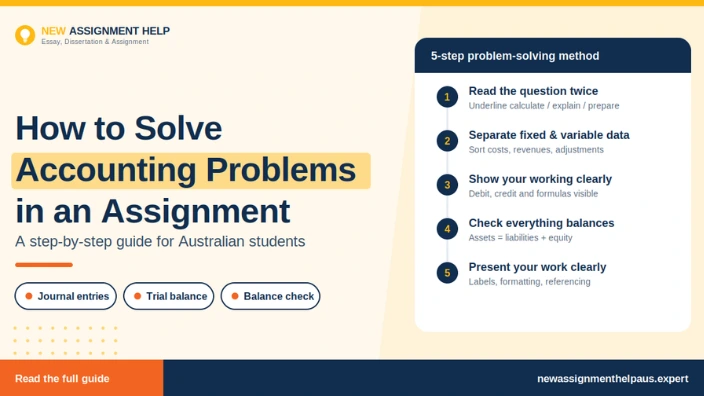
However, if you follow a set pattern of solving accounting problems in your assignment, the process gets much easier to manage. Therefore, this step-by-step guide exists. Here, we break down a simple approach you can use for almost any accounting task at your Australian university. It works for journal entries, trial balances and even full financial statements.
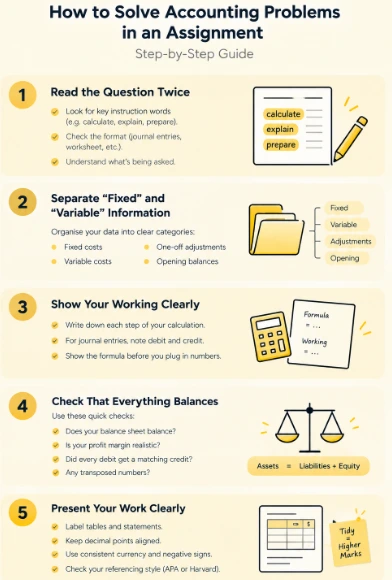
Step 1: Start by Reading the Question Twice
Many students lose marks before they even start calculating because they skip or misread what the question is actually asking. A question might ask you to "prepare" a statement, but you accidentally explain a concept instead. And your entire assignment goes in the wrong direction.
To prevent this from happening, read the question slowly and twice. Underline key instruction words like "calculate", "explain", or "prepare". These words will tell you exactly what kind of answer is expected and how you should approach the question.
Check the format too. Some lecturers want journal entries while others want a full worksheet. When you get these wrong, all your time and effort go to waste even if your numbers are correct. Now once you know what the question wants, you can move on to sorting out the numbers themselves.
Step 2: Separate “Fixed” and “Variable” Information
Most accounting problems mix several types of data together. Costs, revenues, and adjustments all often appear in one long paragraph. Your first real task is to organise this information into separate heads.
Before you touch a single formula, group your data into the following clear categories:
- Fixed costs, like rent, that stay the same no matter what
- Variable costs, like materials, that change with output
- One-off adjustments, such as depreciation or accrued expenses
- Opening balances you need to carry forward
Students often treat a fixed cost as variable or forget an adjustment entirely. But when you sort your data using the categories, you’re dodging one of the biggest errors. With your data organised, you are ready to work through the actual calculation now.
Step 3: Show Your Working Clearly
In Australia, markers check your accounting assignments one calculation at a time. Points are awarded for the method you use, not only the answer itself. A correct total with no working often earns fewer marks than a clear process with a small error in it.
Therefore, the best way to approach this is by writing down each stage of your calculation. If you are doing a journal entry, note which account is debited and which is credited. If you are working through depreciation, show the formula before you plug in numbers.
This habit will show up later, especially when your final answer looks wrong, you’ll have a path to trace back your mistake. Without written working, you are left guessing where things went off track. Now that your working is complete, it is time to check whether the numbers actually make sense or not.
Step 4: Check That Everything Balances
Accounting is built on the idea that both sides of an equation must match. An asset should always equal liabilities plus equity. If your trial balance does not match this, something has gone wrong.
Use these quick checks before you consider your accounting problem solved:
- Does your balance sheet actually balance on both sides?
- Is your profit margin realistic for the type of business?
- Did every debit entry get a matching credit entry?
- Are there any numbers that look transposed, like 54 instead of 45?
These checks might take a few extra minutes, but they catch most common errors that are mostly avoidable. A small gap in your balance sheet almost always points to a transposition mistake or a missed entry somewhere earlier. Fixing it now saves you from losing marks later. Now comes the polishing of presentation.
Step 5: Present Your Work Clearly
After everything is done right, it is very important that your work looks tidy and easy to read from start to finish. Even a correct calculation can lose marks if it look messy or is hard to follow. Therefore, a good accounting assignment format is very important to follow.
Label every table and statement clearly. Keep your decimal points aligned in columns. Use consistent formatting for currency and negative numbers throughout the assignment. Also check your referencing style. Many accounting units in Australia ask for APA or Harvard referencing when you use textbooks or standards like IFRS. Small citation errors can lower your overall grade, even when your maths is spot on.
A final read-through will let you reveal mistakes you missed the first time. Try to do this step after a little break with a fresh perspective.
Conclusion
Solving accounting problems is all about following a consistent process. Begin with a thorough reading of your question, sort out your data, show your working, check your balances, and present everything in the right way.
If a particular topic still feels confusing after trying these steps, you need expert support. Online accounting assistance can walk you through the logic behind trickier questions and build stronger habits for your next assignment.

 7 Years | Ph.D. in Audits