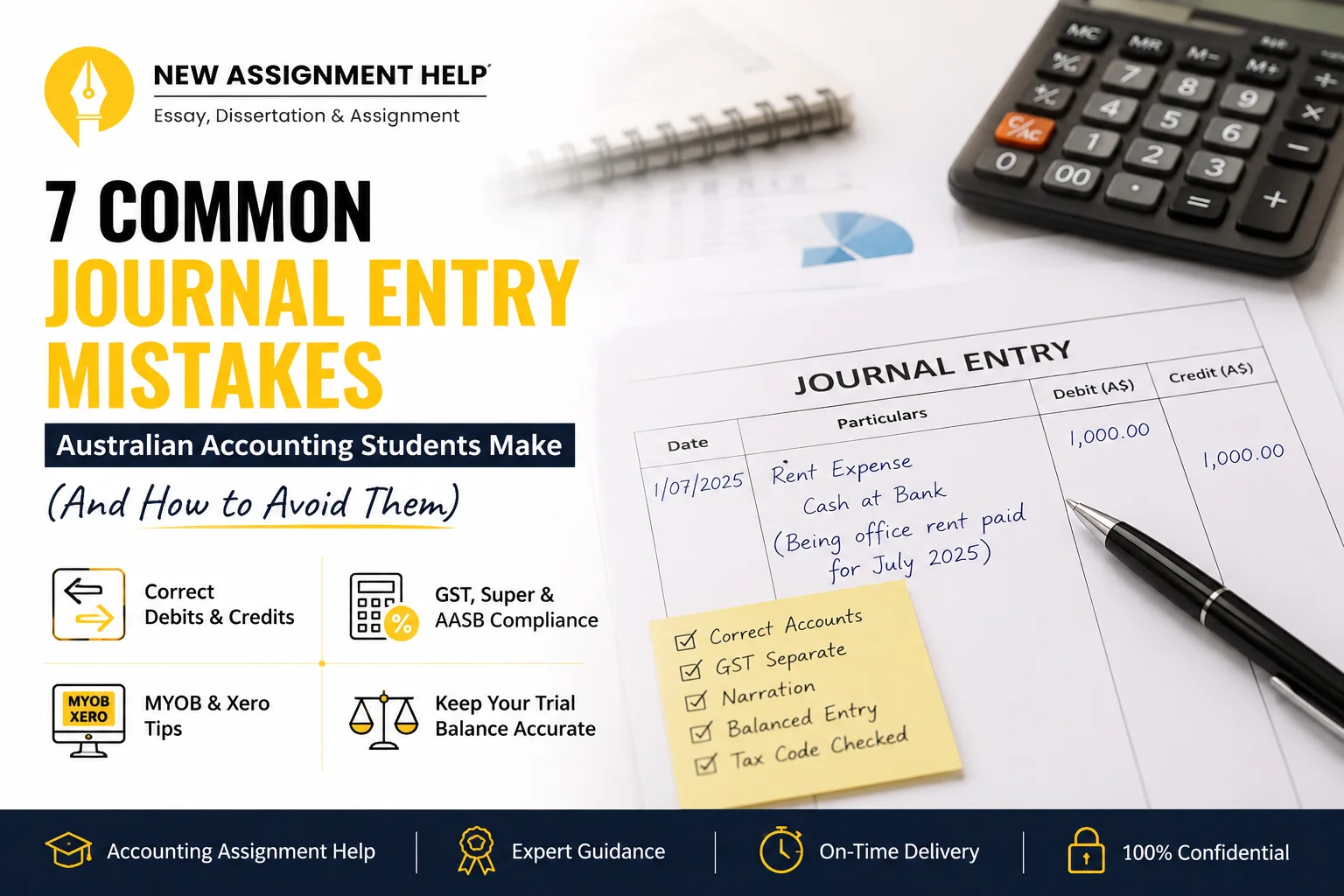
Journal Entries Made Easy: Common Accounting Assignment Mistakes Australian Students Make
If you've ever stared at a journal entry and thought, "I'm sure this is right". But when you submit, you get it back with red marks all over it. Then, you're not alone. Journal entries trip up thousands of Australian accounting students every semester.
And guess what the frustrating part is? These mistakes happen because of small, avoidable slip-ups. A flipped debit. A missing GST line. A narration that's too vague. One wrong entry can throw off your entire ledger, mess up your trial balance, and corrupt the whole practice set. This guide is here to break these mistakes down with tips and solutions so you can learn how to stop them.
One Wrong Entry Can Break Everything
Here's something your textbook doesn't say clearly enough: journal entries don't exist in isolation. Every entry you make flows into the general ledger. The ledger feeds into your trial balance. The trial balance builds your financial statements.
So when something goes wrong at the journal entry stage, it will keep growing. By the time you reach your bank reconciliation, that one small mistake from three steps back has turned into a much bigger problem.
This is especially true in Perdisco, which is used by universities like Monash, RMIT, UQ, Deakin, and UniSA. Perdisco penalises every incorrect entry. So fix errors as soon as you spot them. Don't move forward and hope it resolves itself.
A quick rule before we get into the mistakes. Debits must always equal credits. If they don't, something is wrong. Keep the accounting equation in mind:
Assets = Liabilities + Equity
Every single entry you make has to keep that equation balanced.
7 Journal Entry Mistakes and Tips You’re Not Aware Of
1. Flipping Debits and Credits
This is the most common mistake in accounting assignments. Students know the words "debit" and "credit" but under pressure, they often mix them up. So the next time, use “DEAD CLIC” mnemonic to remember it.
- Debit side increases: Expenses, Assets, Drawings
- Credit side increases: Liabilities, Income, Capital
So if your business pays rent, you debit Rent Expense (expense goes up) and credit Cash (asset goes down). If you flip those, your entry is wrong, and your trial balance won't balance.
Draw a T-account on paper before you type anything into MYOB or Xero.
2. Forgetting GST
GST is 10% in Australia and it applies to almost every transaction. The mistake students make is recording the full GST-inclusive amount in one account instead of splitting it out. Let's say your business buys office supplies for $1,100, including GST.
- Debit Office Supplies Expense: $1,000
- Debit GST Paid (Input Tax Credit): $100
- Credit Accounts Payable: $1,100
And for a GST-inclusive sale of $1,100:
- Debit Accounts Receivable: $1,100
- Credit Sales Revenue: $1,000
- Credit GST Collected: $100
GST Paid and GST Collected should always come in two separate accounts. Never roll them into the main figure.
3. Posting to the Wrong Account
This one is sneaky because the entry may look balanced with all the debit and credit, but the accounts speak otherwise.
A classic example would be recording office supplies as inventory. Under AASB 102, inventory is goods held for sale or used in production. For which office supplies, like pens, paper, printer ink, etc., don't qualify. They go to an expense account, not an inventory account. Getting this wrong means your financial statements misrepresent what the business actually owns.
So the next time you get to write an entry, ask yourself, What type of account is this? Asset? Liability? Expense? Revenue? Equity? Getting that right will make the rest of the entry much easier.
4. Skipping the Narration
A lot of students treat narration like a formality. At most Australian universities, it’s a direct marking criterion. Miss it or write something vague, and you lose marks even if the debit and credit are perfect.
If you want to build a narration that tells the marker exactly what happened and why, then use this format:
"Being [reason for the transaction] refer [source document, e.g., Invoice No. 47]."
So instead of writing "rent paid", write: "Being office rent for July 2025, refer Receipt No. 18."
5. Wrong Amounts and Transposition Errors
You'd be surprised to know how often this happens. A student copies $9,200 from the question and types $92,000 into their entry. Or writes 59 instead of 95. These are called 'transposition errors', and they're brutal in Perdisco because the wrong number flows through every subsequent step.
However, the fix is simple: after you finish an entry, read the numbers back against the question out loud or point to it. And always check your trial balance totals before moving on.
6. Forgetting Superannuation as a Separate Entry
Superannuation is a legal obligation, and in your assignments, it needs its own journal entry. One that is separate from wages.
The employer super contribution (currently 11.5% of ordinary time earnings under the Superannuation Guarantee) is recorded like this:
- Debit Superannuation Expense: [amount]
- Credit Superannuation Payable: [amount]
Students either forget this entry entirely or bundle it into the wages entry. Both are wrong. Super is its own expense and its own liability. Treat it that way.
7. Using the Wrong Tax Code in MYOB or Xero
Most Australian universities require students to work in MYOB or Xero. The journal entries on those screens look completely fine, but the tax code is often wrong underneath. You've selected GST-free instead of 10% GST, or you've used the wrong BAS category.
This silently corrupts your GST reports and your business activity statement figures. The numbers in your trial balance might still balance, so you won't even notice until the BAS doesn't match.
To get it right, make sure that every time you enter a transaction in MYOB or Xero, the tax code is on line. It takes two seconds but saves hours of backtracking.
Experts from accounting assignment support label them as “easy yet avoidable mistakes”. If you pay a little more attention, these can be caught and improved before they affect your marks.
How to Fix a Wrong Journal Entry Without Making It Worse
First, never delete a posted entry in MYOB or Xero. Deleting breaks the audit trail and can cause more problems than the original one. Instead, write a correcting entry. Use this structure:
- Identify what went wrong. Was it the account, the amount, the tax code, or the period?
- Reverse the incorrect entry by swapping debits and credits for the same amounts.
- Post the correct entry immediately after.
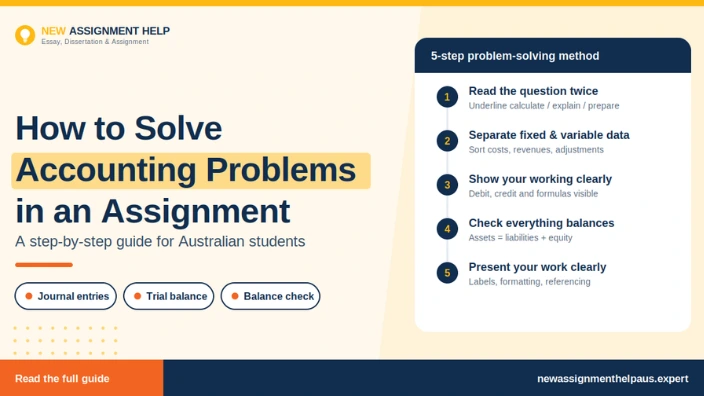
- Recheck your trial balance to make your debits and credits equal before you move on.
In Perdisco, do this before proceeding to the next module because a mistake when carried forward can create multiple errors.
Before You Submit, Run This Quick Check
Don't just re-read your entries; rather, verify them against these five things:
- Does every entry include a date, correct accounts, balanced amounts, and a narration?
- Have I recorded GST as a separate line on every applicable transaction?
- Does my trial balance balance to the cent?
- Have I recorded superannuation separately from wages?
- Have I checked the tax code on every line in MYOB or Xero?
If you can tick all five, you're good to go.
The Bottom Line
Journal entries follow rules, and once you know them, things get easier. Especially the Australian-specific ones like GST, SUPER, and AASB standards. You don't need to be a maths genius to ace your accounting assignments. Just slow down, be focused on numbers and check your work carefully.
If you’re still confused and looking for someone who can get you out of this, then reach out to New Assignment Help Australia and get all your journal entries up to the mark.

 10 Years | Ph.D. in Financial Accounting