How to Write a Management Assignment in Australia: 7-Step Expert Guide
I still remember myself thinking, “How to write a management assignment", when I had it for the first time during my Australian university coursework. The major reason for my confusion was that it wasn’t like school essays. It asked me to solve a business problem, use theories, and sound like a manager, all at once.
Today, I, Julia Morton, an academic writer for New Assignment Help Australia is going to tell you what I’ve learned over the years. With my approach, I’ve successfully assisted more of these assignments than I can count.
When you stay with us till the end, you'll end up with 7 simple steps to write a good management assignment, including:
- Decode the assignment question
- Identify relevant management theories
- Analyse the case/scenario using structured models
- Build a clear argument and position
- Support analysis with real-world examples
- Link findings to recommendations
- Apply academic referencing and refine your work
So, keep reading to know each step in detail and handle your next management task like a manager.
1. Decode the Business Problem in the Assignment Question
When I started my master's in management, I used to jump straight into writing, which cost me marks. Over time, I learned that the real task is to decode the question and solve a business situation. Let me tell you how to do that stepwise.
- Start by spotting the management context because every question sits inside a function. Ask yourself: → Is this a strategy problem, a people problem, or a performance problem?
- Next, uncover the real business issue. For example, if a case mentions falling profits, don’t stop there. Ask:→ Is this a cost issue, pricing issue, or competitive strategy failure?
- Then, finalise your decision-making. Make sure that you end up with: → “This assignment is going to solve X business problem by evaluating Y options."
Now that’s your foundation. By using my proven strategy, you can turn a simple assignment into a real business analysis. That’s exactly what gets you higher marks.
2. Identify Relevant Management Theories and Frameworks
Early on, I tried to use every theory I had studied when I used to write my management assignments. But that backfired because my assignments looked full but not focused. In management, using fewer, relevant frameworks is far more effective than listing everything. The best way to choose the right framework is by relating it to the type of business problem you identified in Step 1.
- Strategy issue → think SWOT, PESTLE, Porter’s Five Forces
- Internal performance issue → use Value Chain, KPIs, Balanced Scorecard
- People/HR issue → apply motivation or leadership theories
Tip: Avoid theory dumping.Instead of writing definitions, go straight to application:
“Using a SWOT analysis, Netflix shows…”
3. Analyse the Case/Scenario Using Structured Models (e.g., SWOT, PESTLE)
With over 6+ years of teaching students how to write management assignments, I’ve come across one common issue. Using models without actually analysing them. Read below to know how to turn points into insights.
- Don’t write “high competition” or “rising costs”; rather, try to find out, “What does this mean for the business?”
- Link factors together. For example, include rising costs (weakness) and high competition (threat) to explain the pressure on profitability.
- Avoid any generic statements and keep everything case-specific. The best way to do that is by constantly asking the "So what?” question.
4. Build a Clear, Argument-Driven Response
This is the point where your management assignment either makes or breaks. At our management assignment help service, I’ve seen many students make the mistake of getting distracted and losing their main argument.
So, always start with a clear stance by asking yourself, “What should the company actually do?” Once you finalise this, make sure that your entire assignment moves towards supporting that decision; no wandering.
Next, use a simple structure that moves from claim to evidence to implication in each paragraph. Example:
The company should focus on cost leadership (claim), as rising operational expenses are reducing margins (evidence). That means efficiency improvements are important to stay competitive (implication).
5. Use Real-World or Corporate Examples to Support Analysis
As a management expert, let me give you one simple trick to make your assignment sound instantly credible. Always use real company examples to show application beyond the case study. Use examples to strengthen your argument, not replace it. For example: “This is similar to how Walmart maintains low prices…”
But one thing to remember, keep your examples short and relevant. You don’t need long case studies. All you need is one or two lines that clearly support your argument. One more thing: always choose a familiar Australian company as an example, as it would be easier to understand.
Lastly, never forget to link your example back to your argument. After every example, ask, “What does this show for my case?" This final link is what turns an example into evidence.
6. Link Findings to Recommendations and Managerial Implications
This is where many assignments fall apart. Students do good analysis but then give generic recommendations that don’t connect to anything. In management, your recommendations should feel like a direct outcome of your analysis. It should not surprise the reader; rather, it should feel obvious after your argument.
Make your recommendations specific and actionable. When you suggest that the company should improve its strategy, it sounds vague. When writing a management assignment, you need to think like a real manager. You must suggest practical ways to address the “what” and “how” of your company’s issue.
Since you have to take steps for your company, you should also not forget to think about what your decision will mean for managers. When you start adding these to your assignments, you’ll look like a real-life manager capable of decision-making power.
7. Apply Referencing and Refine for Clarity and Flow
And now we’ve reached the final step of how to write a management assignment in Australia. At this point, you must remember that you can easily lose marks over small issues. If you have an error in formatting or if you do not reference your claims properly, that’s a red flag.
Just because you need to cite your information doesn't mean that you do it randomly. Always confirm your specific referencing style beforehand. Whether it’s APA 7 or Harvard style, the key is to use it correctly and consistently.
After your entire assignment is done, take a last review. This will help you to catch any errors in the flow or structure. Check:
- Does each paragraph link to the next?
- Is the argument easy to follow?
- Are sentences simple and direct?
- Is the language clear and professional?
- Does this read like a structured business analysis or just a collection of answers?
If something feels hard to read, refine or rewrite it. This final step will save you all your effort from the first idea to your final sheet of the assignment. At this point, I would also recommend you take expert guidance from online assignment help services for management subject.
Conclusion
Learning how to write a management assignment in Australia is less about writing and more about thinking like a manager. What can really help you improve your grade is framing your next assignment as per the 7 steps discussed above.
In the end, a strong management assignment is not the longest or the most detailed. It's the one that shows clear thinking, relevant analysis, and practical recommendations. That’s what markers look for, and that’s what I’ve taught you today. Use this framework in your next assignment and come tell us how easy it felt. However, if you're still feeling overwhelmed and find yourself searching for someone to "do my management assignment," the experts at New Assignment Help Australia are always available to provide professional guidance and academic support.
Management Assignment Examples & Free Template
Seeing real examples can make the process much clearer. Different management subjects follow the same structure but vary in focus. The key is how you apply theory to your specific topic. Here are simple examples to guide you.
A strong assignment might analyse a company’s competitive position. For example, you could apply Porter’s Five Forces to explain market pressure. Then, suggest strategies for growth based on your findings.
- HR Management:
This type of assignment focuses on employees and their performances. When you get to use Maslow’s or Herzberg’s theory, link it to real workplace practices and outcomes.
Here, the focus is on processes and efficiency. You are required to analyse supply chain issues or production delays. So, tools like process mapping or lean management can be used to support your points.
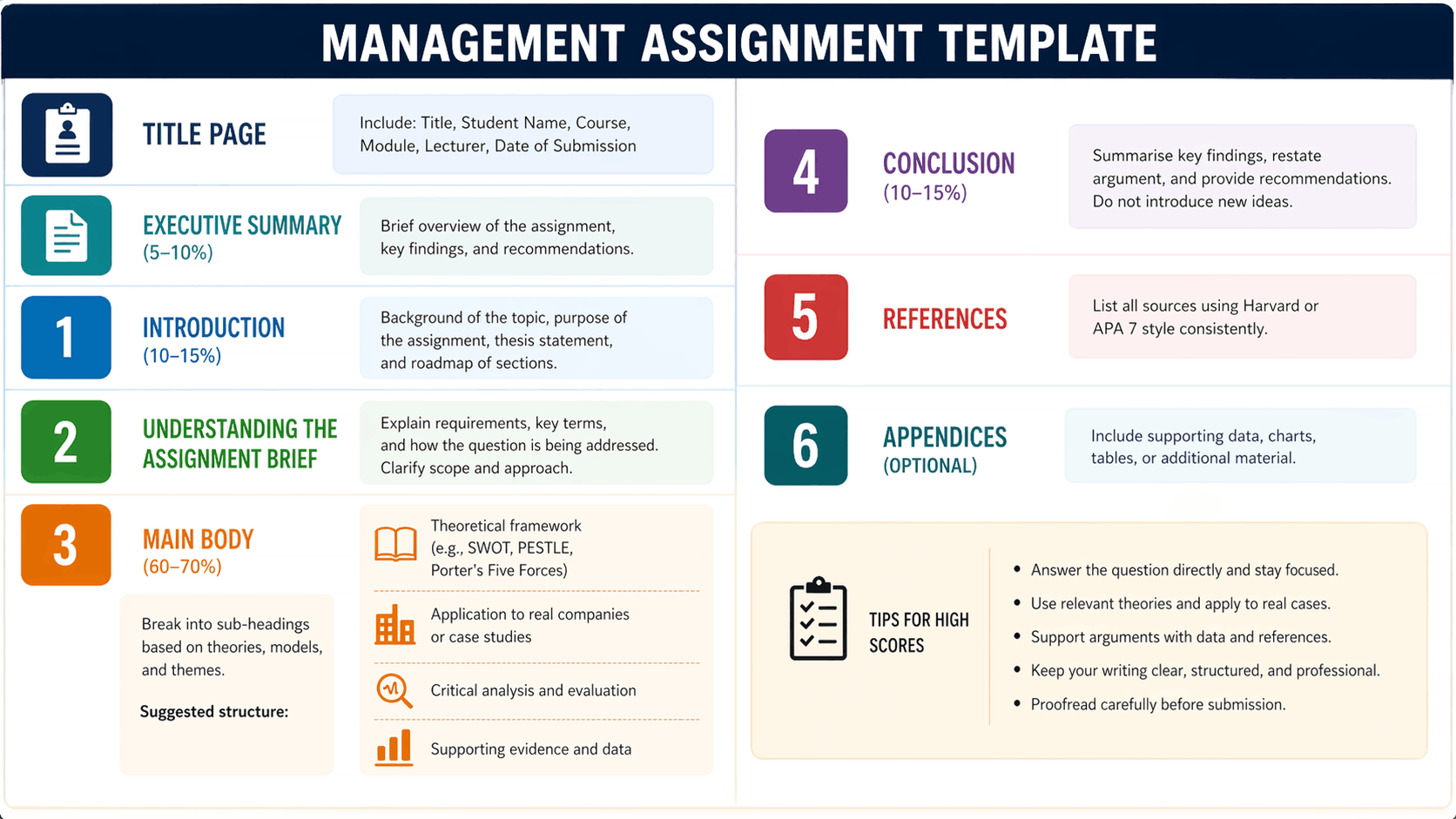
If you wish to make your work easier, you can save the following management assignment template on your phone and get a structure ready at your hand.

 6 Years | MIM