Key Takeaways
- Abraham Maslow introduced his hierarchy in a 1943 paper in Psychological Review, not as a pyramid — that came later.
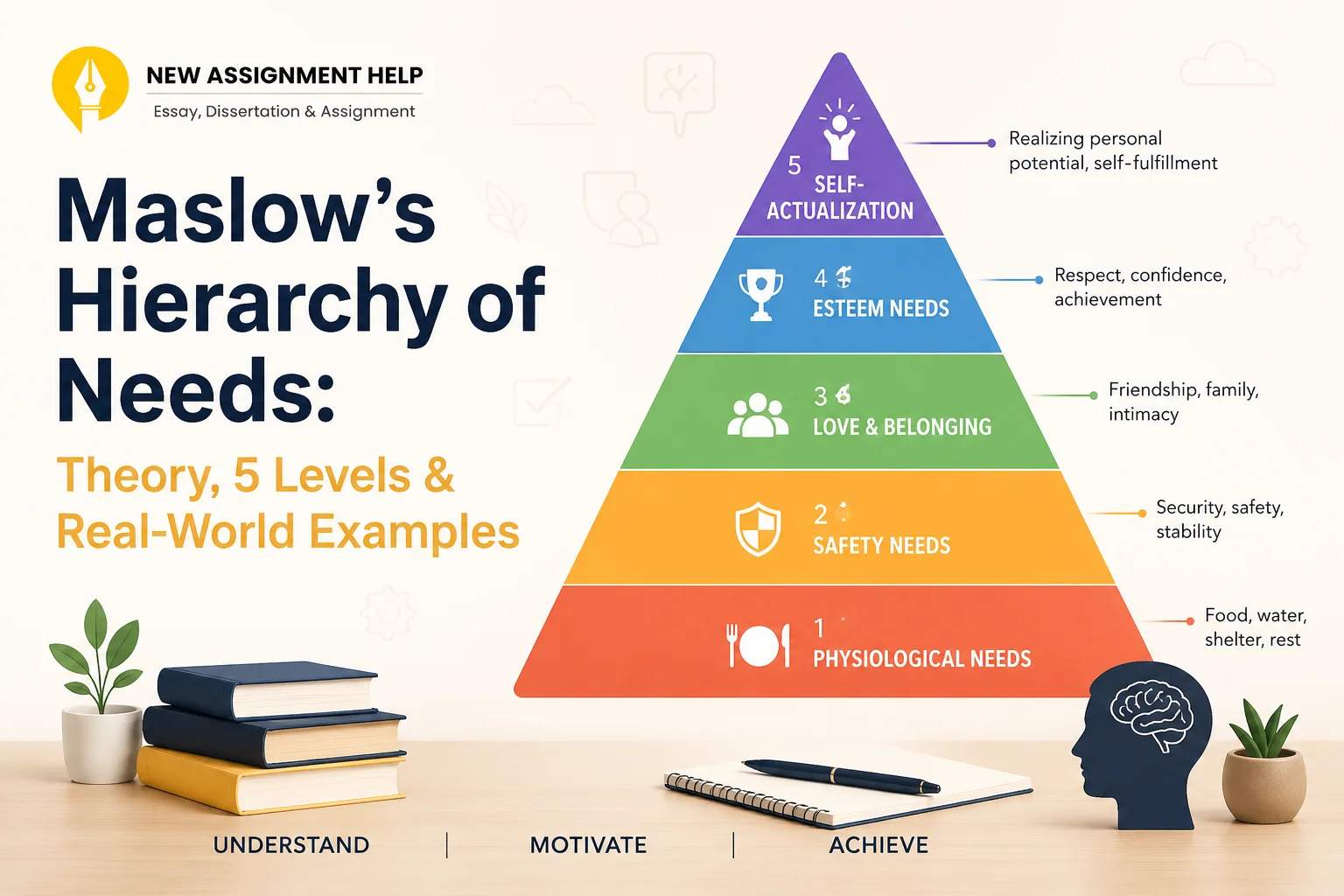
- The model organises human motivation into five levels: physiological, safety, love and belonging, esteem, and self-actualisation.
- The bottom four levels are deficiency needs; only self-actualisation is a growth need.
- Maslow later expanded the model to seven or eight tiers, adding cognitive, aesthetic, and transcendence needs.
- The theory has significant applications in education, clinical psychology, and organisational management — but it also has well-documented limitations.
You have probably come across motivational quotes telling you to follow your dreams or reach your potential. But how does psychology actually explain what drives humans to act — and in what order? That is precisely what Abraham Maslow set out to answer.
Among the many theories of human motivation, Maslow's Hierarchy of Needs remains one of the most cited, debated, and applied frameworks in psychology, education, and management. Understanding it is not just useful for psychology students; it offers a lens through which any discipline, from nursing to business strategy, can interpret human behaviour.
This guide walks through the theory from the ground up, explaining where it originated, what each level actually means, and how the model has held up under scrutiny, as well as where it has not.
What Is Maslow's Hierarchy of Needs?
In 1943, the Brooklyn-born psychologist Abraham Maslow published a paper titled "A Theory of Human Motivation" in the journal Psychological Review. In it, he argued that human needs are not random or equal — they form a hierarchy, with more fundamental needs taking precedence over higher-level ones until they are sufficiently met.
Maslow's central claim was straightforward: a person who has not eaten in three days is not thinking about career advancement or creative fulfilment. They are thinking about food. Only once basic survival requirements are addressed can people meaningfully turn their attention to anything beyond them.
The theory describes five clusters of needs, arranged in ascending order of psychological sophistication:
- Physiological needs (survival)
- Safety needs (security)
- Love and belonging needs (connection)
- Esteem needs (recognition and self-respect)
- Self-actualisation (reaching full potential)
One important point that textbooks often miss: Maslow himself never drew a pyramid. The iconic triangular diagram that appears in virtually every psychology textbook was introduced by consultant Charles McDermid in a 1960 article in Business Horizons. Maslow described the hierarchy in prose. The pyramid is an interpretive tool — useful but also responsible for some of the rigidity that critics have since identified in the model.
The 5 Levels of Maslow's Hierarchy Explained
1. Physiological Needs
The base of the hierarchy consists of the biological requirements for survival: air, food, water, shelter, clothing, sleep, and homeostasis (the body's ability to regulate its internal environment). These are the most prepotent of all needs — meaning they exert the strongest pull on behaviour when unmet.
Maslow described physiological needs as "instinctoid" — biologically determined patterns rather than learned behaviours. If a person is severely deprived of any of these, the rest of the hierarchy becomes essentially irrelevant. A student who arrives to a 9am lecture having not slept or eaten is not going to absorb much cognitive content. Their body's demands override everything else.
Physiological needs include:
- Food and water
- Air and shelter
- Sleep and rest
- Clothing and warmth
- Homeostasis (internal body regulation)
2. Safety Needs
Once physiological needs are reasonably met, a new motivational cluster emerges: the need for safety and security. This includes physical safety (freedom from violence, accidents, and harm), financial stability (employment, savings, insurance), emotional security (freedom from fear and anxiety), and health safety (access to medical care).
Maslow noted that safety needs are particularly prominent in children, who are more dependent on external stability. In adults, they manifest most visibly during periods of economic crisis, illness, or social instability. A person who feels genuinely unsafe in their environment — whether due to an abusive home, job insecurity, or conflict — will not be able to focus consistently on social connection or achievement.
Safety needs include:
- Personal security from physical harm
- Financial security (employment, savings, insurance)
- Health and well-being
- Stability and predictability in daily life
A key nuance Maslow introduced is that needs do not require 100% satisfaction before the next level becomes relevant. A person might have safety needs 70% met while beginning to engage meaningfully with belonging needs. The hierarchy describes dominance, not strict sequencing.
3. Love and Belonging Needs
Humans are social animals — not metaphorically, but neurologically. The third level of Maslow's hierarchy reflects this: once physical and safety needs are reasonably addressed, people are strongly motivated by the need for connection, acceptance, and affection.
This encompasses friendships, family relationships, romantic partnerships, and membership in social groups and communities. Maslow described both the giving and receiving of love as part of this need — it is not merely about being accepted, but about having meaningful reciprocal bonds.
Loneliness and social exclusion, when persistent, produce measurable psychological harm. Research published in the journal PLOS Medicine has found that social isolation carries health risks comparable to smoking 15 cigarettes a day — a finding that gives Maslow's inclusion of belonging among the foundational needs considerable empirical backing.
Love and belonging needs include:
- Friendship and peer relationships
- Family bonds
- Romantic and intimate relationships
- Membership in community or social groups
- A sense of acceptance and belonging
4. Esteem Needs
From this level onward, the needs become more internally driven. Maslow divided esteem into two categories:
Self-esteem — confidence in your own abilities, your sense of competence, independence, and belief in your own worth.
Esteem from others — recognition, respect, reputation, and the acknowledgement you receive from the people and institutions around you.
Both matter. A person who is respected by their peers but has deep personal insecurity is not truly satisfying their esteem needs. Equally, a person with strong internal self-belief but no recognition from others often still feels something is missing.
When esteem needs are unmet, people tend to feel inferior, helpless, or undervalued. When met, they produce feelings of confidence, achievement, and a sense of contribution to the world around them.
Esteem needs include:
- Self-esteem (confidence, competence, independence)
- Recognition from others (respect, status, prestige)
- A sense of achievement and mastery
- Reputation and social standing
5. Self-Actualisation
At the apex of the original five-tier model sits self-actualisation — the desire to fulfil one's unique potential and become the most complete version of oneself possible.
Maslow was careful to note that what self-actualisation looks like varies enormously between individuals. For one person, it might mean becoming an accomplished surgeon. For another, it is raising a family with purpose and presence. For another still, it is producing art or contributing to scientific knowledge. There is no single template.
What matters is not the destination but the direction: self-actualising individuals are oriented toward growth, meaning, and the realisation of their authentic capacities, rather than merely filling deficits.
Maslow coined the term "peak experiences" to describe the moments of profound clarity, joy, or transcendence that self-actualising people tend to report. These are the moments when everything feels aligned — when a researcher finally solves a problem they have been working on for years, or when a musician performs a piece that moves the room to silence.
Self-actualisation includes:
- Pursuing meaningful personal growth
- Creative expression and problem-solving
- Realising unique abilities and talents
- Contributing to something beyond the self
- Living in alignment with your core values
Deficiency Needs vs Growth Needs
In the late 1950s, Maslow drew a distinction that is often glossed over in introductory courses but is central to understanding his full theory: the difference between deficiency motivation (D-needs) and growth motivation (B-needs, from being).
Deficiency needs are the bottom four levels of the hierarchy — physiological, safety, love and belonging, and esteem. They are called deficiency needs because they are activated by a lack of something. When you are hungry, that deficiency motivates you to eat. When you feel unsafe, that deficiency motivates you to seek security. Once the gap is filled, the motivational pull disappears — at least temporarily.
Growth needs — most clearly represented by self-actualisation — work in the opposite direction. Meeting them does not reduce the desire; it intensifies it. The more a person grows and actualises, the more motivated they become to continue. There is no satiation point.
This distinction matters practically. It explains why some people — once materially comfortable — still feel chronically dissatisfied: their deficiency needs are met, but they have not engaged meaningfully with growth. And it explains why self-actualising individuals can tolerate considerable hardship in other areas of life while remaining motivated and purposeful.
As Maslow put it in Motivation and Personality (1954): fully functioning people are not driven by what they lack but by what they are becoming.
The Expanded Hierarchy: Beyond the Original 5 Levels
The five-tier model is the one most commonly taught — but it is not the version Maslow himself considered final. In his later writings, particularly in the revised edition of Motivation and Personality (1970) and posthumous publications, he extended the hierarchy to include additional needs that reflect a more nuanced picture of human motivation.
Cognitive Needs
Maslow argued that humans have a genuine drive to know, understand, and make sense of the world around them. Curiosity, the desire for knowledge, and the need to comprehend one's environment are not simply instrumental (learning to earn more money, for example) — they are intrinsically motivating. This is why students who are genuinely intellectually engaged with a subject learn at an entirely different level than those who are merely fulfilling requirements.
Aesthetic Needs
Separate from cognitive needs, Maslow proposed that people are also motivated by beauty, order, and form. The need to experience and create beautiful things — whether in nature, art, architecture, or mathematics — is a genuine motivational force for many individuals. Aesthetic deprivation (exposure to chronic ugliness, chaos, or sensory poverty) can itself be demoralising.
Transcendence Needs
At the very top of the expanded model, Maslow placed transcendence: the motivation to help others achieve their own self-actualisation, or to connect with something larger than the individual self — spiritual experience, service, or identification with the wider human community. This distinguishes his later thinking significantly from earlier readings that treated self-actualisation as the ultimate end point of development.
The expanded hierarchy is less frequently assessed in undergraduate modules but reflects Maslow's own evolving understanding that human motivation, even at its highest levels, extends beyond personal fulfilment.
Real-World Applications of Maslow's Hierarchy
The theory's enduring influence comes from its applicability far beyond the walls of a psychology lecture room. Here are the three most significant domains where it has been meaningfully applied.
In Education
After the model's publication in 1943, educators began recognising its diagnostic power. A student who arrives at school hungry, cold, or living in an unsafe home environment is not going to engage fully with mathematical reasoning or literary analysis — their brain is still managing more fundamental concerns.
Understanding Maslow's hierarchy gives teachers and school administrators a framework for identifying why a student is disengaged before assuming the issue is intellectual or motivational in the conventional sense. Schools that have adopted trauma-informed approaches — providing breakfast programmes, stable routines, and emotionally safe environments — are applying Maslow's hierarchy in practice, whether they name it that or not.
For motivated students whose lower needs are already met, the framework also suggests how to create conditions for genuine intellectual engagement: autonomy, challenge, and environments that support the satisfaction of esteem and self-actualisation needs.
In Clinical and Counselling Psychology
Maslow, as a practising psychologist, intended his theory as a clinical tool. It gives practitioners a framework for assessing which layer of a patient's motivational structure is disrupted. A patient presenting with chronic anxiety might have unmet safety needs — persistent financial instability or an unsafe living situation — that are directly fuelling their psychological distress.
A patient who feels persistently empty despite professional success might be experiencing unmet belonging needs, or a gap at the level of self-actualisation — a mismatch between the life they are living and the one they feel they should be living. Rather than treating the symptom in isolation, the hierarchy encourages looking at the full motivational picture.
In Business and Organisational Management
This is where the theory has perhaps been most heavily — and sometimes most superficially — applied. Managers and HR professionals use Maslow's hierarchy to diagnose what is driving disengagement or high turnover in a team.
If employees feel financially insecure (physiological and safety needs unmet), no amount of culture initiatives will compensate. If they feel undervalued or invisible (esteem needs unmet), bonuses alone will not retain them. The hierarchy suggests that sustainable employee motivation requires attending to multiple levels simultaneously, not simply optimising for compensation.
During the COVID-19 pandemic, many organisations found themselves navigating Maslow's hierarchy in real time — suddenly forced to address employees' physiological and safety needs (remote working, physical health, job security) before anything else became meaningful.
Alternative Models: Alderfer's ERG Theory
Maslow's work directly inspired subsequent theories of motivation that attempted to address its limitations. The most significant of these is Clayton Alderfer's ERG Theory, developed in 1972.
Alderfer condensed Maslow's five levels into three: Existence (corresponding roughly to physiological and safety needs), Relatedness (love and belonging, plus the social dimension of esteem), and Growth (intrinsic esteem needs and self-actualisation).
The key innovation was removing the rigid sequential structure. Where Maslow proposed that higher needs cannot become prominent until lower ones are sufficiently met, Alderfer argued that multiple need categories can be active simultaneously, and that frustration of higher-level needs can cause a person to regress to lower-level needs — a mechanism he called the "frustration-regression" principle.
This is arguably more consistent with lived experience. A person who is blocked from growth at work does not simply stop caring about growth — they may redirect their energy back toward safety or belonging needs in ways that are visible to managers as disengagement or increased conflict-seeking. ERG theory offers a more flexible and empirically testable framework than Maslow's original model, and is increasingly preferred in contemporary organisational psychology.
Criticisms and Modern Interpretations
Maslow's Hierarchy of Needs is not without significant criticism, and understanding those criticisms is as important as understanding the theory itself — particularly in an academic context.
Lack of Empirical Support
The most persistent critique is methodological. Maslow developed his theory primarily through observational and biographical analysis — he studied people he considered exemplars of self-actualisation, including Abraham Lincoln and Albert Einstein. A 1976 review by Mahmoud Wahba and Lawrence Bridwell, published in Organizational Behavior and Human Performance, found limited empirical support for the hierarchical structure when subjected to quantitative testing. A meta-analysis in the Psychological Bulletin (2011) similarly concluded that the evidence for a fixed sequence of needs is mixed at best.
Cultural Bias
The hierarchy reflects a broadly Western, individualistic value system. In collectivist cultures — prevalent across East Asia, South Asia, Latin America, and many African communities — social belonging and communal obligations may take precedence over individual esteem or self-actualisation in ways the original model cannot accommodate. Cross-cultural psychologist Geert Hofstede argued that interpreting Maslow's hierarchy through a culturally sensitive lens is essential, noting that the relative weighting of belonging versus individual esteem varies significantly across societies.
The Rigidity Problem
Maslow himself acknowledged that the hierarchy is not meant to be read as an absolute gate — a person does not need 100% satisfaction at one level before the next becomes relevant. But the pyramid metaphor invites exactly that misreading. Research consistently shows that people pursue multiple need categories simultaneously, and that significant disruptions (a traumatic event, for example) can reactivate lower-level concerns in people who had long since moved beyond them.
The Self-Actualisation Definition Problem
Self-actualisation is extraordinarily difficult to operationalise or measure. Who decides what constitutes a person's "full potential"? Maslow's descriptions of self-actualising individuals drew heavily on historically prominent Western figures, which introduced both selection bias and a culturally specific definition of what human flourishing looks like.
These criticisms do not render the theory useless — they refine how it should be applied. The hierarchy is best understood as a heuristic framework: a useful starting point for thinking about motivation, not a scientifically precise mechanism.
Supporting Evidence
Despite the methodological criticisms, a body of research broadly supports the premise that unmet lower-order needs disrupt higher-order motivation.
A 2017 study published in the Journal of Personality and Social Psychology found that individuals do pursue goals related to multiple levels of the hierarchy simultaneously, with the relative salience of each level fluctuating based on circumstance — a finding that supports a more dynamic reading of Maslow than the rigid pyramid suggests.
Neuroscientific research on threat response is consistent with Maslow's prioritisation: when the brain detects a threat to physical safety or social belonging, it activates the hypothalamic-pituitary-adrenal (HPA) axis, diverting cognitive resources away from higher-order thinking. This is why students in chronically unsafe environments show impaired working memory and executive function — the brain is physiologically constrained from accessing the faculties required for learning.
Research on self-determination theory (Deci and Ryan, 1985) — one of the most empirically supported theories in contemporary motivational psychology — converges with Maslow on the importance of autonomy, competence, and relatedness, even if the theoretical architecture is different. This convergence suggests that Maslow identified real motivational structures, even if his model of their organisation was imprecise.
Conclusion
Maslow's Hierarchy of Needs is not a perfect model, and Maslow never claimed it was. What it offers is something more modest and more durable: a structured way to think about the layered nature of human motivation, and a practical tool for identifying what might be missing when people — students, patients, employees, or ourselves — struggle to engage fully with their lives.
The pyramid that generations of students have studied is not quite what Maslow drew; the sequence is not quite as rigid as it appears; and the model reflects one cultural tradition more than others. But the fundamental insight — that basic needs, if unmet, crowd out everything else — holds up surprisingly well across decades of subsequent research.
For students of psychology, the value of this theory lies not in memorising its levels but in learning to use it as a diagnostic lens: to ask, before assuming laziness or lack of will, what layer of motivation might actually be disrupted.
FAQs About Maslow's Hierarchy of Needs
Q1: Can people pursue needs from different levels at the same time?
Yes — and this is one of the places where the pyramid metaphor misleads. Maslow himself described the hierarchy in terms of dominance, not strict sequential gates. A person can have their safety needs substantially met while simultaneously pursuing belonging and esteem.
A 2017 study in the Journal of Personality and Social Psychology confirmed that individuals frequently pursue goals across multiple levels concurrently, with the relative importance of each fluctuating based on circumstance. Think of it less like climbing stairs and more like managing several ongoing processes, some of which are more urgent than others at any given moment.
Q2: How does culture shape the application of Maslow's Hierarchy?
Culture has a profound effect on which needs are prioritised and how they are expressed. Physiological and safety needs tend to be relatively universal, but the higher levels vary considerably.
In collectivist societies — common across East and South Asia, Latin America, and much of Africa — the need for group belonging and social harmony may take clear precedence over individual esteem or self-actualisation. Dr. Geert Hofstede, whose work on cultural dimensions remains foundational in cross-cultural psychology, noted that applying Maslow's framework without accounting for cultural context risks misreading motivation in non-Western individuals entirely.
Q3: What are the main criticisms of Maslow's Hierarchy?
The key criticisms are:
- Limited empirical support for the fixed hierarchical sequence (Wahba & Bridwell, 1976; Psychological Bulletin meta-analysis, 2011)
- Cultural bias toward Western, individualistic values
- Oversimplification of complex and often simultaneous motivational forces
- Difficulty defining and measuring self-actualisation in a scientifically rigorous way
- The pyramid diagram (not Maslow's own creation) has encouraged overly rigid interpretations of a theory that Maslow intended to be flexible
Despite these criticisms, the theory remains a foundational framework in psychology curricula precisely because its core insight — that unmet basic needs dominate behaviour — is both intuitive and reasonably supported by adjacent research.
Q4: How can students apply Maslow's Hierarchy to their own academic experience?
Maslow's hierarchy is a practical self-diagnostic tool, not just an abstract theory. Here is how to use it:
- Audit your lower levels first. Are you sleeping enough, eating adequately, and physically safe? Skimping on these genuinely impairs cognitive function.
- Assess your safety layer. Chronic financial stress, housing insecurity, or relationship instability will create background anxiety that competes with your capacity to focus.
- Check your belonging level. Social isolation during demanding academic periods is a well-documented driver of poor performance and withdrawal. Actively maintaining connections is not a distraction from study — it is part of the infrastructure that makes study possible.
- Use esteem strategically. Small, completed goals build the sense of competence that fuels further progress. Break large tasks into achievable units.
- Define what self-actualisation means for you. Not in career terms alone, but in terms of the kind of thinker and person you are trying to become. Having a clear answer to that question is itself a motivational resource.

 8 Years | PhD