How to Use the IRAC Method For Your Law Problem Questions With Examples
In Australia, as a law student, you've probably got a task and been asked to use the IRAC framework in solving it. But just like most students, you don't even know what it means or how to use it the right way. So here you are.
In this post, we'll walk through each step of IRAC, look at a full worked example, and cover a few things that trip up a lot of students. You'll also get to learn the difference between IRAC and a few similar-sounding methods. So, let's not waste any more time and begin learning.
What Is the IRAC Method?
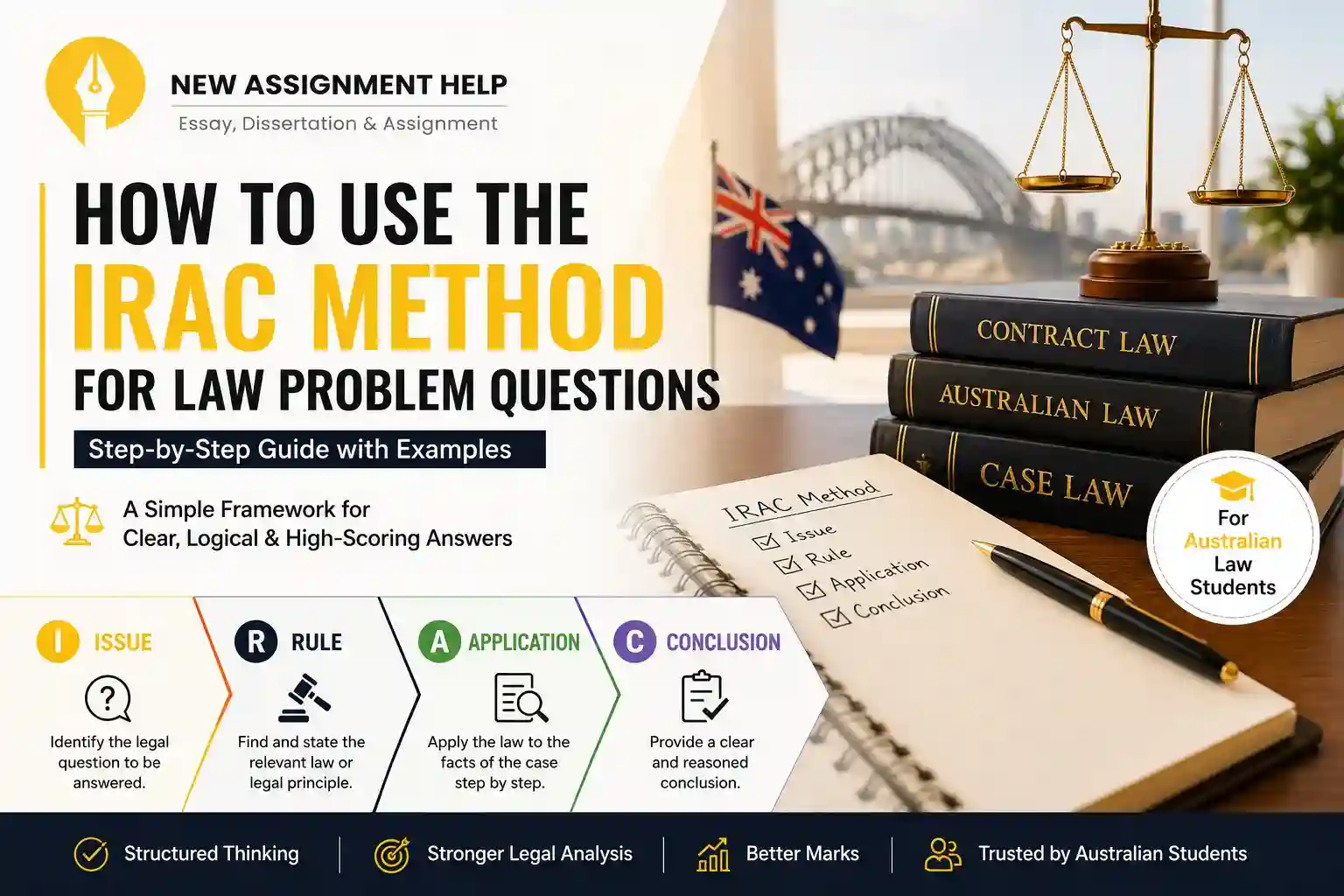
IRAC is a simple four-step method that helps you break down a messy legal problem into something clear and easy to follow. When you follow the steps in order, your answer comes out structured, logical, and easy for your marker to follow. Here's what each letter means:
Issue – What is the legal question you need to answer?
Rule – What law applies to that issue?
Application – How does that law apply to the current facts?
Conclusion – Based on all of that, what's the likely outcome?
Many students often get confused between IRAC and ILAC. They're basically the same thing with just a little "letter swap". In ILAC, the "rule" becomes the "law". That is it, with the goal being the same.
IRAC, HIRAC, and a Few Other Methods You Might Hear
Just like IRAC, you must have heard about another method called HIRAC. This is just IRAC with an extra "H" at the front, which stands for 'Heading'. So, before you dive into the issue, you write a short heading that names the problem or the parties involved. Some Australian law schools, including UWA, teach this version.
Just like that CIRAC is another one, where you state your conclusion at the very start and again at the end. This can help your marker understand where your answer is heading before you even get into the details.
Next is MIRAT. It stands for Material Facts, Issue, Rule, Application, and Tentative Conclusion. When using this framework, you present your facts before identifying the issue. IRAC skips that step, which is why a lot of Australian law schools prefer it.
So if your lecturer mentions any of these names, you now know all. They're all alike, sharing the same idea: spot the issue, find the law, apply it, and conclude. Now, let's get into a little depth for each step.
Breaking Down Each Step of IRAC
We know that IRAC is used in law assignments, but in case you don't know how, here is the explanation. Let's take up each one-by-one in detail.
Issue: What legal question needs to be answered?
This is where you identify what the question is actually asking. To get this right, read the problem carefully and make a specific issue statement, something like a question you can actually answer using the law.
Let's say you want to imply whether Sarah wins her case or not. So, write something like "Did Sarah and Tom form a legally binding contract when they exchanged text messages?"
Another thing, if there's more than one issue in the problem, deal with each one separately. Don't try to squash everything into one big paragraph.
Rule: What Law Applies?
Once you know the issue, the next step is to find the law that deals with it. This could be a piece of legislation, a case, or both. State the legal principle or test clearly, without going off on a tangent about the history of the law or unrelated cases. If a case set out a test with multiple parts, list those parts, because you'll need them for the next step.
In Australia, you'll usually need to reference this using AGLC 4 (the Australian Guide to Legal Citation). Since this referencing style is a little tough, looking up the available online samples from law assignment assistance can help you.
Application: Justify the law in the case
This is the longest and most important part of your answer. Here, you take the rule you just explained and apply it to the facts of the problem, step by step.
For each part of the legal test, ask: Does this fact satisfy this part of the rule? Walk through it logically. If the rule has three elements, go through all three using the facts you've been given. Don't just state a conclusion and skip the reasoning. Your marker wants to see how you got there, not just where you ended up.
Conclusion: What Can Be the Possible Outcome?
This is where you bring everything together. Based on your application, what's the answer to the issue you identified at the start? That is what you're going to state here in short and direct language.
Sometimes the law isn't crystal clear, and that's okay. If that's the case, give a "tentative" conclusion. Something like, "it's likely, but not certain, that a contract was formed" is a perfectly acceptable way to finish, as long as you've explained why in your application section.
A Quick Worked Example
Let's say the problem question involves two people, Mia and Jake, who exchange text messages agreeing that Jake will buy Mia's car for $3,000. But later on, Jake changes his mind and labels the entire conversation as a "joke". Now, how will you present this case using the IRAC method? Below is how.
- Issue: Did Mia and Jake form a legally binding contract through their exchanged text messages?
- Rule: As per the rule, a binding contract must have an offer, acceptance, consideration, and intention to create legal relations.
- Application: Mia's message offering the car for $3,000 is likely an offer. Jake's reply agreeing to buy it seems like acceptance. The $3,000 is consideration. The harder question is intention, since Jake claims it was a joke. The court will now look at the context and the exchanged messages to decide whether a reasonable person would think the parties intended to be bound.
- Conclusion: Based on the wording of the messages, it's likely a court would find the parties did intend to be bound, meaning a contract was probably formed.
Did you see how each section builds on the one before it? That's the whole point of IRAC. It stops you from jumping straight to an answer and builds a proper flow to reach your reasoning.
Common Mistakes to Avoid
When you talk about solving law problem questions using the IRAC method, there are a few things that cost students marks again and again:
- Vague issue statements. "Will X win?" isn't specific enough. Name the actual legal question.
- Skipping the application step. Stating the rule and then jumping to a conclusion without showing your working is one of the biggest mark-losers.
- Mixing up multiple issues. If there's more than one legal issue, give each one its own full IRAC structure rather than blending them together.
- Forgetting citations. Even a strong legal argument loses marks if it's not properly referenced.
If you're new to legal writing, learning from students who've used law assignment guidance for case-study style questions, you often notice the same pattern: identify the problem, apply the relevant rule or standard, then justify your answer.
Wrapping It Up
IRAC isn't complicated. All you have to do is spot the issue, find the rule, apply it carefully to the facts, and write a clear conclusion. Do that for every issue in the problem, and you'll already be ahead of a lot of your classmates.
In case you're stuck on a particular problem question or just want someone to check your structure before you submit, getting support from New Assignment Help Australia can take some of the pressure off. This will be quite helpful during exam season when everything seems to land at once.

 8 Years | Master of Finance