.webp)
Writing an accounting assignment should not feel as hard as it does. As an Australian university student, you might definitely know the numbers and the theories. But still, if the marks don't add up, it certainly needs direction.
Well, here's the good news. You’re at the right place for your problem. Most accounting assignments follow a pattern. Once you see the pattern, the writing gets easier. With this guide by your side, you'll stop guessing the outcomes and will start ticking off what gets you those grades.
So, let’s not wander around much and get straight into the process. From reading the question to proofreading your final draft, keep this guide open through each step and hopefully you’ll end up learning how to write an accounting assignment the way professionals do. Before moving on to the steps, let's first see the difference between a good assignment and a weak one, so you know where you stand.
Weak vs Strong Accounting Assignment
| Weak Assignment | Strong Assignment |
|---|---|
| Only calculations | Calculations plus explanation |
| No AASB references | Correct AASB application |
| Generic discussion | Evidence-based analysis |
| Minimal sources | Evidence-based analysis |
This was just a brief overview of what you are going to learn in this guide. That is to use real evidence, a mix of credible sources and an explanation of calculations. With that in mind and this table to hand, let’s learn how to move from the left column to the right.
Step 1: Understand the Question First
Before you touch a spreadsheet, read the question twice. Then read it a third time. Every accounting assignment uses instruction words. These words tell you what to do, and missing them is a quick way to lose easy marks. Here's what each word in your brief means:
- Calculate means to show your numbers and your workings. Don't just write the final figure.
- Analyse means to break the numbers down and explain what they show about the business.
- Compare means looking at two things side by side and pointing out the differences and similarities.
- Discuss means to explore the topic from more than one angle, including any counterarguments.
- Evaluate means to judge how good or bad something is and back up your judgement with reasons.
- Recommend means give clear advice based on your findings, not just a summary of them.
A lot of students lose marks here without realising why. They calculate a ratio when the question actually asks them to evaluate it. They discuss a topic when the question asks them to recommend a course of action. The maths might be perfect, but if you answer the wrong instruction, you're marked down anyway.
Therefore, here is the simple way to fix it. Underline every instruction word before you start writing. Then jot one sentence next to each one, explaining what you plan to do to satisfy it. This takes five minutes but saves you from writing pages that miss the point.
Step 2: Research the Right Sources
Good research makes your accounting assignment stronger. Weak research makes it obvious that you rushed, even if your writing sounds confident. Therefore, invest your time here. If you need proper sources to dig in, here you go:
- Your textbook, which usually sets the framework your lecturer expects
- Peer-reviewed journals, for deeper analysis and academic weight
- Annual reports from real companies, especially ASX-listed ones
- AASB standards, for the technical rules behind your topic
- Company financial statements, so your numbers come from real data
Try not to lean only on blogs or random websites. Markers notice this fast, and it usually costs you marks for depth and credibility. A good rule is to start broad and then narrow it down. Read your textbook chapter first, then find one or two journal articles, then pull a real annual report to apply the theory to.
If your assignment involves financial reporting, it helps to understand which AASB standards apply to your assignment before you start writing. Knowing the standard early shapes how you approach the whole task.
Step 3: Create a Simple Outline
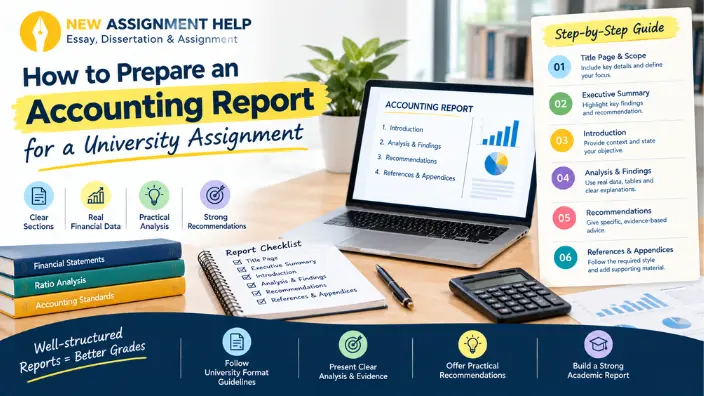
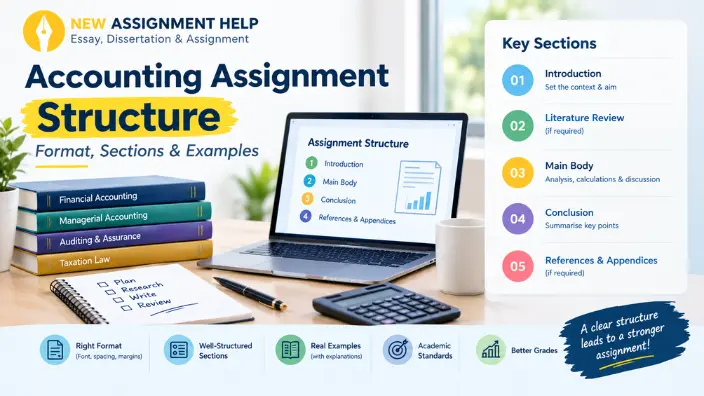
When you have a clear outline before you begin writing, it can actually save you a lot of time. It eventually stops you from staring at a blank page in the middle of your assignment. If you're still deciding what to focus on, these accounting assignment topics can help you narrow down a suitable topic before building your outline. This is a suggested outline for an accounting assignment by many accounting assignment help providers:
- Introduction: In which you define the scope of your assignment
- Background: In which you provide background on the company/issue
- Accounting analysis: In which you use the theoretical framework
- Calculations: In which you provide your calculations
- Discussion: In which you interpret your results
- Recommendations: In which you provide recommendations based on your discussion
- Conclusion: In which you summarise the important aspects of your assignment
- References: In which you cite all the references used in your assignment
Do not look any further; just follow this order and your assignment will flow naturally from one section to the next. Before you write a single sentence, jot a one-line summary under each heading. This will help you remember what that section should achieve.
Step 4: Do the Calculations, Then Explain Them
This is where most students lose marks. Because they randomly put the digits there without explaining what they mean. Let's look at a quick example where you have to calculate a company's current ratio.
Current ratio = Current assets ÷ Current liabilities
If current assets are $200,000 and current liabilities are $100,000, the ratio is 2.0.
A weak answer stops here. A strong answer explains that the company has twice as many current assets as current liabilities. It suggests the business can cover its short-term debts comfortably.
Just like this, always show your formula, show your workings, and then explain what the number actually tells the reader.
Let's try one more example, this time with depreciation. Say a machine costs $50,000, has a useful life of 10 years, and no residual value. Using the straight-line method:
Depreciation expense = (Cost − Residual value) ÷ Useful life
That gives you $5,000 per year.
Again, a strong answer here will explain that the company will expense $5,000 each year to reflect the machine wearing out over its useful life. This reduces reported profit but keeps the asset's carrying value realistic.
Expert Tip: Always explain what the numbers mean and link them to the accounting theory because this is exactly what your markers expect to see. So, whether your accounting assignment is about depreciation, revenue, or impairment, do not forget this step.
Step 5: Support Your Arguments with Evidence
Mind that stating an opinion without backing it up with real evidence will only drop your grades. Therefore, you must support your claims using:
- AASB standards, to show your argument follows the actual rules
- Academic journals, to show you understand the wider debate on the topic
- Textbooks, to ground your explanation in accepted theory
- Real annual reports, to prove your point with actual company data
Basically, if you say a company's revenue recognition policy looks aggressive, show why. Quote the standard, then reference the accounting policy note in the annual report. For example, instead of writing:
"The company's inventory policy is appropriate."
Write:
"According to AASB 102, inventory should be measured at the lower of cost and net realisable value. ABC Ltd's 2025 Annual Report states that inventory is measured using this approach, indicating compliance with the standard."
By backing your arguments in this way, you can move on from a pass to a distinction. This basically helps you prove the opinion using sources that the marker can actually check.
Step 6: Use Accounting Terms the Right Way
Accounting has its own language. Using it correctly shows the marker you understand the subject. Here is the glossary of a few terms that you'll come across often and is expected to use:
- Assets, resources the business owns or controls that will bring future value
- Liabilities, what the business owes to others
- Equity, what's left over for owners once liabilities are paid
- Depreciation, the gradual expense of using up a physical asset over time
- Accrual, recording income or expenses when they happen, not when cash moves
- Impairment, when an asset's value drops below what's recorded in the books
- Revenue recognition, the rules for when income actually counts as earned
Try to use these terms inside your calculations and discussion, not just as a standalone list. For example, when you explain depreciation, use the term while you're working through the numbers, the way we did in Step 4. It shows real understanding, not memorised definitions copied from a glossary.
A quick trick works well here. After a paragraph, check if you could swap the term for plain English without losing meaning. If you can, you're using it correctly. If the sentence falls apart without it, it's probably decoration and won't earn you any marks.
Step 7: Proofread Before You Submit
Proofreading catches the small mistakes that cost easy marks. It's the last chance to fix something before a marker sees it. Therefore, before you submit your accounting assignment after applying all the above steps to it, take a minute and ask yourself:
- Did I answer every part of the question, including any smaller sub-questions?
- Are my calculations accurate, and do the numbers actually add up?
- Have I truly explained every ratio or figure I used apart from calculating it?
- Did I cite my sources correctly, using the referencing style my course requires?
- Did I reference the relevant accounting standards where needed?
- Did I remove any leftover notes or placeholder text from my draft?
Either you save this blog for your upcoming assignments or get this list printed. So that you can always have this beside you while you write and to have a quick check by the end.
Tick each box before you hit submit. It only takes a few minutes but it catches the kind of small errors that are easy to miss when you've been staring at the same document for hours.
Avoid These Common Mistakes
Even after knowing all, you might fall short on these common mistakes. Every semester we see students hitting the same wall while working on their accounting assignments:
- Copying financial statements without analysis. Pasting a table of numbers into your assignment doesn't answer the question. The marker wants to see what those numbers mean to real-world situation.
- No discussion of results. This is the same mistake from Step 4, just left unfixed. A calculation without an explanation is only half an answer.
- Formula errors. Small errors early on throw off every number after them. One wrong figure in Step 4 can ripple through your entire discussion.
- Wrong referencing. Check your university's referencing style before you submit, since different courses often expect different formats.
- No application of accounting standards. If the assignment involves reporting, standards usually need to be mentioned by name and applied to the specific scenario.
- Missing assumptions. If you assumed something to make a calculation work, such as a tax rate or an exchange rate, say so clearly.
Most of these mistakes come from rushing the early steps rather than a lack of ability. Students often understand the material perfectly well but run out of time to explain it properly. Fix Steps 1 and 4, and most of this list disappears on its own.
A Realistic Workflow You Can Follow
After understanding every step in detail, here is a quick copy-paste version for you to never miss out on any step. This simple process works best for students who come to the internet searching how to write an accounting assignment.
- Receive the assignment and read it fully before doing anything else.
- Identify what each part is actually asking, using the instruction words from Step 1.
- Gather your sources from textbooks, journals, and real financial statements.
- Finalise which AASB standards would be the perfect fit for this specific topic.
- Complete your calculations explaining every step clearly.
- Interpret what the numbers mean, using the approach from Step 4.
- Start with your draft using the outline given in Step 3.
- Proofread using the checklist from Step 7.
This order matters more than it looks. Students who jump straight to calculations often miss the standards that should shape their whole analysis. Working out the standard first means your calculations and discussion line up with what's actually required.
If you're unsure which standards apply to your topic, this AASB standards guide breaks down the ones you'll actually use in coursework, rather than trying to cover every standard that exists.
Final Thoughts
If you’re struggling with how to write an accounting assignment, then first you need to understand this. It isn't about being a maths genius rather it's about following a clear process every time. For starters, understand the question precisely. Then start with your research. Do not forget to show your workings and what they mean. And then lastly, proofread everything before you submit.
The trick here is simple: do all of them, in order, instead of rushing to the calculations and hoping the explanation writes itself. Get these steps right, and your assignments will read like the work of someone who actually understands accounting. Save this guide, come back to it before your next assignment, and use the checklist every time.
Also, if you find yourself getting stuck on a particular step, let the experts at New Assignment Help Australia know. We’ll figure it out together and you’ll get the most reliable accounting assignment help that will save your grades.

 10 Years | Master of Professional Accounting