What Is a PEEL Paragraph? Structure, Examples & Sentence Starters
If you have ever finished writing a paragraph and felt like it went off track somewhere, the PEEL method is what you were missing. It gives every body paragraph a fixed job, and more importantly, it stops you from padding, drifting, or skipping the part markers actually care about.
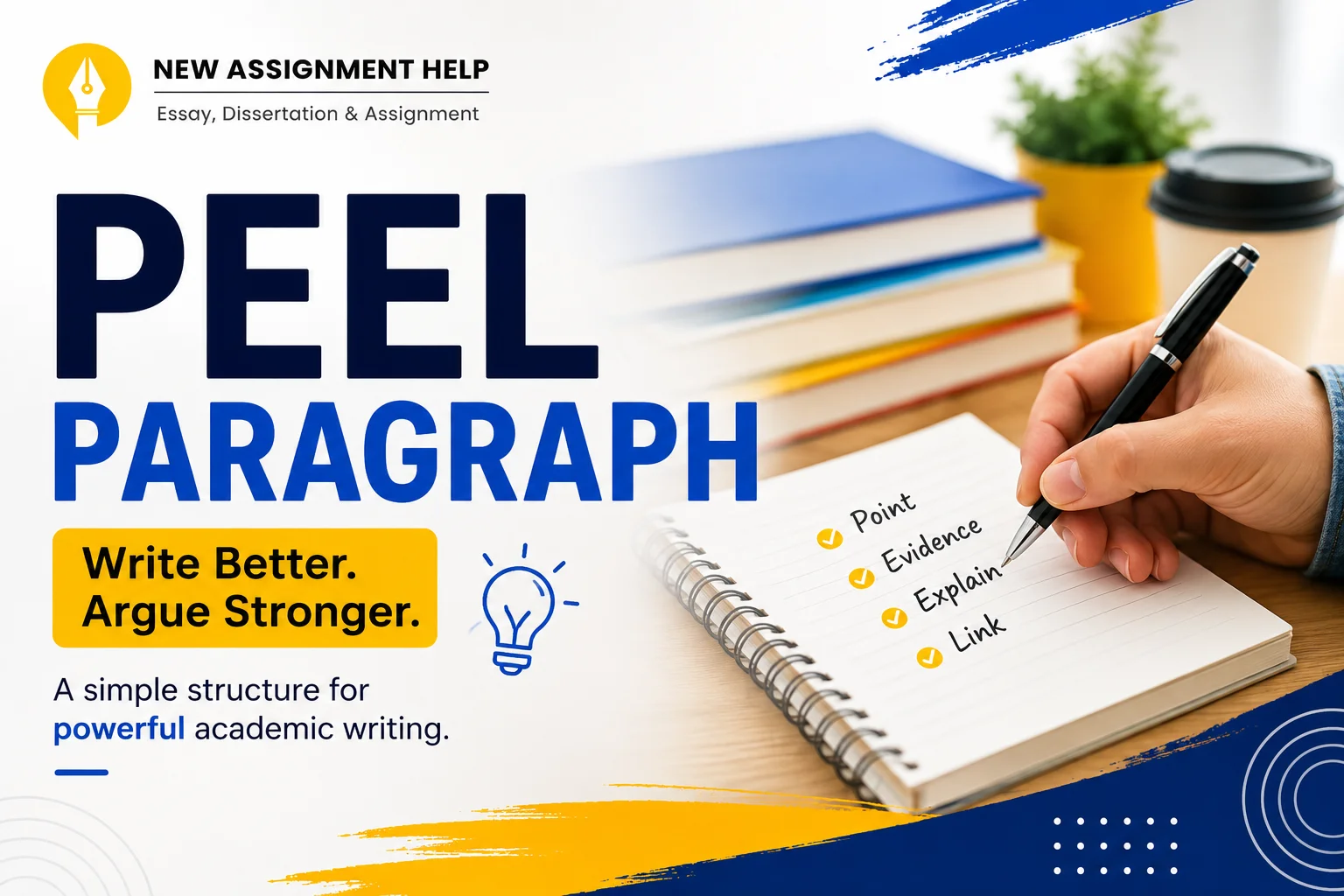
A PEEL paragraph is a body paragraph built around four components: Point, Evidence, Explanation, and Link. It is one of the most widely used paragraph frameworks in Australian secondary and tertiary education because it works across every subject, not just English. Whether you are writing a history essay, a science report, or a persuasive piece, the same four-part structure applies.
This guide covers how PEEL works, how to write each section properly, examples across four subjects, a ready-to-use sentence starters list, a PEEL vs TEEL comparison for Australian students, and a full checklist you can use before you submit anything.
What Does PEEL Stand For?
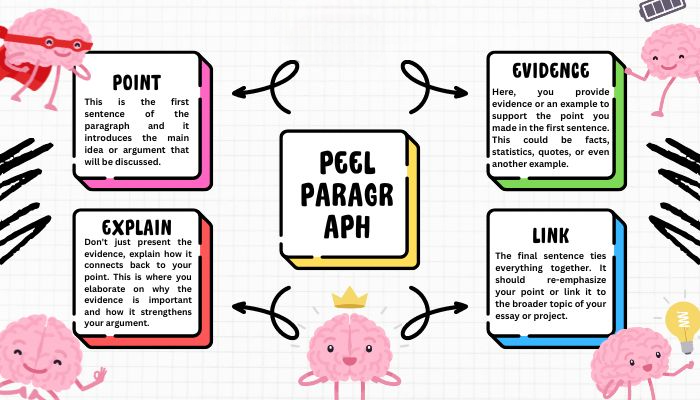
PEEL is an acronym where each letter names one component of a structured body paragraph:
| Letter | Component | What It Does |
|---|---|---|
| P | Point | States the main argument of the paragraph |
| E | Evidence | Provides facts, data, quotes, or examples to back up the point |
| E | Explanation | Analyses the evidence and shows why it proves the point |
| L | Link | Ties the paragraph back to the essay question or thesis |
Every paragraph covers one idea. The PEEL structure ensures that the idea is introduced, proven, explained, and closed in that order, every time.

PEEL Paragraph Structure Step by Step
Here is how each component works, and what you should actually be writing in each section.
P Point (Your Topic Sentence)
The Point is your opening sentence. Its only job is to tell the reader exactly what this paragraph will argue. Think of it as a mini-thesis, one sentence that makes a claim directly connected to your essay question.
What it is not: background information, a general observation, or a repeat of your introduction. If your Point sentence could appear in anyone's essay on a different topic, it is too vague.
- Strong: "Social media algorithms deliberately extend adolescent screen time in ways that disrupt sleep cycles and academic concentration."
- Weak: "Social media has become very popular in recent years."
The strong version makes an argument. The weak version states a fact. Only one of them can be proven in a paragraph.
E Evidence
The Evidence sentence is where you bring in proof. This can be a statistic, a research finding, a direct quote from a text, a historical event, or a case study. The rule: be specific. Name the study, source, author, or date wherever possible.
"Research shows that…" is not evidence; it is a gesture toward evidence. "A 2022 study published in the Journal of Adolescent Health found that…" is evidence.
One well-chosen, specific piece of evidence is worth more than three vague ones.
E Explanation
The Explanation is the most important part of the PEEL structure, and the part where most students lose marks either by skipping it entirely or by restating the evidence instead of analysing it.
Explanation is analysis, not a summary. Your job is to unpack why the evidence proves your Point. Ask: What does this evidence mean? Why does it matter? What does it reveal about the argument?
Write two to three sentences. Do not hedge ("this might suggest," "it could indicate"). Make a direct analytical claim.
L Link
The Link closes the paragraph. It reinforces the argument you have just made and, where relevant, gestures toward your next paragraph or back to the essay question.
The Link is not a repeat of your Point. The Point opens the argument; the Link lands it. A useful technique: re-read your Point sentence before writing your Link. They should feel like a matched pair.
How to Write a PEEL Paragraph
How to Start a PEEL Paragraph
Start with your Point sentence, a direct, specific statement of the argument your paragraph will make. Do not open with a quote, a rhetorical question, or a general contextual sentence. Your first sentence should argue, not introduce.
Before writing, check: Does this sentence respond directly to the essay question? If yes, write it. If it sounds like context-setting, delete it and try again.
How to Write the Evidence Sentence
After your Point, bring in the strongest, most specific evidence you have. If you have multiple options, choose the one that is hardest to dismiss: a peer-reviewed finding, a primary source quote, or a documented statistic. Keep the evidence sentence concise: one or two sentences maximum. You are not explaining it yet.
How to Write the Explanation
This is where you earn your marks. Unpack the evidence: explain what it means, why it is significant, and how it directly proves your Point. The question to ask yourself at this stage is: "So what does this actually show?"
Write two to three sentences of analysis. Do not introduce new evidence here, and do not simply restate what the evidence said in different words. Both are common mistakes that markers pick up immediately.
How to End a PEEL Paragraph (The Link)
Your Link sentence closes the argument. It should refer only to what you have already proven in this paragraph; it should not introduce anything new. Use language that signals a conclusion and connects back to the essay question.
Practical tip: if your Link sentence could work as a Point sentence for a new paragraph, it is doing the wrong job.

PEEL Paragraph Examples
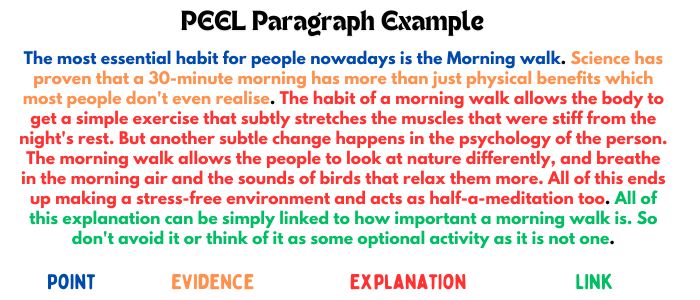
Below are four PEEL paragraph examples across different subjects, with each component labelled. Use these as reference models, not templates to copy the structure is what matters, not the wording.
Example 1: Persuasive Writing
Essay question: Should junk food advertising be banned during children's television programming?
[POINT] Restricting junk food advertising during children's programming is a necessary public health intervention, given the direct and documented link between advertising exposure and poor dietary habits in children under twelve.
[EVIDENCE] A 2019 study published in BMC Public Health found that children who watched more than two hours of commercial television per day were 1.7 times more likely to consume fast food at least three times per week compared to children with limited commercial viewing.
[EXPLANATION] These findings make it clear that advertising is not passively absorbed by children; it actively shapes food preferences before children develop the cognitive tools to recognise persuasive intent. Unlike adults who can critically evaluate a marketing message, children aged five to twelve often cannot distinguish between information and promotion. Limiting this exposure during peak viewing hours would remove a key environmental driver of unhealthy eating before those patterns become habitual.
[LINK] The evidence therefore supports government intervention on junk food advertising during children's programming, not as an overreach, but as a proportionate response to a documented public health risk.
Example 2: English Literature
Essay question: How does George Orwell use language to convey the oppressive nature of the Party in Nineteen Eighty-Four?
[POINT] Orwell's invention of Newspeak demonstrates how the Party uses the deliberate impoverishment of language as a mechanism for eliminating political dissent at its source.
[EVIDENCE] O'Brien explains to Winston that "the whole aim of Newspeak is to narrow the range of thought. In the end, we shall make thoughtcrime literally impossible, because there will be no words in which to express it."
[EXPLANATION] By framing the destruction of vocabulary as the destruction of thought itself, Orwell exposes a regime that understands language not as communication but as the medium through which resistance is formed. To eliminate a word is to eliminate the concept it represents and with it, the capacity to imagine anything outside Party doctrine. The chilling precision of O'Brien's delivery, framed as fact rather than threat, shows how thoroughly the suppression of individual expression has been normalised; the Party no longer needs to enforce conformity because its citizens will no longer have the language to conceive of anything else.
[LINK] Orwell's portrayal of Newspeak reveals that the Party's most effective instrument of control is not physical force but the systematic removal of the vocabulary needed to resist.
Example 3: Science
Essay question: Explain how human activity is accelerating the rate of species extinction.
[POINT] Habitat destruction driven by agricultural expansion is the single leading cause of accelerating species extinction rates, eliminating the ecological conditions specialist species require to survive.
[EVIDENCE] The World Wildlife Fund's 2022 Living Planet Report recorded an average decline of 69% in monitored wild vertebrate populations since 1970, identifying habitat loss from land conversion for agriculture as the primary driver in 45% of cases.
[EXPLANATION] A 69% population reduction across monitored species in just over fifty years represents a rate of loss that far exceeds the natural background extinction rate, which scientists estimate at one to five species per year. When natural habitats are converted to farmland, species lose not just shelter but the specific ecological conditions, food sources, migration corridors, and breeding sites on which their survival depends. Generalist species can sometimes adapt to fragmented environments; ecological specialists cannot, and because specialists often occupy unique positions in food webs, their loss triggers cascading effects on the broader ecosystem.
[LINK] Agricultural land use, therefore, remains the most urgent variable in addressing biodiversity collapse, requiring policy responses that move beyond protected areas to address how productive land is managed globally.
Example 4: History
Essay question: To what extent was propaganda responsible for sustaining public support for World War I?
[POINT] In Britain, government propaganda played a decisive role in maintaining voluntary enlistment and civilian morale during the early years of World War One, before public disillusionment and casualty figures made such campaigns increasingly difficult to sustain.
[EVIDENCE] Between 1914 and 1916, the Parliamentary Recruiting Committee produced over 12.5 million posters that drew on imagery of duty, shame, and patriotic obligation to encourage enlistment ahead of conscription, which was not introduced until January 1916.
[EXPLANATION] The scale and speed of this campaign reflect how quickly the British government recognised that public willingness to support the war could not be assumed and had to be manufactured. By framing military service as a personal and moral obligation rather than a state demand, propaganda pre-empted dissent and created social pressure that made non-participation publicly costly. The fact that voluntary enlistment held until 1916, despite growing awareness of trench conditions and mounting casualties, suggests the campaign was more effective than its critics acknowledged at the time.
[LINK] Propaganda was therefore not merely a support mechanism in the early years of World War One; it was an active instrument in shaping what the public understood the war to be and what they understood their obligation within it to require.
PEEL Paragraph Sentence Starters
Having a set of sentence starters for each component removes one source of blank-page hesitation. Use the table below as a reference and rotate the starters so your writing does not sound repetitive across paragraphs.
| Component | Sentence starters to use |
|---|---|
| Point | One key reason… / A central argument is… / It is evident that… / [Subject] demonstrates that… / A closer examination reveals… / This is most clearly seen in… |
| Evidence | According to… / Research by [source] indicates… / For instance… / This is demonstrated by… / A study conducted in [year] found that… / [Author] argues that… / Statistical data from [source] shows… |
| Explanation | This is significant because… / What this reveals is… / The implication of this evidence is… / This demonstrates that… / This highlights the extent to which… / By [doing X], [subject] shows that… / Consequently… |
| Link | Therefore… / Hence, it is clear that… / This ultimately demonstrates that… / It can be concluded that… / As this evidence shows… / This reinforces the argument that… / In summary, this paragraph has established… |
Avoid starting every Point with "One key reason" and every Link with "Therefore" markers. Noticewhen the structure becomes mechanical. Vary the starters to keep the writing natural.
PEEL vs TEEL: What Is the Difference?
If you are studying in Australia, you have almost certainly encountered both PEEL and TEEL. They are different acronyms for the same paragraph framework, with one letter changed:
| component | PEEL | TEEL |
|---|---|---|
| First component | Point | Topic sentence |
| Second component | Evidence | Evidence |
| Third component | Explanation | Explanation |
| Fourth component | Link | Link |
There is no structural difference between a PEEL paragraph and a TEEL paragraph. "Point" and "Topic sentence" are the same thing, the opening sentence that states the paragraph's argument. TEEL is more commonly used in NSW curriculum documents and some VCE English subjects. PEEL is widely used in Queensland and across many primary and secondary schools nationally.
Use whichever your teacher or subject guide specifies. The writing technique and the marking criteria are identical.
How to Write an Extended PEEL Paragraph
An extended PEEL paragraph uses the same structure but includes two pieces of evidence, each followed by its own explanation. It is appropriate when:
- You have two strong, distinct pieces of evidence that both support the same Point
- Your analysis requires more than one layer to be complete
- You are writing at HSC, VCE, or university level, where single-evidence paragraphs can appear underdeveloped
The structure looks like this:
Point → Evidence 1 → Explanation 1 → Evidence 2 → Explanation 2 → Link
The non-negotiable rule: both pieces of evidence must support the same Point. If the second piece of evidence leads you toward a different argument, it belongs in a new paragraph,h not an extended one.
Extended PEEL paragraphs typically run 150–200 words. Use them selectively. Not every paragraph needs to be extended, and forcing the structure where the argument does not require it produces padding, not depth.
PEEL Paragraph Checklist
Run through this before submitting any piece of writing that uses PEEL structure.
Point
- Does the topic sentence make a clear argument (not just state a topic)?
- Is it directly connected to the essay question?
- Could it stand alone as a one-sentence summary of the paragraph's argument?
Evidence
- Is the evidence a specific named source, statistic, quote, or event?
- Is it the strongest evidence available, not just the easiest to find?
- Is it introduced in one or two sentences without explanation bleeding in?
Explanation
- Does the explanation analyse the evidence rather than summarise or restate it?
- Have you answered, "So what does this show?"
- Is it written entirely in your own words (no quoting again here)?
- Does it connect explicitly back to your Point?
Link
- Does the Link close the argument rather than repeat the Point verbatim?
- Does it connect back to the essay question, thesis, or the next paragraph?
- Does it avoid introducing any new ideas or new evidence?
Common PEEL Paragraph Mistakes and How to Fix Them
Skipping the Explanation entirely. This is the most common mistake in student writing at every year level. The pattern looks like this: Point → Evidence → "Therefore…" → Link. The Explanation is simply absent. Without it, the evidence floats without context, and the marker is left to do the analytical work you were supposed to do. Fix: After every piece of evidence, write the sentence "This shows that…" and complete it. That is the beginning of your Explanation. Then add one or two more sentences of analysis.
Making the Point sentence too broad,d "Technology affects students" is a topic. "Constant smartphone notifications fragment the sustained attention secondary students need for deep learning tasks" is a Point. The difference is specificity and arguability. Fix: Every Point sentence should include a "because" or an implied causal claim. If your Point is a fact that requires no proof, it is not yet an argument.
Confusing Evidence with Explanati: on Students who explain in the Evidence section, or introduce new evidence in the Explanation section, have blurred the two components. The marker can see this clearly because the paragraph loses its logical order. Fix: Keep them physically separate. Evidence: one or two sentences, source-cited. Explanation: your analysis only, no new sources.
Writing the Link as a new Point. If your Link sentence introduces a new idea or makes a new argument, it is functioning as a Point. A Link should only refer to what the paragraph has already proven. Fix: Read your Link sentence and ask: "Does this introduce anything I have not already argued?" If yes, cut it.