What Is a PETAL Paragraph?
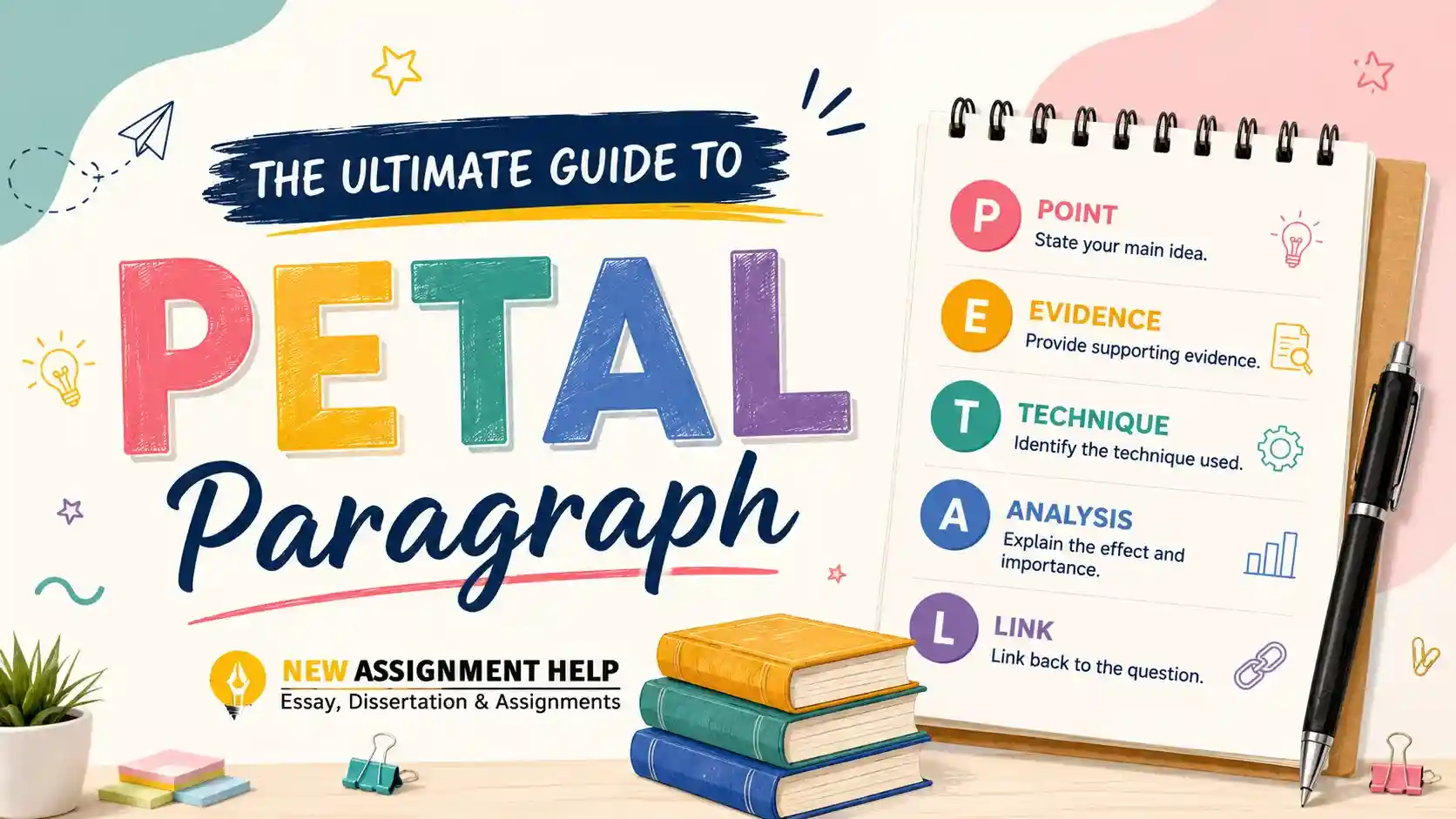
PETAL is a paragraph writing framework used in Australian English classrooms from Year 7 to HSC. It stands for Point, Evidence, Technique, Analysis, and Link. Those five steps guide you from a claim to proof to what that proof actually means. Teachers use PETAL paragraph because it helps name the technique an author used before you explain its effect. That single step separates PETAL from other frameworks like PEEL paragraph, which skips straight from evidence to explanation.
This guide walks you through the full PETAL structure with two complete worked examples using Macbeth and The Crucible. You’ll also get ready-to-use sentence starters for each step and will learn how the framework shifts as you move forward. By the end, you will know exactly what each letter is asking you to do and how to write the best PETAL paragraph on your own. So, let’s start with understanding how much space each element should take up.
PETAL Paragraph Structure
A PETAL paragraph follows five steps in a fixed order: Point, Evidence, Technique, Analysis, and Link. Each step builds on the one before it, so skipping or reordering them weakens the whole paragraph. Here is what each step does and roughly how much space it should take up in a 150-250 words HSC paragraph.
| Step | Purpose | Typical Length |
|---|---|---|
| Point | States the specific, arguable claim this paragraph will prove | 1 sentence |
| Evidence | Gives one well-chosen, embedded quote or textual reference | 1 sentence |
| Technique | Names the exact literary device used in that evidence | 1 sentence |
| Analysis | Explains the effect of the technique and what it reveals about character, theme, or purpose | 2–4 sentences |
| Link | Connects the analysis back to the Point and the wider argument | 1 sentence |
Basically, each one depends on the one before it. A vague Point gives your Analysis nothing to prove, and a Link that does not return to the Point leaves the paragraph unresolved. We know that reading about the structure is just one thing. So, let’s look at a finished paragraph built from it to see what actually makes the pattern click.
PETAL Paragraph Example
A complete PETAL paragraph puts all five steps together into one short, connected piece of writing. Here is a full example built from Macbeth, one of the most studied texts in HSC English.
How to Write a PETAL Paragraph on Macbeth
Shakespeare presents Macbeth not merely as a man driven by ambition, but as one destroyed by it, fully aware of that destruction before it happens. As Macbeth states in his Act 1, Scene 7 soliloquy: "No spur / To prick the sides of my intent, but only / Vaulting ambition, which o'erleaps itself / And falls on the other." The playwright uses an extended metaphor of riding here, where the act of jumping over too much results in falling off the horse. It becomes clear from the word choice: ambition doesn't stumble or lose momentum, it overreaches and, therefore, fails. The soliloquy serves as a way to emphasise that Macbeth, being aware of the trap ahead of him, chooses to jump into it, not out of lack of information but rather of something else, such as compulsion. By doing this, Shakespeare sets the foundation for the ambition to become the main driving and fatal force of the play.
Here is where each PETAL step sits inside that paragraph:
- Point (sentence 1): States the claim that Macbeth is destroyed by the ambition he already saw coming
- Evidence (sentence 2): The embedded quote from Act 1, Scene 7
- Technique (sentence 3): Names the equestrian metaphor
- Analysis (sentences 4–5): Unpacks the effect. Ambition works against itself by design
- Link (final sentence): Returns to the Point and connects it to the tragedy as a whole
If this isn't enough, we have another example for you.
PETAL Paragraph on The Crucible
Here is the five-step method used on Arthur Miller's play The Crucible, which applies to many modules in HSC English.
Miller presents John Proctor's final refusal to falsely confess not as an act of stubborn pride, but as the one form of integrity still available to a man who has already compromised almost everything else. In Act Four, when pressured to sign a false confession, Proctor tears the document and cries, "Because it is my name!" Miller uses an exclamatory short sentence, a sharp contrast to the long, legalistic speech surrounding it, to isolate "name" as the play's central symbol, turning a single word into the moral climax of the entire drama. The brevity of the line is the point: after four acts of testimony, accusation, and confession, Proctor's defence of himself collapses into four words. "Name" carries the weight of his identity, his children's future, and the one thing the court cannot force him to falsify. There's a bitter irony here too: the same Puritan society that condemned others on the strength of rumour and reputation is now the one demanding Proctor sacrifice his own. Miller uses this moment to suggest that integrity, once everything else has been stripped away, is the last thing a person actually owns. Proctor's death reframes his earlier failures (his affair, his silence, his hesitation) not as the defining measure of his character, but as the price he pays to arrive at this final, costly act of honesty, which Miller positions as the play's true moral resolution.
Here is where each PETAL step sits inside that paragraph:
- Point (sentence 1): States the claim — Proctor's refusal is the only authentic act left to him.
- Evidence (sentence 2): The embedded quote from Act Four — "Because it is my name!"
- Technique (sentence 3): Names the exclamatory short sentence and its contrast with the surrounding legalistic speech.
- Analysis (sentences 4–6): Unpacks how brevity carries moral weight — "name" represents identity, legacy, and integrity. Brings in the irony of the society demanding the very thing it exploited in others.
- Link (final sentence): Returns to the Point — Proctor's earlier failures become the cost of arriving at this act, which Miller frames as the play's true moral resolution.
Hopefully, this has now given you the full picture of how to write a PETAL paragraph. With this, we’ll learn some sentence starters that will help you write your next PETAL paragraph.
PETAL Paragraph Sentence Starters
Good PETAL paragraph sentence starters are the opening lines for each step used as scaffolding first. Later, you may adjust the wording to fit your own argument and text.
| PETAL Step | Sentence Starters |
|---|---|
| Point | "Shakespeare presents [character] as..." / "[Author] constructs [character/theme] as..." / "In [text], [author] argues that..." |
| Evidence | "This is evident in [scene/chapter/stanza] when [author] writes..." / "In [text], [author] states..." / "[Character]'s [action/speech] in [scene] demonstrates this when..." |
| Technique | "[Author] employs [technique] to..." / "Through the use of [technique]..." / "The [technique] in '[quote]' suggests..." |
| Analysis | "This [technique] creates the impression that..." / "The effect of this [technique] is to position the reader to..." / "By choosing this [technique], [author] reinforces the idea that..." |
| Link | "Ultimately, this paragraph demonstrates that..." / "This reveals [author]'s broader concern with..." / "This connects to [essay thesis] by showing that... |
Don't copy these word-for-word into your final essay. Use them to get started, then rewrite the phrasing so it sounds like you and fits your argument. Sentence starters work the same way at every year level, but what markers expect from the finished paragraph changes a lot between Year 7 and HSC.
How Does PETAL Change Across Year Levels?
PETAL is taught from Year 7 onwards, but what changes is how precise and independent your thinking needs to be for each PETAL paragraph.
What Does PETAL Look Like in Year 7 and Year 8?
At this stage, the goal is simply learning the five steps in the right order. The Point can be a bit more general. For Evidence, even a clearly introduced quote is fine. The main focus is Technique where you can correctly name a simile, a metaphor, or an example of imagery. Analysis just needs one clear sentence that explains the effect. The Link can restate the Point in slightly different words.
What Does PETAL Look Like in Year 9 and Year 10?
By Year 9 and Year 10, the Point should start making an argument. Evidence should be woven into your own sentence. Naming the Technique should get more specific too. Analysis should cover how the technique affects the reader and how it connects to a theme. Lastly, the Link must point toward the bigger meaning of the text and your perfect PETAL paragraph is ready to submit.
What Does HSC (Year 11 and Year 12) Expect From a PETAL Paragraph?
HSC markers want independent thinking, so the Point must respond directly to the essay question or module focus. Evidence needs to sit inside your sentence smoothly. Analysis should link the language choice to the author's purpose, the context of the text or its central themes. At last, the Link should tie back to your whole essay thesis. If this deeper level of structuring is giving you trouble, our English assignment help team is here to review your paragraphs and guide you the right way.
Does PETAL Work the Same Way for Every Text Type?
Actually no, PETAL techniques look different depending on the form. For film, look at cinematography, mise-en-scène, or sound design. For poetry, look at enjambment, caesura, volta, or sound devices. Whatever the text type, name the specific technique for that form rather than saying something vague like "the director uses techniques".
Once you know how PETAL paragraphs shifts by year level, it helps to see how it compares to the two frameworks you'll most likely meet alongside it.
PETAL vs PEEL vs TEEL: Which Should You Use?
You'll likely encounter all three of these frameworks during school. They're more similar than different, but the distinction matters depending on what type of paragraph you're writing.
| Technique | Best Used For | Components |
|---|---|---|
| PETAL | Literary and text analysis (novels, poems, films, speeches) | Point, Evidence, Technique, Analysis, Link |
| PEEL | General academic arguments and persuasive writing | Point, Evidence, Explanation, Link |
| TEEL | General academic arguments | Topic sentence, Evidence, Explanation, Link |
If you're analysing a text and identifying how an author uses language, use PETAL. The Technique step forces you to engage with the writing itself, which is exactly what English markers expect. If you're writing a paragraph that doesn't involve a specific literary text, PEEL or TEEL will do the job. However, for HSC English, PETAL is almost always the right choice.
Last but not least, knowing the mistakes and how to avoid them will be a game-changer while writing a PETAL paragraph.
Common Mistakes To Avoid When Writing PETAL Paragraphs
When you learn where the pitfalls are, you are conscious enough to avoid them. Here's what to watch for.
- Listing techniques without analysing them. Naming a metaphor is not enough. You need to explain what that metaphor does: what it makes the reader feel, think, or understand. If you can't explain the effect, you haven't finished the Analysis.
- Dropping evidence as a standalone quote. A quote sitting in its own sentence, surrounded by white space, signals that you're unsure how to integrate it. Embed quotes into your own sentence structure wherever possible.
- Writing a Point that's too broad. Do not write something like "The author explores the theme of power" because that sounds more like a topic. A Point must make a specific, arguable claim that the rest of the paragraph will prove.
- Repeating the Point word-for-word in the Link. The Link is a conclusion, not a copy-paste. Therefore, it should show how your analysis has actually proved the Point.
- Skipping the Technique step entirely. Some students jump straight from Evidence to Analysis. Without naming the technique, the analysis has no anchor, and in any text-response context, it's also incomplete.
- Writing Analysis that summarises the plot. "This shows that Macbeth is going to kill the king" is a summary. Analysis explains how the language constructs that meaning, and why the author chose it.
Even students who understand the structure fall into the same traps while writing a PETAL paragraph. Hopefully, after reading this guide, you won't fall for them. If you need expert feedback before submission, our professionals at New Assignment Help Australia are here to review your draft and return it with annotated corrections.

 6 Years | Master of Teaching (Secondary English), Macquarie University